Axios Vitals

November 26, 2025

🦃 Happy Thanksgiving Eve! We're thankful for all of you. Have a great holiday weekend, and we'll see you again Monday.
Today's newsletter is 1,275 words or a 5-minute read.
1 big thing: How the ACA subsidy drama could end

President Trump's trial balloon for extending the Affordable Care Act's enhanced subsidies has been shot down, but the real moment of truth for him and Congress may come in the run-up to the next government funding cliff, in late January.
Why it matters: There still are multiple scenarios for preventing steep increases in premium costs for millions of Americans heading into an election year dominated by affordability issues.
- Before Republicans pushed back against this week's effort, Trump had broached the prospect of a health care deal that would coincide with the Jan. 30 deadline for funding the government.
Two of the most likely scenarios:
Dueling health care votes fail, subsidies expire
It's usually not a bad bet to assume gridlock will win out in Congress. And that appears to be in the cards as Democrats await the subsidy vote they were promised by Dec. 12 as part of the deal to end the government shutdown.
- The most likely scenario is that Democrats propose a clean subsidy extension that fails to get the 13 Senate GOP votes needed to extend the tax credits.
- Republicans could offer an alternative, although it's not yet clear what that would look like since the Trump plan is on hold. Any GOP-only plan would also fail to get the required 60 votes.
- With the parties canceling each other out, the subsidies would expire on Dec. 31.
Plot twist: Revival in January
It's possible that after that, the parties find it in their mutual interest to hash out a deal — perhaps with more health policy add-ons.
- Sources say there is some chance of assembling a package ahead of the next government funding deadline that could include other health priorities like an overhaul of pharmacy benefit managers' business practices.
Between the lines: The timing of a January deal would be awkward, after the subsidies have already expired. But the thinking is the out-of-pocket costs hitting home for consumers could light a fire under Republicans.
- Still, there are significant hurdles, including the GOP's insistence on more restrictions on subsidy money being used on health plans that cover abortions.
2. Latest Medicare drug price talks to save $12B
Medicare administrators yesterday said they negotiated list price reductions of up to 85% for 15 widely used drugs in the program, including Novo Nordisk's blockbuster GLP-1 drug Ozempic.
Why it matters: The price cuts are expected to save $12 billion over a year. Seniors are expected to see a $685 million reduction in out-of-pocket costs when they take effect in 2027.
State of play: While President Trump has struck deals with individual drug companies to lower the prices of a broad range of medicines, his administration has has concurrent talks with manufacturers of popular but expensive Medicare drugs.
- The Medicare drug price negotiations stemmed from the Inflation Reduction Act. The first set of negotiated prices for 10 drugs, including blood thinner Eliquis and diabetes drug Jardiance, will take effect on Jan. 1.
- In the latest round, Medicare negotiated a list price of $274 for a month's supply of Ozempic and its related medications, Wegovy and Rybelsus — a 71% discount from the 2024 list price of $959, per CMS.
However, Trump announced earlier this month that Novo Nordisk and its rival Eli Lilly will decrease the price Medicare pays for a month's supply of GLP-1 drugs to $245.
- CMS, HHS and the White House didn't respond to questions about the discrepancy.
3. Louisiana vaccine skeptic gets No. 2 CDC job

The Trump administration tapped a former Louisiana health official who ordered a stop to promotions of mass vaccination events last winter to be the CDC's new principal deputy director.
Why it matters: The move begins to fill out the top ranks of the CDC, whose leadership was left in limbo after a wave of high-level departures this summer, including the August firing of former director Susan Monarez.
Driving the news: Former Louisiana Surgeon General Ralph Abraham was listed as CDC's principal deputy director on an internal email server, Inside Medicine first reported yesterday.
- HHS later confirmed his appointment, which is not subject to Senate confirmation.
- He would be the most senior medical professional at the public health agency, serving under acting director Jim O'Neill, a former Silicon Valley investor and entrepreneur.
Abraham was a three-term congressman from 2015 to 2021 who spent 10 years as a veterinarian before going to medical school and then practicing family medicine, according to his official biography.
- He has publicly sparred with Senate health committee Chair Bill Cassidy (R-La.) over vaccines, saying he doesn't believe COVID-19 shots are safe and admonishing Cassidy, also a physician, to "stay in his lane."
4. Trump admin floats Medicare ratings overhaul
CMS yesterday proposed scrapping a dozen quality measures for Medicare Advantage plans and derailing a Biden administration plan to reward insurers that improve the health of low-income and disabled enrollees.
Why it matters: The plan marked the Trump administration's first shot at putting its mark on the privatized Medicare program and delivered a mixed bag for top plans like UnitedHealth Group and CVS Health's Aetna.
Driving the news: The administration is taking aim at the star ratings that plans get based on performance metrics and determine whether they get bonus payments.
- Medicare is proposing to not implement a Biden-era change that was due to take effect in 2027 and would give plans extra incentives for improving health outcomes for low-income and disabled seniors.
- The administration would instead continue the current system, which rewards plans that achieve high and stable performance across measures.
- Medicare administrators estimate the star ratings changes would cost taxpayers about $13 billion over a decade.
CMS also wants to remove 12 quality measures, including two measures of how plans respond to appeals of claim denials. Measures of how many enrollees leave plans, customer service and a rating of health care quality would also be eliminated.
5. Formula: FDA doesn't require botulism test

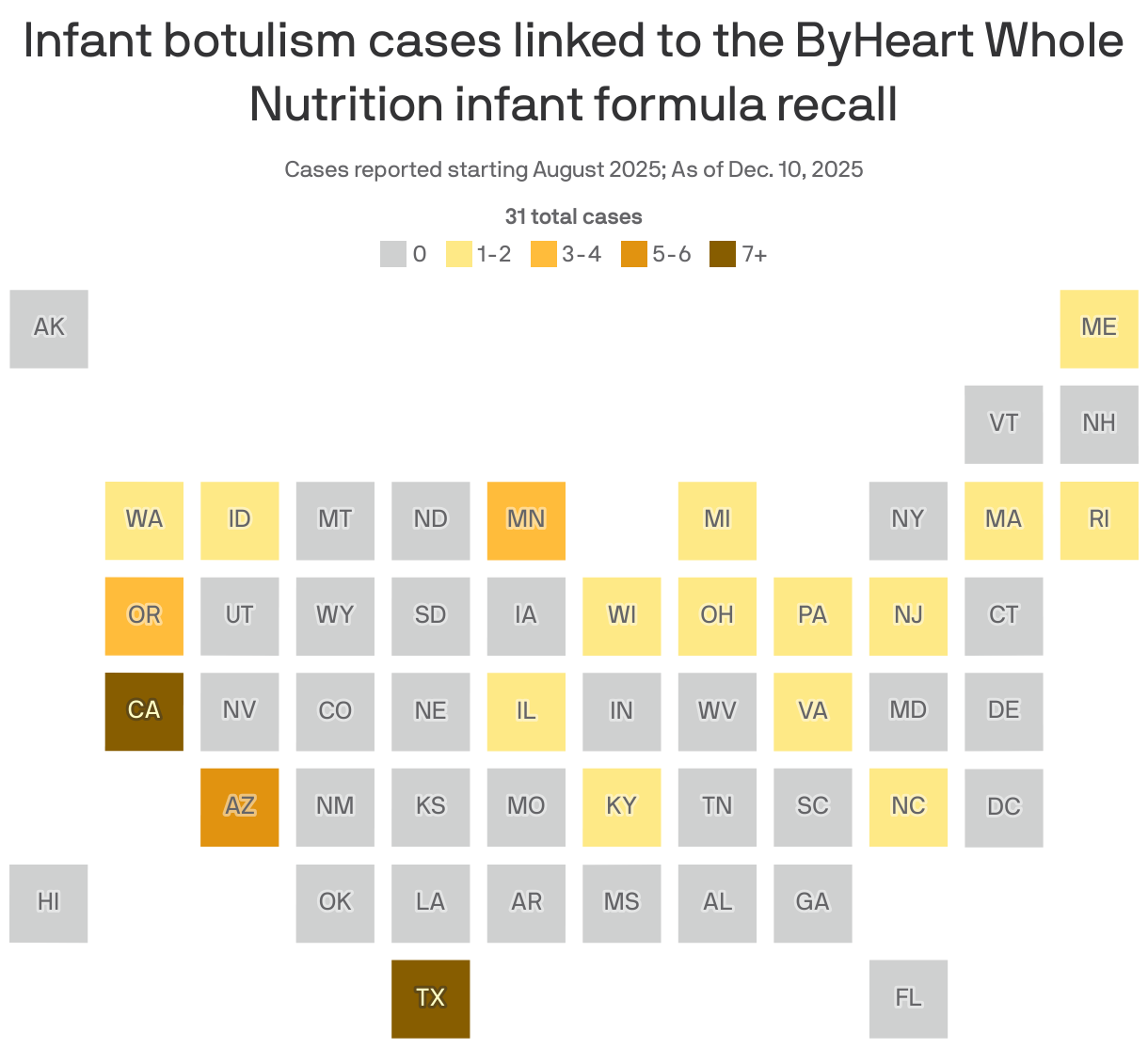
More than 30 infants have been hospitalized for suspected or confirmed botulism in an outbreak linked to ByHeart baby formula — a product made with whole milk and prebiotics, and marketed as closely mimicking breast milk, the FDA says.
Why it matters: Though botulism in infants is rare, it's become a new concern for parents of formula-fed babies.
- The FDA doesn't require formula companies to screen products for the bacteria that causes botulism.
State of play: Screening tests can flag the presence of Clostridium botulinum (C-bot) spores that cause infant botulism and are found in honey.
- HHS Secretary Robert F. Kennedy Jr.'s Operation Stork Speed review of the infant formula food supply has promised to screen for more contaminants in infant formula, but it hasn't said how or whether screenings for the spores will be part of the effort.
What we're watching: An investigation by federal and state health officials is seeking to pinpoint the cause of the outbreak, and whether it was tied to a specific ingredient or another part of the ByHeart supply chain.
6. Catch up quick
🪃 HHS has brought back all 954 employees it laid off during the government shutdown, a top official told a California federal court. (The Hill)
🤖 Medicare claims tied to AI have increased dramatically in the past seven years and the health industry needs to plan for the continued growth of AI-associated care, consulting firm Manatt Health said. (Modern Healthcare)
🔬 A federal commission is calling for changes to how the government funds and assesses scientific research, including better integrating data and AI tools. (Stat)
Thanks for reading Axios Vitals, and to editors Adriel Bettelheim and David Nather and copy editor Matt Piper. Please ask your friends and colleagues to sign up.
Sign up for Axios Vitals