Axios Vitals

July 07, 2026

Welcome to Tuesday! Today's newsletter is 861 words, a 3-minute read.
1 big thing: Fentanyl makers pivot to peptides
The influencer-driven craze for peptides — the heavily hyped but loosely regulated proteins — may be turning into an unexpected bonanza for Chinese manufacturers of fentanyl precursors.
Why it matters: The biohackers, fitness enthusiasts and others chasing promises of anti-aging and other health benefits often have no idea who they're buying from.
- They're increasingly using cryptocurrency, because traditional banks and credit card processors won't allow the sale of unregulated substances.
The latest: The blockchain analysis firm Chainalysis recently found proceeds from online peptide sales in the U.S. were flowing to to China-based manufacturers of chemicals used to produce synthetic opioids like fentanyl.
- It's a fast-growing source of business. Crypto payments to gray-market peptide vendors, many of which are part of the fentanyl business, totaled $27 million in the first quarter of this year, up nearly 150% from Q4 2025, per Chainalysis.
- TRM Labs, another blockchain analytics company, has observed a similar pattern of China-based chemical companies that produce fentanyl precursors turning to the peptide business.
Between the lines: The findings may fuel arguments to ease FDA regulations that now restrict U.S. compounding pharmacies from making peptides because of a lack of studies on their health effects.
- An FDA advisory committee is due to meet this month to consider including several peptides on a list of substances that can be used in compounding.
- FDA scientists found that there wasn't enough evidence to evaluate the effectiveness of peptides for the stated use of wound healing, which could clash with Health Secretary Robert F. Kennedy Jr.'s push to promote the proteins.
Zoom in: Chainalysis found one China-based company — which had been previously identified through its digital crypto wallet as selling fentanyl precursors — posted on message boards selling cosmetic and weight loss peptides.
- "For these manufacturers that decided to pivot, it was really a business decision," Chainalysis senior intelligence analyst Sara Graham.
2. Where Obamacare enrollment is plummeting

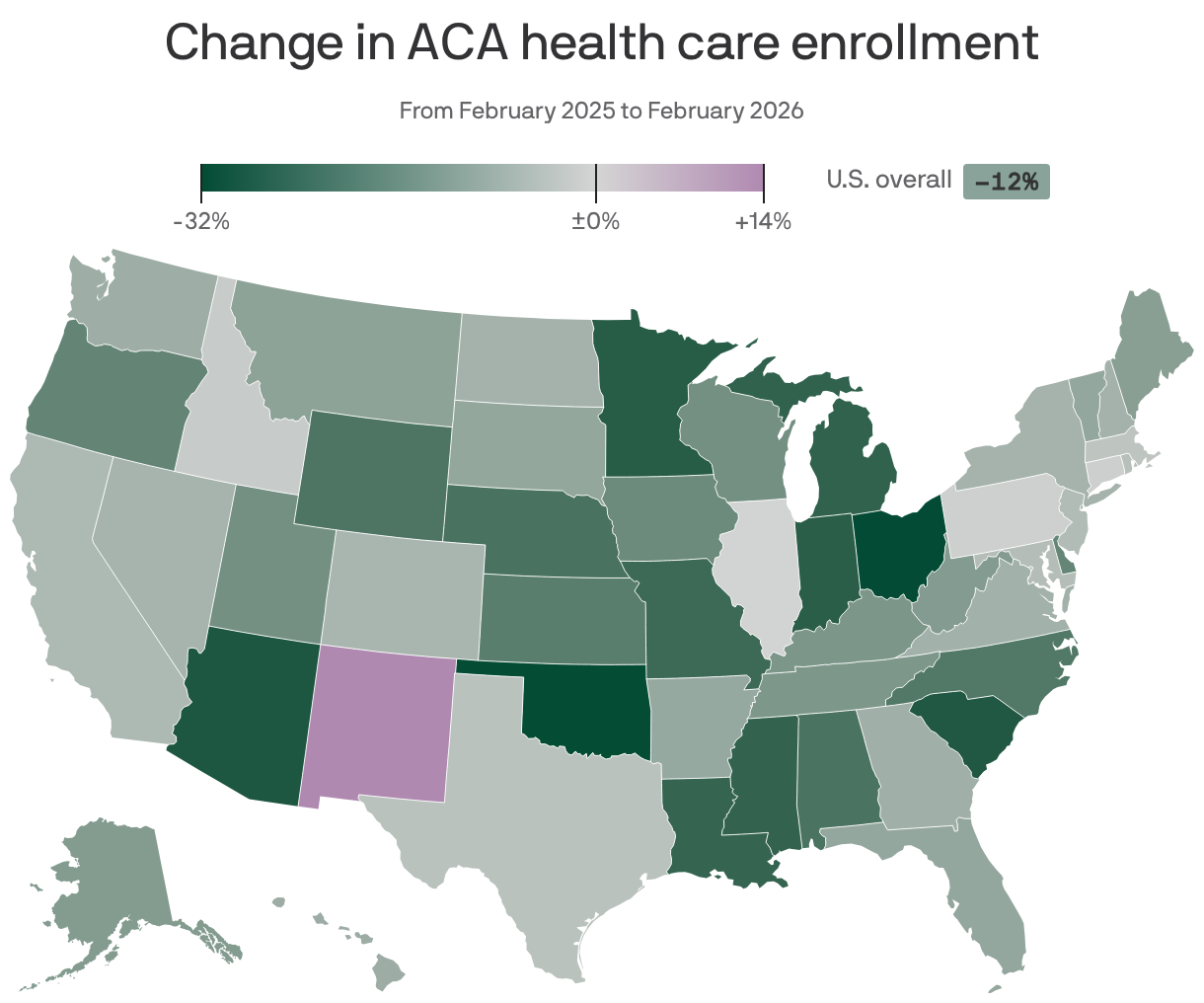
Ohio, Oklahoma, Arizona, South Carolina and Minnesota have sustained some of the deepest losses in Affordable Care Act coverage since beefed-up federal subsidies expired this year, according to state-by-state federal data.
Why it matters: The coverage losses are hitting deep-red states as well as blue ones after Congress let the subsidies expire.
By the numbers: Ohio and Oklahoma each lost nearly a third of their Obamacare enrollment since last year, with other states' coverage dropping more than a quarter, according to the state breakdown, first reported by the Associated Press.
- Indiana, Michigan, Mississippi and Louisiana also had deep coverage losses.
- Nationally, Obamacare enrollment fell by about 3 million since last year, or about 13%, according to a separate federal report from the Department of Health and Human Services last month.
- That report attributed the drop-off to improper or fraudulent sign-ups by "phantom enrollees." But health policy experts have pointed to large numbers of people not paying their first ACA premium following the expiration of subsidies.
What we're watching: How Republican candidates in the midterms talk about Obamacare subsidies and the coverage losses — if they talk about them at all. (We know what Democrats are going to say.)
3. Private equity finds growth via health nonprofits

Private equity firms are expanding their health care footprint through more joint ventures with nonprofit health systems, according to a new report that documents arrangements spanning hospitals, inpatient rehabilitation, hospice and more.
Why it matters: States and federal regulators are putting more checks on private equity–fueled mergers in response to concern about the influence of corporate medicine.
- But the report from the Private Equity Stakeholder Project said less-publicized joint ventures can make tax-exempt businesses generate profits for their owners instead of giving back to the community.
What they found: More than one-fifth (21.4%) of private equity–owned hospitals are owned through joint venture arrangements with nonprofit health systems.
- Apollo Global Management–owned Lifepoint Health operates 61% of its hospitals through joint ventures with nonprofit and other providers.
- One common business arrangement is a sale-leaseback, in which a hospital sells its real estate to a third party and leases it back. The payments can be used to pay a cash dividend to the private equity owner.
The report recommends strengthening oversight of nonprofits to keep up with increasingly complex ownership arrangements. It notes that most IRS guidance governing joint ventures between nonprofits and for-profits dates from 1998 and 2004.
The other side: Private equity interests like the American Investment Council have argued that their investments have strengthened access to telehealth, urgent care and other services and have also helped drive medical innovation.
4. Catch up quick
⚕️California's next governor will face tough decisions on health coverage for the more than 1.4 million low-income residents without legal status. (KFF Health News)
🔬 Republican lawmakers are pushing Trump's FDA to ensure clinical trials enroll diverse populations. (Stat)
🧠 A vaccine commonly used against tuberculosis could change the brain's immune responses and potentially reduce the risk of Alzheimer's. (MedPage Today)
🧒🏼 Kids and teens who received flu shots had an 80% lower risk of death from influenza-related illness, according to a new study spanning eight seasons. (MedPage Today)
Thanks for reading Axios Vitals, and to editors Adriel Bettelheim and David Nather and copy editor Brad Bonhall. Please ask your friends and colleagues to sign up.
Sign up for Axios Vitals