Axios Vitals

August 05, 2026


🐪 Halfway there, gang. Today's newsletter is 850 words, a 3-minute read.
1 big thing: Fauci's woes could have a ripple effect

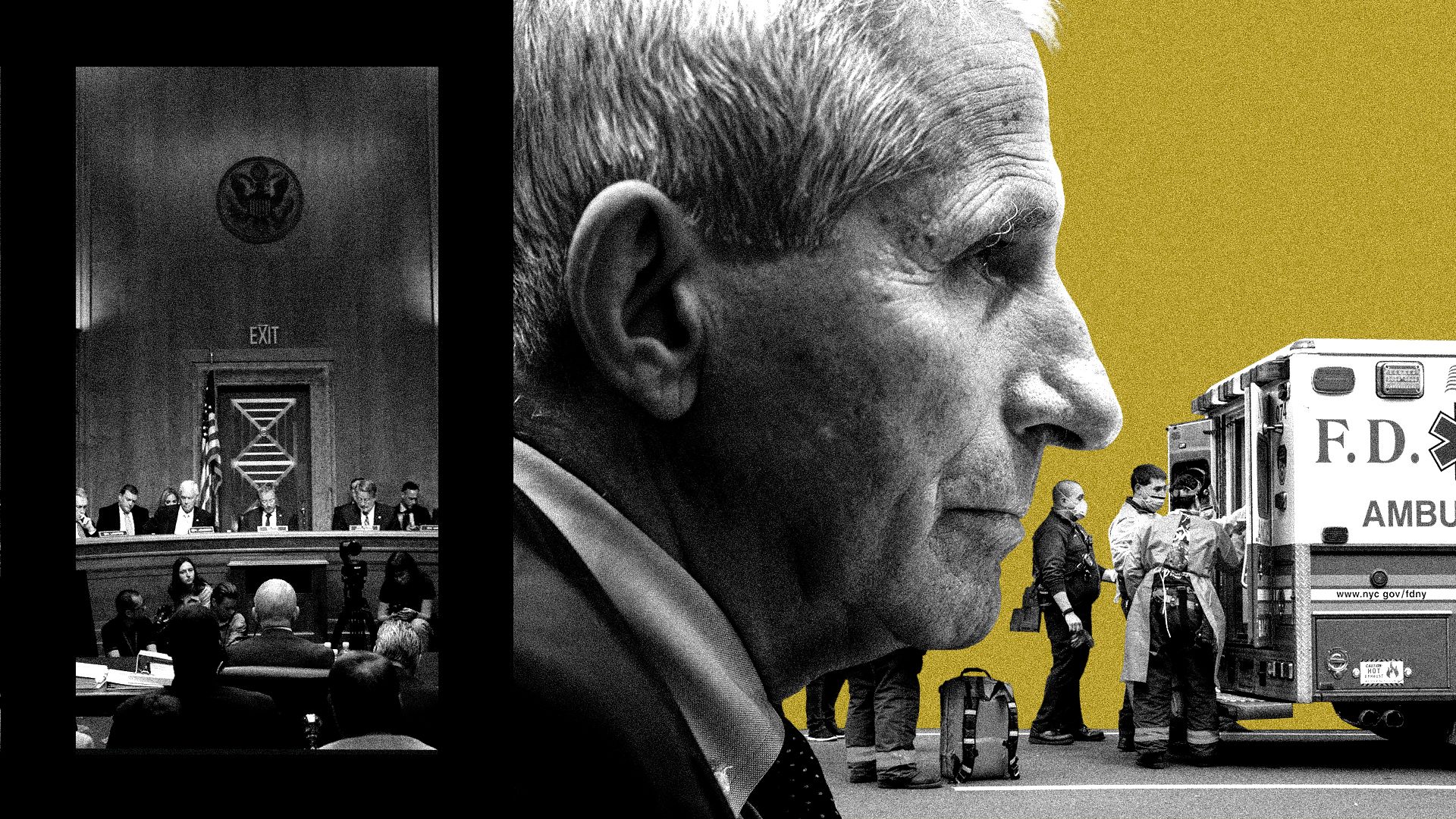
Senate Republicans' planned vote this week on whether to hold Anthony Fauci in contempt of Congress is the latest escalation in their attempt to right perceived COVID-era wrongs and further disempower the federal health care bureaucracy.
Why it matters: Critics fear the Senate Homeland Security Committee's efforts will deter scientific talent from taking government jobs, weakening America's public health infrastructure and ceding its dominance in biomedical innovation.
Driving the news: The panel is expected to vote tomorrow to hold the nation's former top infectious disease official in contempt for refusing to answer the committee's questions on the coronavirus during a hearing last week.
- Fauci repeatedly invoked the Fifth Amendment in response to senators' questions and accused Chairman Rand Paul (R-Ky.) of having an "unhinged obsession with calling for my prosecution."
- Paul has argued that the Fifth Amendment didn't apply to Fauci because he's already received a preemptive pardon from former President Biden covering all of his pandemic-era work.
- All of this "has a chilling effect" on scientists considering future government work, top committee Democrat Gary Peters of Michigan told Axios. "You could be pulled before a committee and have every decision you make questioned in a hostile way."
The big picture: The panel's actions follow a broad hollowing out of the federal health workforce and efforts to assert more political control over career scientists.
- HHS reduced its workforce from 82,000 full-time employees to 62,000 at the beginning of President Trump's second term.
- Senior career health officials have also departed HHS and its subagencies on their own, with several publicly citing disagreement with leadership or a chaotic work environment.
- Senate Republicans have signaled they may subpoena more government officials over their pandemic-era work, including FDA officials involved in COVID vaccine regulation.
What they're saying: "The government is becoming a less and less attractive place" to work, Ashish Jha, Biden's COVID response coordinator and former dean of the Brown University School of Public Health, told Axios.
2. CMS urges tighter control of autism services

The Trump administration yesterday urged states to increase oversight of Medicaid autism services, questioning whether a surge of spending on a type of therapy called applied behavior analysis is supporting medically appropriate care.
The big picture: Autism therapy is one of the fastest-growing segments of Medicaid, and media reports have chronicled how there hasn't been an accompanying increase in regulatory oversight.
- CMS found Medicaid and CHIP spending on the therapy increased 421% between 2021 and 2025, far outpacing the growth in the number of children with an autism spectrum disorder diagnosis receiving services.
Driving the news: A 152-page guidance document recommends states consider limiting the number of hours for direct ABA services, use prior authorization reviews for more intensive services and restrict what services can be delivered by telehealth.
- It also encourages them to monitor ownership changes to providers of ABA services.
- "We are helping states shut down fraud schemes that exploit children with autism and misuse funds from American taxpayers," Health Secretary Robert F. Kennedy Jr. said.
The Council of Autism Service Providers said applied behavior analysis is a proven therapy and that recent increases in Medicaid spending were due to more autism diagnoses and people seeking treatment, not just the growth in clinics.
3. Burnout and depression still plague docs

Just under half of full-time U.S. doctors feel burned out at some point and nearly a quarter experience depression. But most of those struggling try to go it alone, according to Medscape's latest physician burnout report.
Why it matters: Fallout from the pandemic, cost-cutting and administrative hassles continue to weigh on doctors across multiple specialties.
- Many worry that disclosing depression or burnout will follow them through licensing questions or credentialing, or just make them be seen as unreliable by colleagues.
What they found: The survey of more than 5,100 physicians found 47% reported experiencing burnout but didn't seek professional care and wouldn't consider it.
- That's down from 53% three years ago.
- While younger doctors were likelier to report moderate or mid-level burnout, physicians from earlier generations tended to say the situation was so bad that they're considering leaving medicine altogether.
- Bureaucratic burdens were by far the biggest drivers cited, with long hours, lack of respect and insufficient pay following, in order.
Roughly a quarter of those physicians with depression said theirs was clinical depression, while nearly two-thirds described a lower-grade form of feeling down or blue.
- While almost half said their depression doesn't affect how they interact with patients, indicators like exasperation with patients, carelessness with notes and visible frustration all ticked upward.
4. Catch up quick
💉 Moderna began a clinical trial of a vaccine targeting the Ebola strain that's behind the deadly outbreak in the Democratic Republic of the Congo. (ABC)
🧫 A GAO report says HHS could strengthen its ability to detect emerging infectious diseases by improving collaboration across agencies. (CIDRAP)
💊 Procter & Gamble moved to cash in on the red-hot supplement market with plans to acquire supplement maker Thorne for $3.8 billion. (Axios)
Thanks for reading Axios Vitals, and to editors Adriel Bettelheim and David Nather and copy editor Matt Piper. Please ask your friends and colleagues to sign up.
Sign up for Axios Vitals