Axios Vitals

November 22, 2025

Good morning, and happy Saturday. We're back with another special edition of Vitals showcasing key health issues and how they'll play out in the coming year.
- We'll be back with the next special edition on Dec. 6.
Today's newsletter is 1,270 words or a 5-minute read.
1 big thing: The high stakes of China's rise
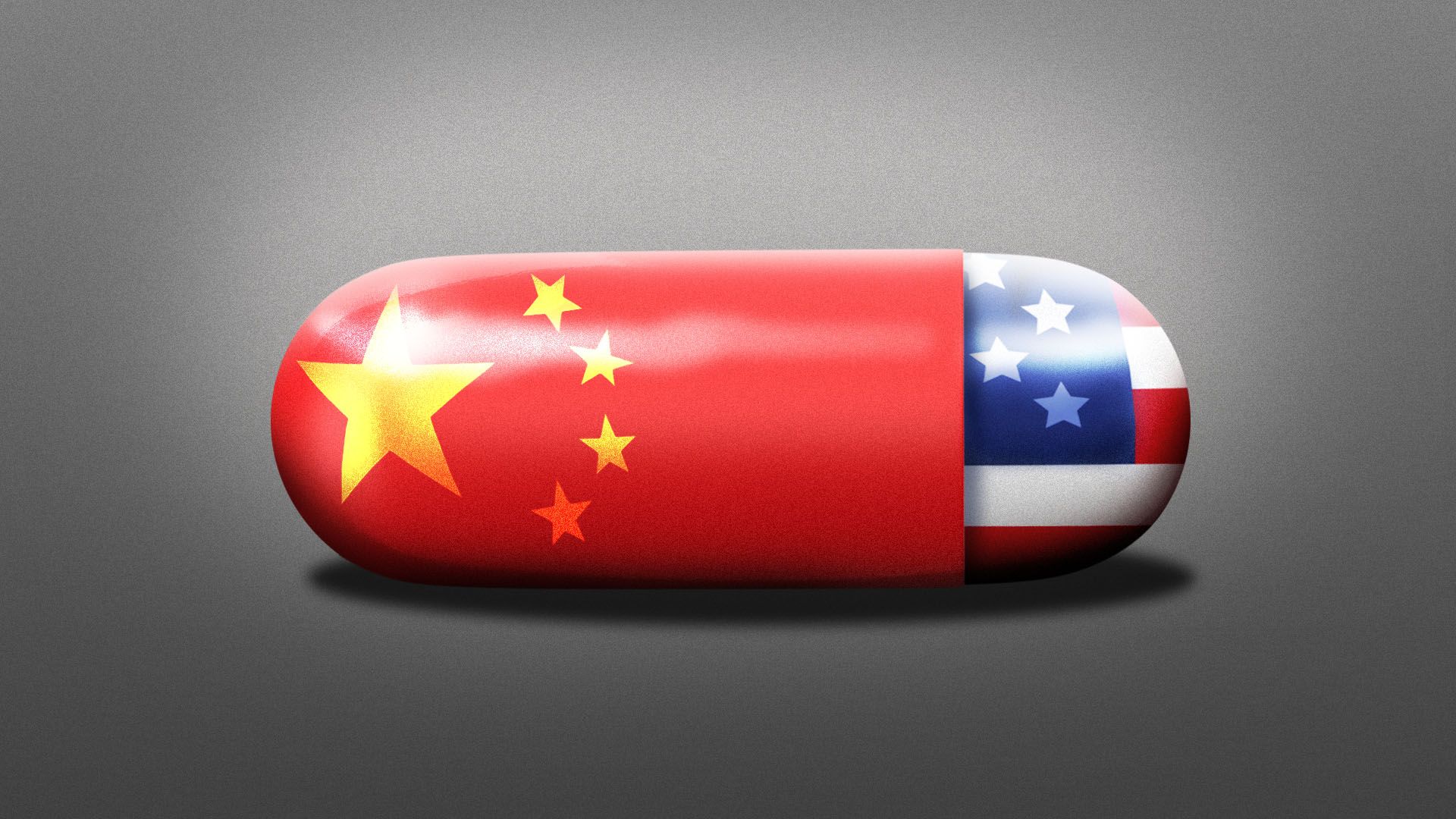
China has rapidly become a world leader in developing next-generation drugs, and that has huge implications for the American pharmaceutical industry, U.S. national security and patients.
Why it matters: There's near-unanimous agreement that the U.S. should try to retain its supremacy in pharmaceutical innovation. But some argue that we're actually headed in the opposite direction.
The big picture: China has manufactured drugs that were developed in the U.S. for a long time, and it's a key source of active pharmaceutical ingredients that have become a geopolitical friction point.
- But over the last five years, China's ability to make its own new drugs has grown by leaps and bounds — the result of an intentional national strategy.
- Experimental products from Chinese biopharma companies now account for 40% of licensing deals, up from 5% in 2020, according to Evaluate.
- Morgan Stanley recently estimated that revenue from drugs originating in China could rise to $34 billion by 2030 and $220 billion by 2040. These drugs could also account for 35% of FDA approvals by 2040, compared with about 5% now.
Where it stands: Those trend lines are setting off alarms in the national security community, which is already fretting over Beijing's role in chips, AI and other technologies.
- China could achieve "first-mover advantage in technologies of the future, like synthetic biology, quantum technologies, and automation (including humanoid robots)," this year's U.S.-China Economic and Security Review Commission report states.
- "U.S. advantages in artificial intelligence (AI), quantum, and biotechnology are increasingly contested," a recent Council on Foreign Relations report states, arguing that control of production of lifesaving medicines, high-efficiency crop chemicals and more is at stake.
- At the same time, big drug companies have treated the rise of early-stage Chinese drug candidates as a business opportunity, spending tens of billions of dollars on licensing deals.
Between the lines: Protectionism won't work here — China doesn't need U.S. know-how to keep advancing in the pharmaceutical space.
- Instead, the U.S. should focus on strengthening its own biomedical innovation capabilities, said Sujai Shivakumar, director and senior fellow of Renewing American Innovation at the Center for Strategic and International Studies.
- "Our strategy should be — yes, we can see China and the headlights in the rearview mirror, and we need to shift gears," he said.
- That includes figuring out how to make the U.S. research and development ecosystem less costly and more efficient, he added, along with getting rid of clunky bureaucracy that slows things down and drives costs up.
And while China takes steps to further strengthen its biotech sector, the U.S. is weakening its own by cutting research dollars and discouraging foreign students from coming here, Shivakumar said.
- "You do the math. Is it really any surprise that China is emerging as a major force in pharma? We are risking that leadership," he said.
2. The FDA's giant role
So far, China's rapid advance is primarily within drug discovery and early-phase clinical trials, not late-stage development.
- And that's largely because it's cheaper to do those pieces of the development process there than in the U.S.
What they're saying: "It's not that Chinese discoveries are superior; they're merely cheaper," former FDA commissioner Scott Gottlieb wrote earlier this year in the Washington Post.
- "The surest way to preserve America's preeminence is not to seal off the marketplace of ideas and risk a global trade war over intellectual property, but to make domestic discovery more competitive — by minimizing China's cost advantage," Gottlieb added.
Between the lines: That puts a lot of the onus on the FDA to make drug discovery more business-friendly.
- "A big part of why we're seeing the early-phase research move abroad is FDA's system for approving first-in-human trials takes more time and has higher regulatory burdens than other countries," said Lowell Schiller, a senior scholar at the USC Schaeffer Institute and a former senior FDA official.
- "Clinical trials are more expensive to run in the United States for a lot of reasons ... but there are ways we can improve the system, and FDA is a big part of that," Schiller said.
- There's an effort underway at the FDA to lower those burdens, he added.
Driving the news: FDA commissioner Marty Makary recently floated higher developer fees for experimental drugs that originate outside of the U.S., Endpoints News reported.
- "If your Phase 1 trial is not in the United States, maybe you should pay a higher [fee]," Makary said at a meeting at the National Academies of Sciences, Engineering, and Medicine late last month, per Endpoints.
- FDA is "actively making important reforms to expedite drug approval pathways, reduce regulatory hurdles, and ensure that meaningful treatments and cures are not only available to the American public, but developed and manufactured in the U.S.," HHS press secretary Emily Hilliard said in a statement to Axios, pointing to the FDA's new priority voucher program as an example.
- Makary has repeatedly talked about speeding up drug reviews and approvals.
Yes, but: A recent survey by No Patient Left Behind of biopharmaceutical CEOs and regulatory affairs professionals found that 82% said they were worried about the FDA's ability to function.
- "CEOs fear that increased volatility in an inherently high-risk business will reduce overall investment in biomedical innovation, or divert it to other nations," dozens of biotech executives and investors wrote in a letter published by the group that detailed the results of the survey.
- "Innovators need to have confidence that FDA will continue to be an evidence-based, science-first institution that evaluates new technologies and novel potential medicines objectively based on the risk/benefit," they added.
- No Patient Left Behind is a coalition of biotech investors, innovators, researchers, physicians and patient advocates.
3. The patient perspective
Pharmaceuticals aren't just geopolitical chess pieces; they're also life-altering for patients, especially when novel products fill some kind of prior treatment void.
The big picture: Patients in the U.S. and around the world need to be able to trust that their products are safely manufactured and well-tested through clinical trials.
- But with these caveats, to many patients a new drug is a new drug, regardless of its origins.
- "I think America[n] patients don't care where their cure was invented as long as it works, was reviewed by the FDA, and is guaranteed to remain in production without fear of geopolitical disruption," said Peter Kolchinsky, a biotech investor at RA Capital Management.
- "This means drug discovery can happen anywhere, including China. The more competition to discover cures, the better for everyone," he added.
Even those worried about the national security implications of China pulling ahead of the U.S. say that promising discoveries should be licensed by pharmaceutical companies and sold to Americans.
- "A good idea is a good idea," said CSIS's Shivakumar.
Yes, but: There could also be some risk that comes with even early-stage trials happening outside of the U.S., USC's Schiller said.
- "If the data are off in some way, and FDA isn't able to inspect them the same way as it can U.S. data, then the trial participants in the later-stage U.S. trials may be at later risk," he said.
The bottom line: China is giving the U.S. a run for its money in the biopharmaceutical sector, and the consequences of who wins are enormous — in terms of money, foreign relations and patient lives.
Thanks for reading Axios Vitals, and to editors Adriel Bettelheim and David Nather and copy editor Matt Piper. Please ask your friends and colleagues to sign up.