Axios Vitals

April 24, 2025

Happy Thursday! Today's newsletter is 1,030 words or a 4-minute read.
Situational awareness: HHS Secretary Robert F. Kennedy Jr. will testify in May before Senate and House committees that oversee his department, after not responding in time to a Senate health committee invitation to appear this month, our friends at Axios Pro Policy scooped. If you need smart, quick intel on health care policy for your job, get Axios Pro.
1 big thing: Key FDA drug data goes missing
FDA databases that physicians and public health experts rely on for key drug safety and manufacturing information have been neglected due to DOGE-directed layoffs, leaving health professionals flying blind on basic questions about certain drugs they're prescribing, current and former FDA officials tell Axios.
Why it matters: Information gaps that have become a hallmark of the workforce reductions and Kennedy's sweeping reorganization of federal health agencies are putting patient safety at risk, according to agency employees.
"It's really a nightmare," said a current FDA official who requested anonymity because they were not authorized to speak to the press. "Things that used to function are no longer functioning."
The big picture: The FDA not only reviews drugs for safety and efficacy but acts as a nerve center churning out information in real time when there are adverse events, quality problems or drug shortages.
- But in several recent instances, current and former officials said, databases didn't get updated promptly or were missing key information because there were no employees to maintain them.
- The FDA has previously referred all questions to HHS, which didn't respond to requests for comment.
Zoom in: The FDA's drug database, which is updated when new drugs are approved, get labeling changes or are pulled from the market, has a growing amount of missing information, an FDA official who was laid off told Axios.
- Most entries into this database since the sweeping April 1 job cuts are missing labeling information, which tells doctors what the drug is approved for, what it shouldn't be used for, dosing instructions and side effects.
- Other repositories with delayed updates due to staff cuts are the National Drug Code Directory and the Drug Registration and Listing Database — which wasn't updated for several days until a few laid-off employees returned part time to help.
- Their jobs are still set to be eliminated on June 2.
"Once June happens ... we have no idea what the plans are," the official said.
2. Big food companies haven't agreed to cut dyes

Major food companies haven't officially agreed to ditch artificial dyes despite Kennedy's push to ban them, though several of the nation's largest companies signaled they're committed to a conversation about it.
Why it matters: Kennedy announced Tuesday that the FDA is working with industry to eliminate synthetic dyes from the American food supply over the next two years.
- "The industry has voluntarily agreed" to do so, Kennedy said, according to NPR.
- An HHS official told Axios the food companies the agency is working with are "eager to engage in discussions about phasing out these dyes to promote a healthier America."
The big picture: None of the industry's largest food companies — including Mars, General Mills, Kraft Heinz and PepsiCo — confirmed they've signed on when contacted by Axios on Wednesday.
- In fact, there's no agreement among food makers in the U.S., according to one food industry official familiar with the talks.
Between the lines: Several major food makers sent signals they'd cooperate but stopped short of endorsing a ban.
- General Mills — whose cereal brands include Lucky Charms and Trix — "strongly" supports "a national, industry-wide standard, and we're committed to continuing the conversation with the administration," company spokesperson Mollie Wulff said in a statement.
3. Gen Z's new health advice ecosystem
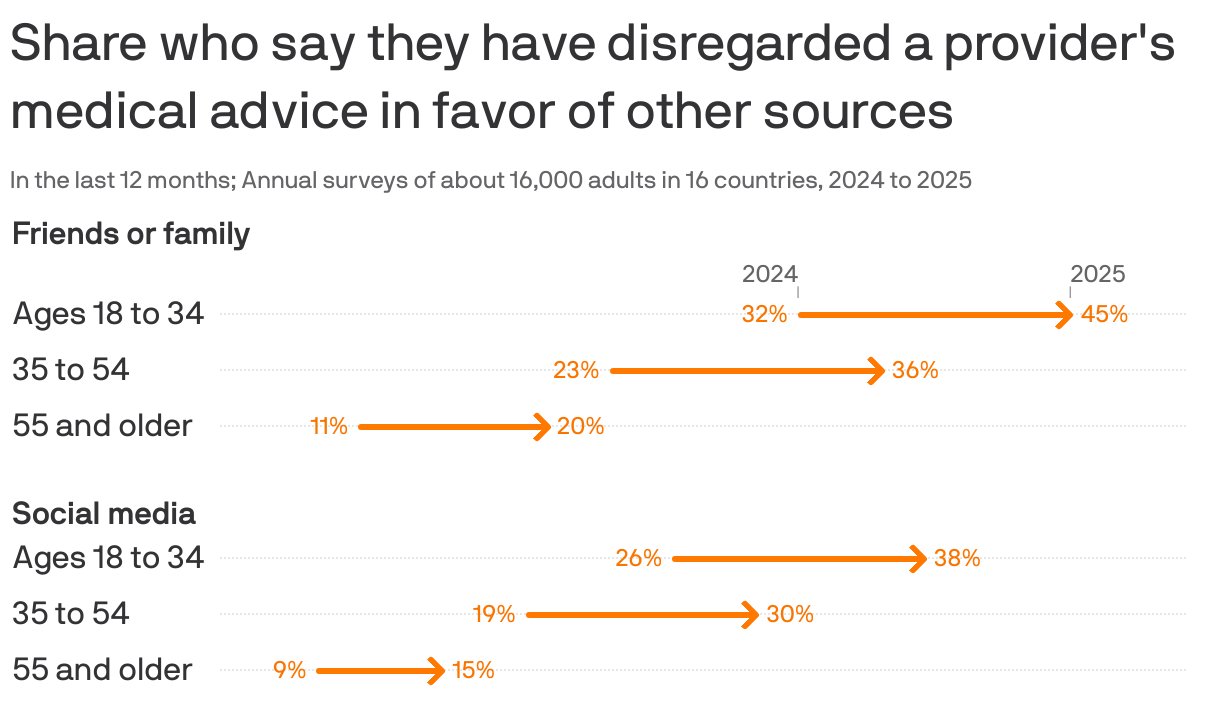
Young adults around the world are increasingly taking health decisions into their own hands, according to new global survey results from communications firm Edelman.
Why it matters: Adults under age 35, many who've come of age since the beginning of the COVID-19 pandemic, still rely on and trust their individual providers to help with medical choices. But they're also seeking information on their own more than ever.
What they found: In all age groups, but especially among adults younger than age 35, peer-driven health care decisions surged between 2024 and 2025.
- 45% of adults age 18 to 34 said they've disregarded their health provider's guidance in favor of information from a friend or family member in the past year — a 13-point increase from the previous year.
Zoom in: Credentials and institutional credence are becoming less important to health care consumers — especially younger ones.
- The vast majority of young adults (82%) still said their individual doctor has influenced their health decisions. But one-third of young adults also reported content creators without medical training have influenced their health decisions.
- Some 45% of young adults say the average person can know as much about health matters as trained doctors, a 7-point increase from 2024 survey data.
- Meanwhile, 61% of U.S. respondents across all age groups said they feel business, government and non-governmental organization actions hurt their ability to get quality health care.

4. Driving with COVID linked to higher crash risk
Driving with a case of COVID raised the odds of having a car crash about as much as being at the legal threshold of DUI or running a red light, according to an analysis of pandemic-era public health and transportation records from seven states.
Why it matters: Even mild COVID infections can cause "brain fog" and other impairment, affecting a person's ability to concentrate, reason and solve problems.
What they found: Driving while infected with COVID, as measured by a PCR lab test, brought a 25% increase in crash risk.
- That is comparable to the rates associated with a blood alcohol concentration of 0.08% — or the legal threshold for driving under the influence in many states.
- It's also consistent with odds linked to habitual speeding or running red lights.
- Being vaccinated didn't appear to deliver added protection against crashes. Some earlier studies that have linked vaccine hesitancy with a higher risk of accidents.
The big picture: Multiple studies have examined the pandemic's effects on traffic safety. The AAA Foundation for Traffic Safety last year found dangerous behavior like speeding, not using seatbelts and impaired driving contributed to a rise in fatal crashes compared with pre-pandemic times.
5. Catch up quick
😷 Nearly half of Americans are now exposed to unhealthy air pollution. (Axios)
📵 The Trump administration has proposed cutting the federal suicide prevention hotline for LGBTQ+ kids. (Axios)
🧠 Elon Musk's Neuralink is eyeing a fundraising round at an $8.5 billion valuation. (Bloomberg)
⚠️ A first-term Trump official cautioned the current administration against erasing HIV progress with funding cuts. (Stat)
Thanks for reading Axios Vitals, and to senior health care editor Adriel Bettelheim, managing editor Alison Snyder and copy editor Matt Piper. Please ask your friends and colleagues to sign up.
Sign up for Axios Vitals


/2025/04/23/1745433579999.gif?w=3840)