Axios Vitals

March 18, 2026

Hello, Wednesday. Today's newsletter is 1,160 words, a 4.5-minute read.
⚡️ Join Axios on Thursday, March 26, at 8am in Washington, D.C., for an event exploring rising health care costs, featuring Sen. Lisa Blunt Rochester (D-Del.), Rep. Adrian Smith (R-Neb.) and more. RSVP here.
1 big thing: Vaccine battle shifts to the states

After being blocked by election-year political considerations and now the courts, vaccine critics' most impactful fights may play out at the state level — at least until the midterm elections are over.
Why it matters: The "Make America Healthy Again" movement and its allies were already targeting state legislatures but those campaigns could take on new significance with much of the federal agenda now frozen.
Driving the news: A federal judge this week temporarily blocked the Trump administration from implementing recommendations made by a vaccine advisory committee handpicked by Health Secretary Robert F. Kennedy Jr.
- It also paused a major overhaul of the childhood vaccine schedule and further recommendations of the advisory panel.
- The decision came as the Trump administration was shifting away from vaccine rhetoric and policymaking after polling showed it was alienating voters heading into the midterms.
Between the lines: HHS said it looks forward to the injunction being overturned. But with so much of its agenda in limbo, statehouses may be vaccine critics' most viable route forward.
- "This likely shifts the medical freedom focus to state-based issues and the midterms," said David Mansdoerfer, a former senior HHS official in the first Trump administration and an adviser to groups critical of vaccine mandates.
State of play: A legislative tracker published by MAHA Action, an organization strongly allied with Kennedy, features more than 50 bills it's watching.
- "Health freedom" bills make up nearly 40% of those being tracked, by far the most common category — though some are bills the MAHA movement opposes, per the tracker.
Where it stands: Idaho passed a bill last year that bans vaccine mandates in the state, as well as requirements for other medical interventions like masks and diagnostic tests. It's been used as a model for legislation introduced in other states in the past year.
- Bills to get rid of vaccine mandates or expand exemptions are being debated in New York, West Virginia, Vermont, Arizona and elsewhere.
- Florida Gov. Ron DeSantis (R) earlier this week urged state legislators to pass a bill that would make changes like expanding school vaccine exemptions and removing the state surgeon general's ability to mandate vaccines during a public health emergency.
2. NIH head pressed on pace of grants
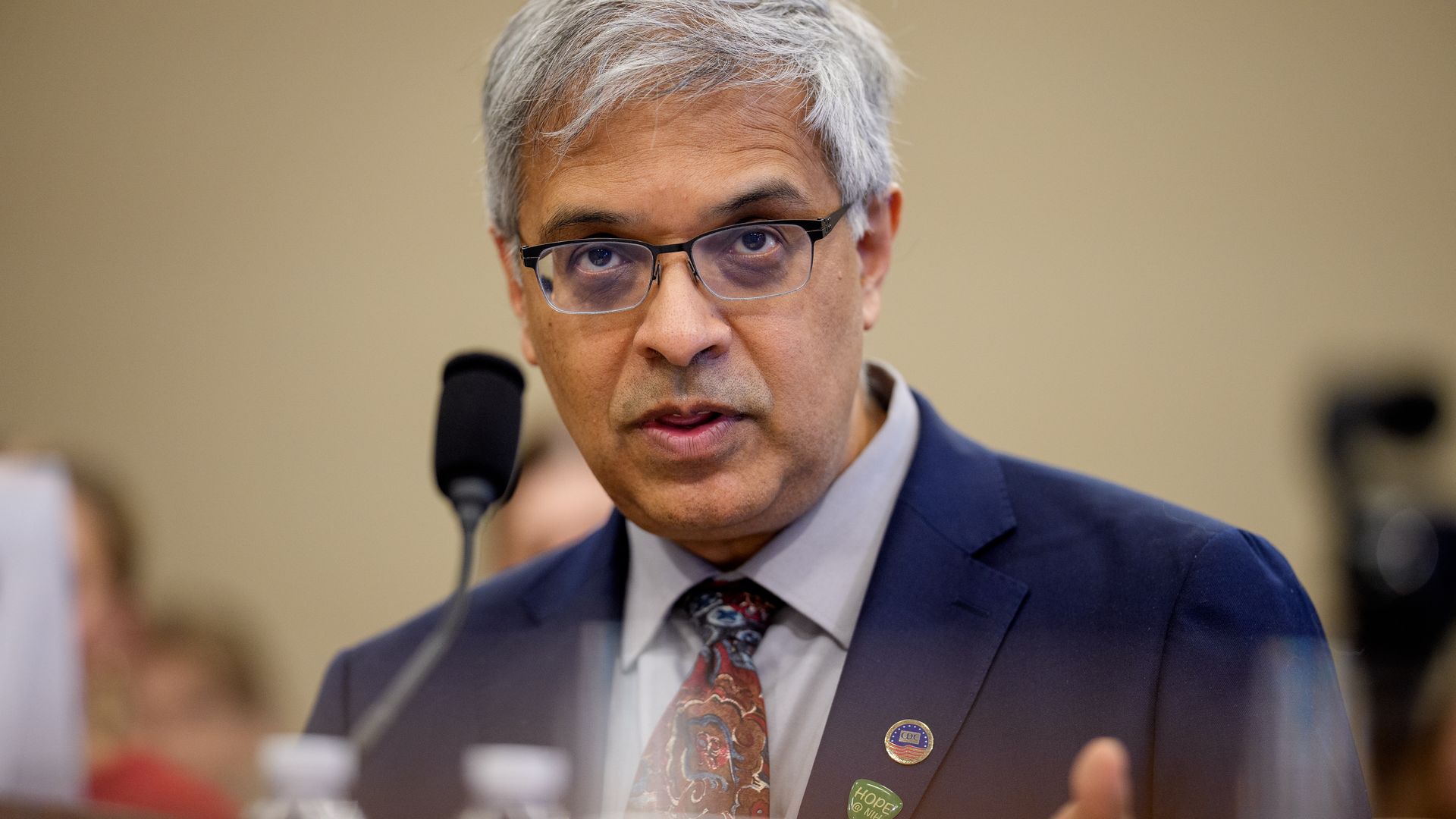
NIH director Jay Bhattacharya yesterday pledged to spend his whole budget this year when pressed by skeptics in Congress about the slow pace of grants for biomedical research.
Why it matters: Universities, research institutions and other grant recipients are some of the biggest employers in some lawmakers' districts, and there's been a steady drumbeat of concern that important funding hasn't been going out the door.
- The agency has increasingly obligated the full value of grants up front rather than on an annual basis, which had the effect of funding 5,500 fewer grants in 2025 compared with 2024, according to United for Medical Research.
What they're saying: "The pace [of grants] has diminished substantially and many researchers are left to wonder how they can plan for the future," Rep. Rosa DeLauro (Conn.), the top Democrat on the House Appropriations Committee, said at a hearing.
- Bhattacharya told the subcommittee with jurisdiction over NIH that "Scientists need not worry; we will get the grants out the door this year."
- "Don't pay attention to the hype," he added. "We are in the process of identifying the excellent projects. The grants are already going out the door."
- Rep. Steny Hoyer (D-Md.) pointed specifically to a lack of grants being made by the National Cancer Institute. Bhattacharya said he had spoken to the institute's director that morning and "he assured me that we are on track to spend all of the NCI budget."
The big picture: Congress on a bipartisan basis pushed back on President Trump's proposed cuts to NIH medical research in this year's spending bill in January, providing an increase to $48.7 billion.
3. FDA pulls plan to curb teen use of tanning beds
The FDA is withdrawing a proposed rule that would have restricted minors from using indoor tanning beds and required adult users to sign an acknowledgement of risks.
Why it matters: The decision at least for now shelves a more than decade-long effort to address the effects of UV radiation that drew in excess of 8,100 comments.
Driving the news: The agency said in a Federal Register notice it will reconsider ways to address the issue and look at potential alternatives. It referenced "compliance burdens on small businesses" and "support for personal choice and parental decision-making" among the considerations.
Catch up quick: The FDA proposed the rule in 2015, at a time when more than 30 million people tanned indoors every year — the majority women under the age of 30.
- Researchers have tied tanning bed use to an almost threefold increase in the risk of developing melanoma, as well as associated DNA damage.
What they're saying: The American Academy of Dermatology Association said it was disappointed by the move, adding that restricting teens' access to indoor tanning was critical to preventing skin cancer.
What we're watching: Whether the FDA issues a new proposal addressing the use of sunlamp products.
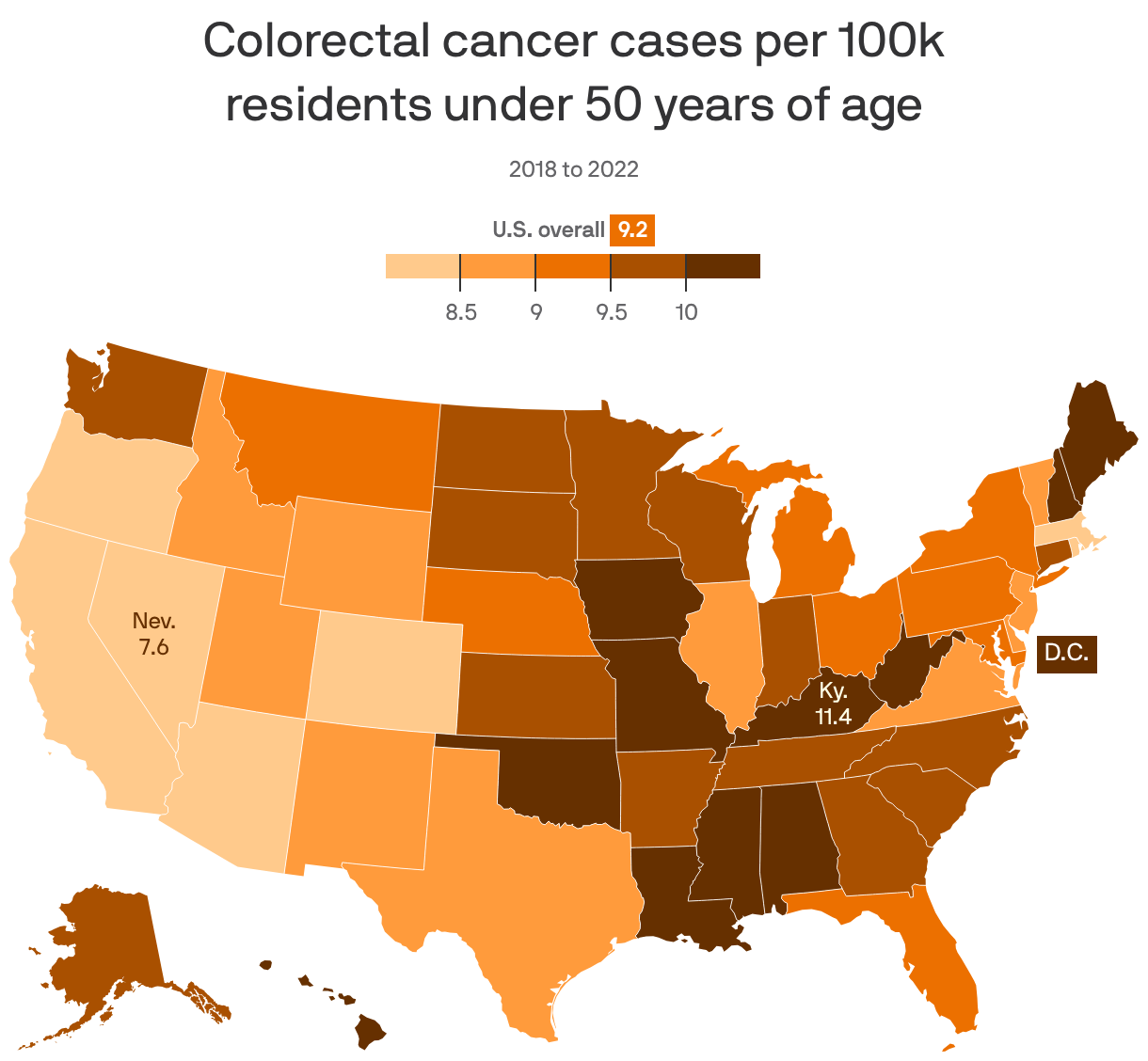
4. Mapped: Colorectal cancer's rise in young adults

Colorectal cancer is now the deadliest cancer for Americans under 50, per new research in JAMA.
Why it matters: While the incidence rates of many other cancers are either stable or going down, the trend for colorectal raises questions about how to better target those who are younger and may be at higher risk.
- The U.S. Preventive Services Task Force lowered its recommended starting age for screening from 50 to 45 in 2021, meaning most insurers are now required to cover it starting at that age.
By the numbers: Colorectal cancer cases in people under 50 have risen nearly 60% since the early 2000s — from about 6.4 cases per 100,000 people to more than 10 — per federal data.
- Kentucky, Louisiana and West Virginia have the highest incidence among both sexes ages 50 and under.
- And 3 in 4 colorectal cancer patients under 50 are diagnosed only after the disease has already spread, according to the American Cancer Society.
While no one's certain what's causing the uptick in this age cohort, "the leading hypothesis is around the environment and ultra-processed foods and something that we're probably eating," said gastroenterologist Austin Chiang.
5. Catch up quick
👀 Drug developers are looking for creative ways to cushion the effect of the Trump administration's "most favored nation" deals on U.S. pricing. (Endpoints News)
👨🏻💻 The psychedelic-like anesthetic ketamine is at the heart of a booming online industry that promises relief from depression but has also led to harm. (WSJ)
🦭 More than two dozen elephant seals tested positive for a subtype of H5N1 bird flu in a Bay Area outbreak. (KRON)
Thanks for reading Axios Vitals, and to editors Adriel Bettelheim and David Nather and copy editor Matt Piper. Please ask your friends and colleagues to sign up.
Sign up for Axios Vitals