Axios Vitals

November 10, 2025



Welcome to Monday! Today's newsletter is 970 words or a 3.5-minute read.
1 big thing: Dems take shutdown deal without ACA guarantee
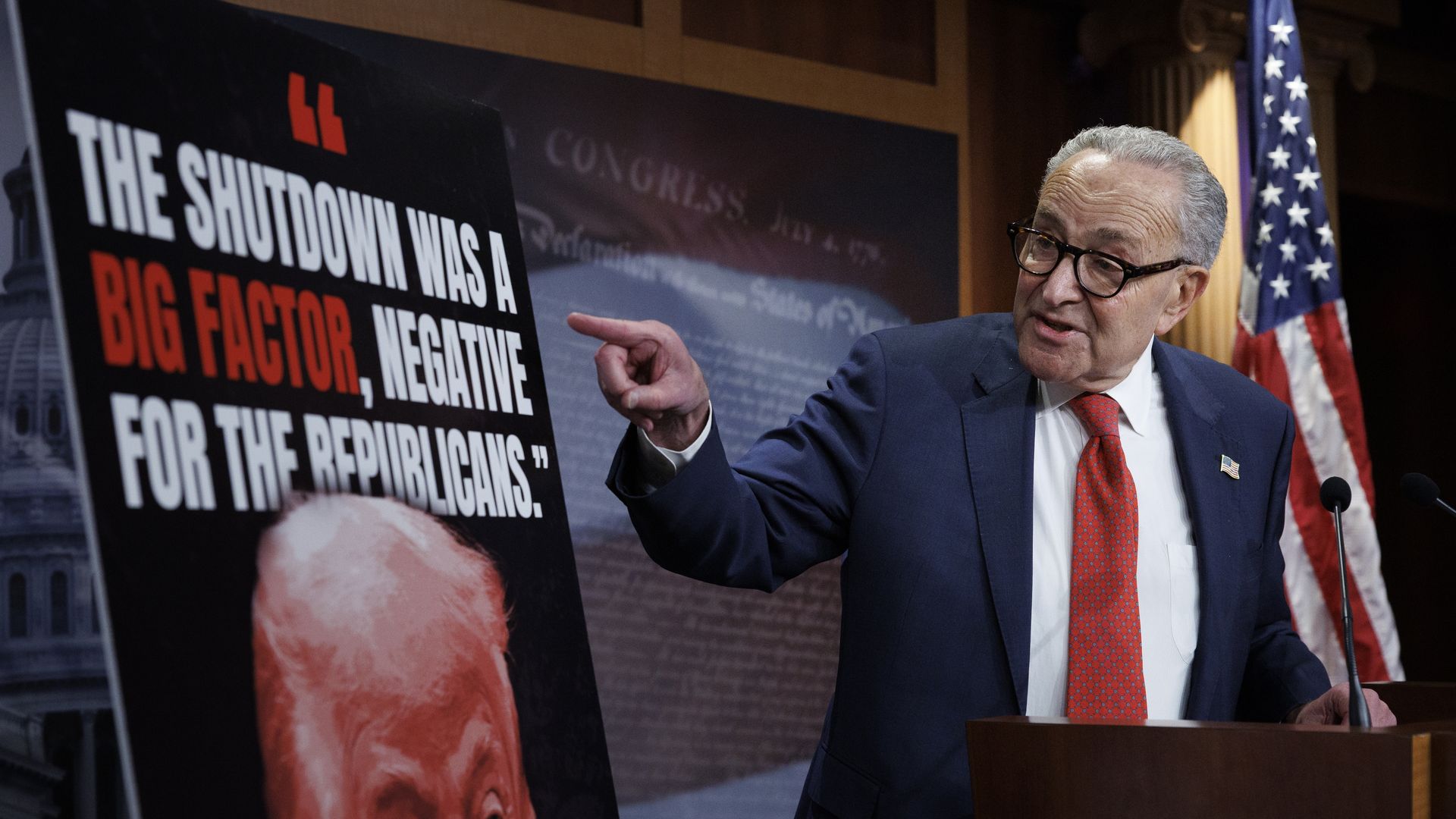
Enough Senate Democrats are poised to accept a deal to reopen the government without a concrete agreement to extend Affordable Care Act subsidies — but with the promise of a showdown vote on the assistance next month.
Why it matters: If a bill to temporarily fund the government passes this week, it would be a relief for much of the country but a major letdown for many Democrats who made ACA financial assistance a centerpiece of the shutdown fight.
Driving the news: The promised Senate vote on the ACA, on a bill of Democrats' choosing, is set to occur by the end of the second week in December, per a source familiar.
- That sets up a crucial period during which senators could delink the enhanced tax credits from government funding and try to reach a deal on eligibility changes that are more acceptable to Republicans.
- The source, speaking on the condition of anonymity because of the sensitivity of discussions, said Democrats will "move swiftly" to take Republicans up on their pledges to negotiate once the government is reopened "and hold them accountable in the public eye if they refuse to engage in good faith."
But an ACA deal still faces difficult odds, especially now that President Trump has weighed in against an extension and proposed sending the money directly to consumers to spend on health care as they chose.
Between the lines: The decision by eight moderate senators — including Jeanne Shaheen (D-N.H.), Maggie Hassan (D-N.H.), Tim Kaine (D-Va.) and Angus King (I-Maine) — to support reopening the government without concrete action on the subsidies prompted blowback from other Democrats.
- "That's not a deal. It's an unconditional surrender that abandons the 24 million Americans whose health care premiums are about to double," Rep. Ritchie Torres (D-N.Y.) wrote on X.
- House Democratic Leader Hakeem Jeffries said he is also opposed to the agreement, saying any government funding deal must extend the ACA tax credits. Senate Minority Leader Chuck Schumer also told reporters he would vote no.
2. Trump injects ACA plot twist

Before the shutdown breakthrough, President Trump spent a good part of the weekend posting on Truth Social that money that's being spent on Affordable Care Act subsidies now should be sent directly to consumers.
Why it matters: Trump's statement in a Truth Social post Saturday — followed by others amplifying the point on Sunday — put further pressure on Republicans to reject Democratic demands to extend the enhanced ACA tax credits.
Between the lines: Republicans and think tanks have suggested changes along similar lines.
- Sen. Bill Cassidy (R-La.), chair of the Senate health committee, last week proposed redirecting the ACA tax credit money into pre-funded federal flexible spending accounts.
- And the conservative Paragon Health Institute has proposed letting low-income Americans put part of their ACA subsidy money into health savings accounts to give them more choice and control over how they spend their money.
- That's closer to what Trump suggested in a Sunday post: "Republicans should give money DIRECTLY to your personal HEALTH SAVINGS ACCOUNTS that I expanded in our GREAT BIG BEAUTIFUL BILL."
Paragon president Brian Blase told Axios in an email that he reads Trump's original post as "an acknowledgement that the status quo is not working and more subsidies directly to insurers will not make coverage more affordable or reduce underlying health care costs."
The other side: Democrats, who had been holding out for a straight extension of the ACA subsidies, have made it clear they're not interested in making changes as a tradeoff.
- "This is, unsurprisingly, nonsensical," Sen. Chris Murphy (D-Conn.) posted on X. "Is he suggesting eliminating health insurance and giving people a few thousand dollars instead? And then when they get a cancer diagnosis they just go bankrupt?"
3. NIH moves to fill eight top vacancies

As the shutdown drags on, NIH is trying to fill eight high-level vacancies, including directors of five institutes and the heads of its research hospital and the National Library of Medicine.
Why it matters: The moves would fill some of the openings created by staff purges, resignations and other changes brought by the Trump administration's sweeping overhaul of federal health agencies.
- NIH leadership last month named a Duke University brain cancer researcher and friend of Vice President Vance to lead the National Institute of Environmental Health Sciences, reportedly bypassing the customary search and vetting processes.
Driving the news: NIH is accepting applications through Nov. 14 for director of the National Institute of Mental Health and the CEO of its clinical center, per its human resources office.
- It's also taking applications through Nov. 21 for deputy director for intramural research, and for the directors of the National Institute of Child Health and Human Development, the National Human Genome Research Institute, the National Institute of Dental and Craniofacial Research and the National Institute of General Medical Sciences.
HHS didn't respond to questions about the timelines for filling the positions and who'll oversee hiring.
- A Trump administration budget proposal over the summer proposed cutting NIH funding by about $18 billion, or roughly 40%, and consolidating its 27 institutes and centers into just eight.
4. While you were weekending

✂️ The Trump administration has already undercut efforts to provide medical care, outbreak response, and other services by cutting and freezing public health funds. (KFF Health News)
🗳️ Allies of President Trump and Health Secretary Robert F. Kennedy Jr. hope the "Make America Healthy Again" movement can help the GOP in the midterms, but Democrats believe Kennedy makes Republicans vulnerable. (Wall Street Journal)
💵 Pfizer won the high-profile bidding war with Novo Nordisk for obesity drug maker Metsera, but not before increasing its original offer almost 40% to as much as $10 billion. (Axios Pro Deals)
Thanks for reading Axios Vitals, and to editors Adriel Bettelheim and David Nather and copy editor Matt Piper. Please ask your friends and colleagues to sign up.
Sign up for Axios Vitals