
Axios Vitals

March 02, 2023
Good morning, Vitals readers. Today's newsletter is 830 words or a 4-minute read.
Situational awareness: The U.S. Select Subcommittee on the Coronavirus Pandemic will hold its first hearing on the origins of COVID next Wednesday.
- Among those scheduled to testify: Former CDC director Robert Redfield.
1 big thing: The missing evidence in the COVID origins debate

Illustration: AĆÆda Amer/Axios
Lingering questions about how the COVID-19 virus emerged could likely only be filled through intelligence or new information gathered from Wuhan, China, in the early days of the pandemic, experts tell Axios' Caitlin Owens and Alison Snyder.
State of play: The debate boils down to whether it's more likely the virus spread from infected animals ā likely at a live market in Wuhan, China, to people at and around the market ā or that researchers at a laboratory in Wuhan accidentally became infected with a virus being studied and then spread it to others.
Details: Supporters of the live animal market origins theory argue that, similar to the first SARS pandemic in 2003, COVID jumped from infected animals held at the Huanan Seafood Wholesale Market to humans at the end of 2019.
- Evidence for this theory was published in two papers last July in the journal Science, and placed some of the earliest human cases close to a section of the market where vendors of live wild animals congregated and where environmental samples positive for the virus were clustered.
- But the theory is missing a key data point: samples from infected animals themselves, which proponents say may not exist after the market and surrounding farms were cleared.
The other side: Lab-leak proponents argue Wuhan is a known international hub of coronavirus research, and there were earlier signs of biosafety problems at the Wuhan Institute of Virology.
- The major hole in this case, however, is that there's no known evidence that a lab in Wuhan had a virus that could have been the precursor to SARS-COV-2, critics say.
- "If one of those labs had a precursor virus, that would probably change my view entirely," said Angela Rasmussen, a virologist at the University of Saskatchewan and an author of one of the Science studies.
- "I think there is never going to be definitive truth, because either the samples are no longer available or the Chinese government has squelched anything and everybody involved in what people think happened," said Cornell University virologist John Moore.
2. Colorectal cancer rises among younger patients
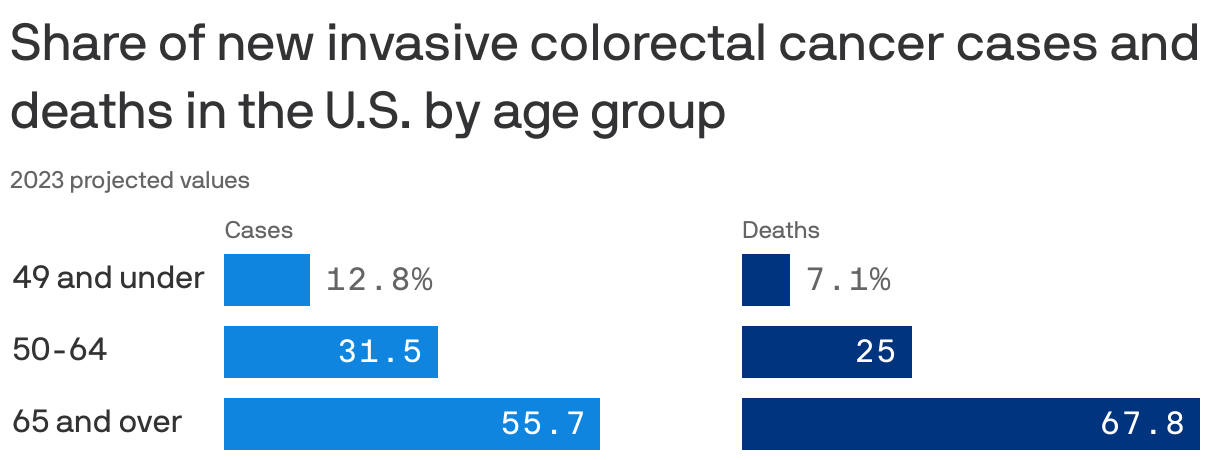
Alarming new findings offer more evidence of a puzzling rise in colorectal cancer in patients in their 50s and younger and the challenges of reaching them with timely screening.
Driving the news: Research published Wednesday showed the uptick in new colorectal cases ā among the top causes of cancer death in the U.S. ā among younger patients as well as an increase in colorectal cancers diagnosed at more advanced stages.
"This is a pretty remarkable outlier because incidence rates for most other cancers are either stable or going down," Arif Kamal, chief patient officer of the American Cancer Society, told Axios.
Details: The research drew on cancer registries from the National Center for Health Statistics and found the proportion of colorectal cancer cases among those younger than 55 years increased from 11% in 1995 to 20% in 2019.
- About 60% of all new cases were advanced in 2019, compared to 52% in the midā2000s and 57% in 1995, before widespread screening.
What they are saying: "Everyone asks why this is happening and the short answer is, we don't know," Robin Mendelsohn, co-director of the Center for Young Onset Colorectal and Gastrointestinal Cancers at Memorial Sloan Kettering, told Axios.
3. Albuterol shortage worsens

Illustration: Brendan Lynch/Axios
Hospitals and health systems are dealing with a shortage of the inhalation drug albuterol after one of the last manufacturers producing the drug shuttered operations, Axios' Arielle Dreher writes.
Why it matters: Liquid albuterol is a mainstay for treating asthma in kids and was in heavy use for RSV and COVID-19. Health systems have scrambled to get more supplies and figured out workarounds after drugmaker Akorn ceased operations in late February, the Washington Post reported.
Where things stand: Albuterol has been on the national medication shortage list for months, and without action by the Food and Drug Administration, a quick replacement is unlikely to materialize in the near future.
- The FDA is reviewing how Akorn's closure will impact the nationwide supply of all the pharmaceuticals they were producing.
The details: Supply chain issues have dogged health care systems throughout the pandemic, including for some of the most commonly used medications.
- The FDA could clarify if a new supplier could purchase the technology from Akorn or needs to submit an abbreviated new drug application ā a process that could take months.
4. Quote du jour: Lilly's insulin cut
āI don't think that these prices are quite as impressive as they look when you first see them ... It doesn't necessarily mean that Lilly is taking a big financial hit to do this."ā Stacie Dusetzina, a professor of health policy at Vanderbilt University School of Medicine, told the New York Times about Eli Lilly's announced plan to cut insulin prices
5. Catch up quick
šFDA panel recommends 2 RSV vaccines for older adults. (New York Times)
𦷠This dental device was sold to fix patients' jaws. Lawsuits claim it wrecked their teeth. (CBS News/KHN)
š U.S. intel review finds no evidence linking foreign adversary to "Havana syndrome." (NBC News)
Have a news tip? Just reply to this email.
Did someone forward this email? Subscribe here.
Thanks for reading,Ā and thanks to senior health care editor Adriel Bettelheim and senior copy editor Bryan McBournie for the edits.


