
Axios Vitals

July 18, 2024

Thursday's here, Vitals readers. Today's newsletter is 881 words or a 3.5-minute read.
1 big thing: A locus for women's cancer deaths
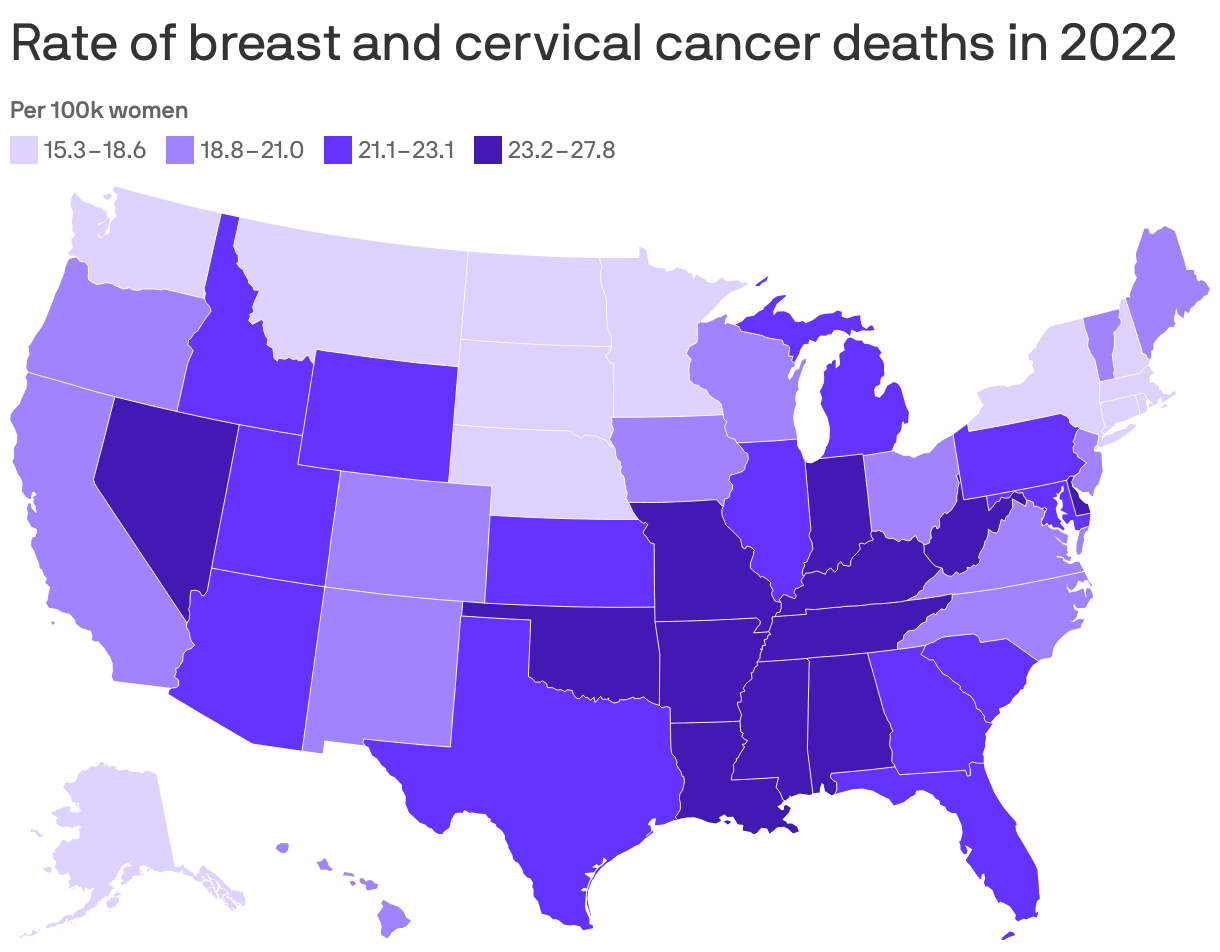
Women are likelier to die from breast and cervical cancer in a cluster of southern states where screenings and other preventive care lag behind the rest of the country.
Why it matters: The gap, revealed in a new analysis of 2022 federal data by the Commonwealth Fund, illustrates how widening disparities in women's health aren't limited to reproductive care.
The big picture: Where a woman lives is becoming a key determinant in how dangerous it is to give birth or if she'll die from cancers considered treatable with proper screening and routine care.
- It's a trend that could intensify as OB-GYNs and applicants to medical residencies in other specialties increasingly move away from states with restrictions on abortion.
- "Rather than policies that might help narrow the divides [in women's health], we're seeing policies that can actually widen and deepen those divides," report author Sara Collins told Axios.
Breast and cervical cancer death is a proxy for assessing women's health services. Nationwide death rates are falling for both cancers, per the National Cancer Institute, as treatments advance and as free or low-cost screenings increase.
- But a cluster of states including Louisiana, Tennessee, Arkansas and Nevada saw between 23 to 28 deaths from cervical and breast cancer per 100,000 female residents in 2022, the Commonwealth Fund found.
- The national average was 20.9 deaths from breast and cervical cancer per 100,000 female residents in 2022.
11 of the 12 states with the highest breast and cervical cancer rates also ranked worse than average for women's health in general, according to the Commonwealth report.
- Mississippi, Texas, Nevada, Oklahoma and Arkansas ranked as the worst states for women's and reproductive health, according to the Commonwealth's analysis.

2. GoodRx teams with Boehringer on Humira knockoff
A new partnership between prescription savings platform GoodRx and drugmaker Boehringer Ingelheim will make the company's Humira knockoff available for a discounted cash price of $550.
Why it matters: While it's still not cheap, the price tag for Boehringer's adalimumab-adbm injection represents a 92% discount from what brand-name Humira made by AbbVie generally costs at the pharmacy counter for those who pay cash.
The big picture: Biological copies of AbbVie's blockbuster anti-inflammatory drug were first allowed on the market in January 2023, but early demand was sluggish.
- Demand shifted as more biosimilars came online and PBM giant CVS Caremark removed Humira from its formulary earlier this year.
Catch up quick: The Boehringer drug, also sold as Cyltezo, was the first biosimilar to get FDA approval as an interchangeable drug with Humira, meaning it can be swapped at the pharmacy counter for the brand-name product.
- At pharmacies that accept GoodRx, patients will be able to get two-packs of both high-concentration and low-concentration versions of the knockoff Humira for $550.
What to watch: AbbVie also has successors to Humira that may recapture some of the market that it's lost, CNBC reported earlier this year.
3. Medical debt fuels mental health treatment gap

As many as 1 in 4 U.S. adults with depression and anxiety can't pay their medical bills — a situation that could be limiting their ability to get timely psychiatric care, Johns Hopkins researchers found.
Why it matters: Fewer than half of all U.S. adults with mental disorders receive treatment, and the findings show those with common behavioral disorders face high out-of-pocket costs because many psychiatrists don't participate in insurance networks.
What they found: Medical debt was linked with more than a twofold increase in delayed or forgone treatment for mental disorders among more than 27,600 adults surveyed, the researchers wrote in JAMA Psychiatry.
- 19.4% to 27.3% reported they had medical debt over the past year.
- Insured people with high deductibles were likelier to be affected than uninsured people, who may already be forgoing treatment.
- Efforts to relieve some of the debt burden could actually worsen mental health, if the assistance is insufficient and winds up amplifying a patient's feelings of distress.
4. Balding medical tourists flock to Turkey
As medical tourism becomes increasingly popular, Turkey has emerged as a destination of choice for balding American men seeking a cure to their receding hairlines.
Why it matters: The boom underscores the extent to which social media and pop culture have normalized cosmetic procedures — and the lengths people are willing to go to achieve their ideal look.
- Getting hair transplants abroad can also offer men a major confidence boost at a fraction of the cost required to get the procedure done at home, proponents say.
Context: The worldwide market for hair transplants has surged in recent years, just as cosmetic procedures have become more commonplace.
- Social media use and the rise of Zoom meetings mean people are spending larger portions of their days looking at images of themselves and others.
- Yet costs for hair restoration remain high — with an average hair transplant costing $7,500 and possibly up to around $15,000, according to the Foundation for Hair Restoration.
State of play: Turkey has emerged as a popular destination for Americans to travel to for the procedure, with glowing testimonials online about the results and cost.
5. Catch up quick
🦠 President Biden tested positive for COVID while campaigning in Nevada and is experiencing mild symptoms. (Axios)
💉 Insulin users fear drugmakers will prioritize development of GLP-1 weight-loss medications and move on without them. (Stat)
🐶 Centuries of co-evolution may have left dogs with an innate ability to feel our pain. (Nature)
Thanks for reading Axios Vitals, and to senior health care editor Adriel Bettelheim and copy editor Matt Piper. Please ask your friends and colleagues to sign up.
Sign up for Axios Vitals