Axios Vitals

August 05, 2022

😎 Happy Friday, Vitals readers. Today's newsletter is 932 words, or a 3.5-minute read.
1 big thing: The next public health emergency

Illustration: Eniola Odetunde/Axios
Facing a groundswell of criticism for its sluggish response to monkeypox, the Biden administration declared a public health emergency on Thursday, potentially unlocking resources to expedite vaccine availability in the U.S., Axios' Arielle Dreher writes.
Why it matters: It's likely the first step toward asking Congress for more money, but also allows the federal health department to tap into other resources as it seeks to beef up countermeasures.
- “It’s absolutely welcome. It’s many weeks overdue, but it's the right move," University of California-Irvine epidemiologist Andrew Noymer told Axios.
Between the lines: Among other things, the move gives the Centers for Disease Control and Prevention access to state and local jurisdictions' data on the number of people vaccinated, hospitalizations and testing.
The intrigue: The Food and Drug Administration is also eyeing plans to stretch the current vaccine supply by administering doses intradermally, between skin layers, instead of as a traditional shot, FDA Commissioner Robert Califf told reporters Thursday.
- This plan would use about a fifth of a current Jynneos vaccine vial per dose, expanding the number of people who could get vaccinated. The FDA plans to issue an emergency use authorization for this approach in the coming days.
What's next: Lawmakers could add money for the response to Democrats' reconciliation bill now being hashed out in the Senate.
- A recent survey of sexual health clinics responding to the outbreak found that the vast majority would use new money to hire additional staff and create educational materials to increase awareness about the virus.
- "New funding is urgently needed to support states, cities and clinics in providing the intensive care required to diagnose and treat patients with monkeypox and prevent cases from spreading," Daniel McQuillen, president of the Infectious Diseases Society of America, said in a statement.
2. Dems' drug bill could hike launch prices

Illustration: Gabriella Turrisi/Axios
Democrats' party-line drug pricing legislation will likely cause manufacturers to raise the launch prices of new drugs, the Congressional Budget Office projected yesterday.
The intrigue: The primary driver of the increases would be a cap preventing prices for existing drugs from rising more than inflation. That provision has received bipartisan support in the past.
- But the measure that allows Medicare to directly negotiate prices with manufacturers — which is highly partisan and controversial — would to a lesser extent also contribute to higher launch prices, CBO said.
Between the lines: This isn't a surprise. It's long been expected that the pharmaceutical industry would try to recoup the revenue lost through price caps or negotiations by raising the prices of other drugs.
- But the finding provides ammunition for opponents of the drug price legislation, particularly because it comes from the nonpartisan CBO.
3. 1 in 8 get long COVID, study finds
One in eight COVID-19 patients appears to develop long COVID symptoms, according to a Dutch study published Thursday in The Lancet.
Why it matters: Pinning this figure down has proved tricky. But doing so could help experts better communicate the risks of COVID and craft a response to what can be debilitating, extended symptoms from the virus.
What they're saying: “There is urgent need for data informing the scale and scope of the long-term symptoms experienced by some patients after COVID-19 illness” lead author Judith Rosmalen from the University of Groningen said in a statement.
- “However, most previous research into long COVID has not looked at the frequency of these symptoms in people who haven’t been diagnosed with COVID-19 or looked at individual patients’ symptoms before the diagnosis of COVID-19.”
Be smart: In this study, conducted in the Netherlands, researchers collected data by asking thousands of participants to fill out digital questionnaires on 23 symptoms commonly associated with long COVID dozens of times over the course of more than a year.
- Of adults infected with COVID, more than one in five (21.4%) experienced at least one new or severely increased symptom three to five months post-infection compared to 8.7% of uninfected people in the same period.
- That suggests that one in eight (12.7%) in the general population experience long-term symptoms due to COVID-19, they said.
4. Over 1M courses of Paxlovid prescribed in July
July marked the first month that more than 1 million courses of Pfizer's COVID antiviral Paxlovid were prescribed, according to Biden administration figures provided to Axios' Oriana Gonzalez.
The big picture: There were 1.26 million courses dispensed last month, a 37% increase over June. Additionally, more Paxlovid was dispensed in July than was prescribed from January through May combined, per the Department of Health and Human Services.
- More than one-third of all reported coronavirus cases in July were treated with Paxlovid, which represents the highest percentage of cases yet treated with the drug.
- But while the Biden administration has promoted Paxlovid as an effective tool to battle COVID, some medical experts have questioned how much the drug helps those who are vaccinated. It's unclear how often so-called "rebound" infections — such as President Biden's — can occur.
Between the lines: In the months after Paxlovid was authorized by the Food and Drug Administration, there was a "substantial gap in prescribing between individuals in high and low social vulnerability areas," according to an HHS spokesperson.
- "Over the past two months, though, we have worked to reduce the equity gap by more than two-thirds — from 31% to 10%," the spokesperson said.
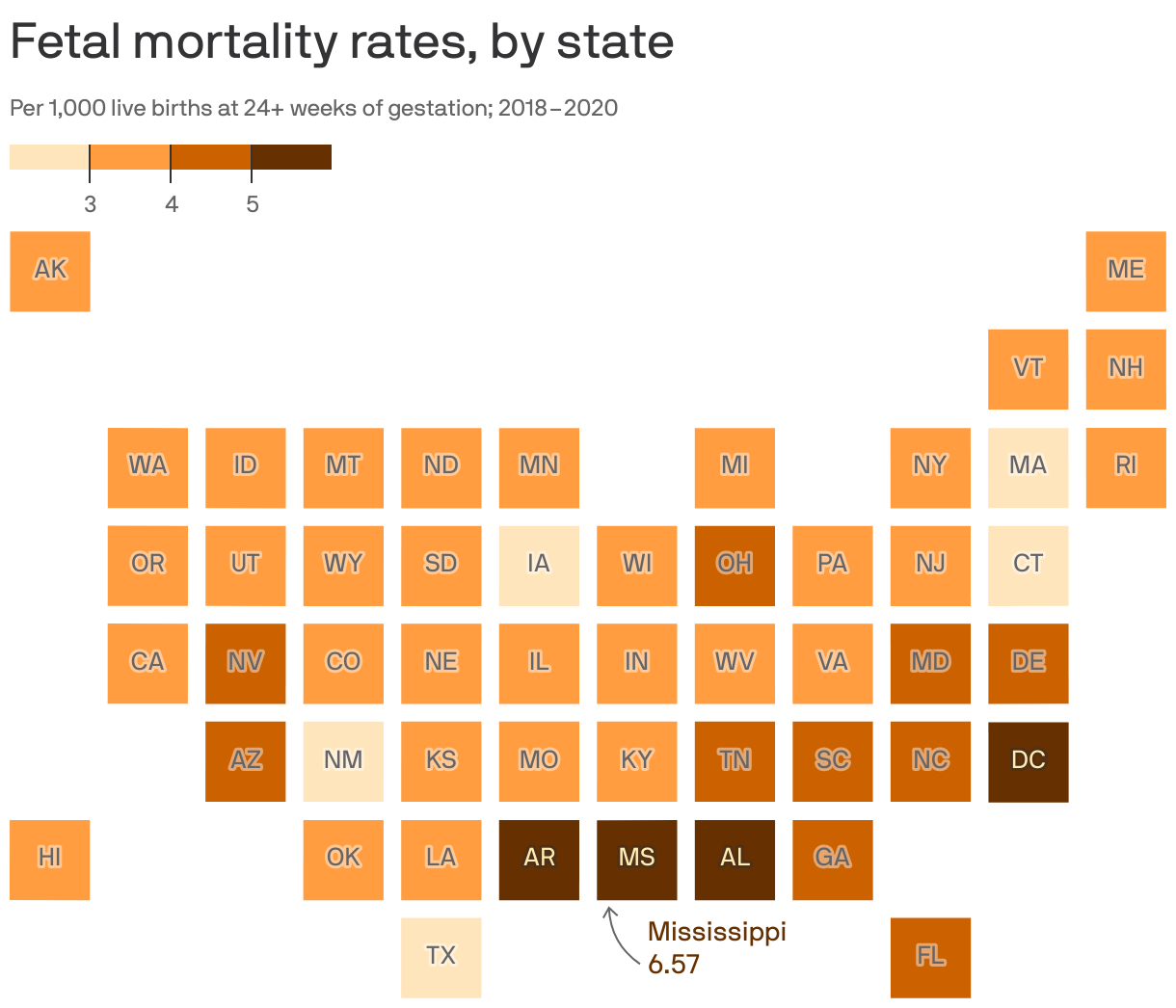
5. Chart du jour: Fetal mortality in the U.S.
6. Dog of the week

Winston. Photo: Karla Hitchcock.
Meet Winston. (We promise, he's in there somewhere!)
- Winston is a 4 1/2 year old Bichon and Shih Tzu mix rescued by his humans, James Leap and Karla Hitchcock, in 2020. He discovered a love of nesting in the bed of irises in her garden.
- "During the pandemic, he was what kept us going," Hitchcock says. (I've heard that from a lot of you. Maybe there should be a study on that.)
Editor's note: The piece on the dog of the week has been corrected to show Winston was rescued by his humans James Leap and Karla Hitchcock. We apologize for the ruff mistake. WOOF!