Axios Vitals

March 26, 2025

Welcome to Wednesday, Vitals gang. Today's newsletter is 1,016 words or a 4-minute read.
Situational awareness: The Senate on Tuesday evening confirmed Jay Bhattacharya as NIH director in a 53-47 party line vote, and Marty Makary as FDA commissioner in a 56-44 vote.
1 big thing: Makary's abortion drug minefield
When Marty Makary officially became FDA commissioner last night, he inherited the explosive matter of mifepristone access — an issue that hung over and complicated his confirmation process.
Why it matters: Abortion remains a politically volatile subject for the GOP in a post-Roe world, but whether and how to reset abortion pill dispensing guidelines now that Republicans are in power may turn out to be the most difficult decision the party's made yet.
The big picture: President Trump hedged on many abortion questions during the campaign, but told Time magazine in December that he'll ensure the FDA doesn't strip access to the pill.
- Makary was asked repeatedly about mifepristone and Mehmet Oz, Trump's nominee to lead CMS, has had his own abortion views questioned by Sen. Josh Hawley (R-Mo.).
Abortion politics did scuttle one Trump appointee: Makary's own choice for the FDA's top lawyer.
- Hilary Perkins, a career Justice Department lawyer and Makary's pick for chief counsel at the FDA, defended the Biden administration's loosening of mifepristone restrictions in a case brought by anti-abortion groups that reached the Supreme Court, Axios reported.
- The next day, Hawley — whose wife represented the petitioners at the Supreme Court as a lawyer for the Alliance Defending Freedom — posted several times on X about Perkins' selection for the FDA post, referring to her as a "Biden abortion lawyer."
- A day after that, Perkins resigned, just before the Senate health committee that Hawley sits on voted on whether to advance Makary's nomination.
Yes, but: Perkins has since said her role was mischaracterized by Hawley, and that the majority of the cases she handled at DOJ were actually defending the FDA's restrictions on mifepristone against challenges by abortion rights groups.
- Perkins told Axios she is a "pro-life conservative who is committed to fighting for President Trump's agenda," and defended herself in more detail in an op-ed published Tuesday night in the WSJ.
- The tense episode may foreshadow the pressures Makary is about to face regardless of what he does or doesn't do about mifepristone.
What he's saying: "If you look at my track record, I have never been afraid to speak my honest scientific opinion," Makary said.
2. Conservatives target extra Medicaid money
A think tank with close ties to the Trump administration is making the case for wonky changes to state Medicaid payments that could allow Republican lawmakers to cut federal spending in the name of cracking down on waste and abuse within the program.
The big picture: Extra Medicaid payments that states can dole out to providers have grown rapidly, and there's been bipartisan support for reining them in.
- But slashing or getting rid of the payments would be a big financial hit for providers, and especially hospitals, who vehemently disagree that the payments are wasteful.
- State-directed payment arrangements approved as of last August are projected to cost more than $110 billion per year, a nearly 60% increase over cost projections from early 2023.
Driving the news: Paragon Health Institute released a report Wednesday characterizing state-directed payments as "legalized Medicaid money laundering."
What they're saying: "Let's be clear: provider taxes and state directed payments provide the means to offset the crippling underpayment by Medicaid for critical care that meets the medical needs of so many kids, mothers, disabled, and seniors," Chip Kahn, president and CEO of the Federation of American Hospitals, said in a statement to Axios.
3. Speaking of Medicaid cuts ...
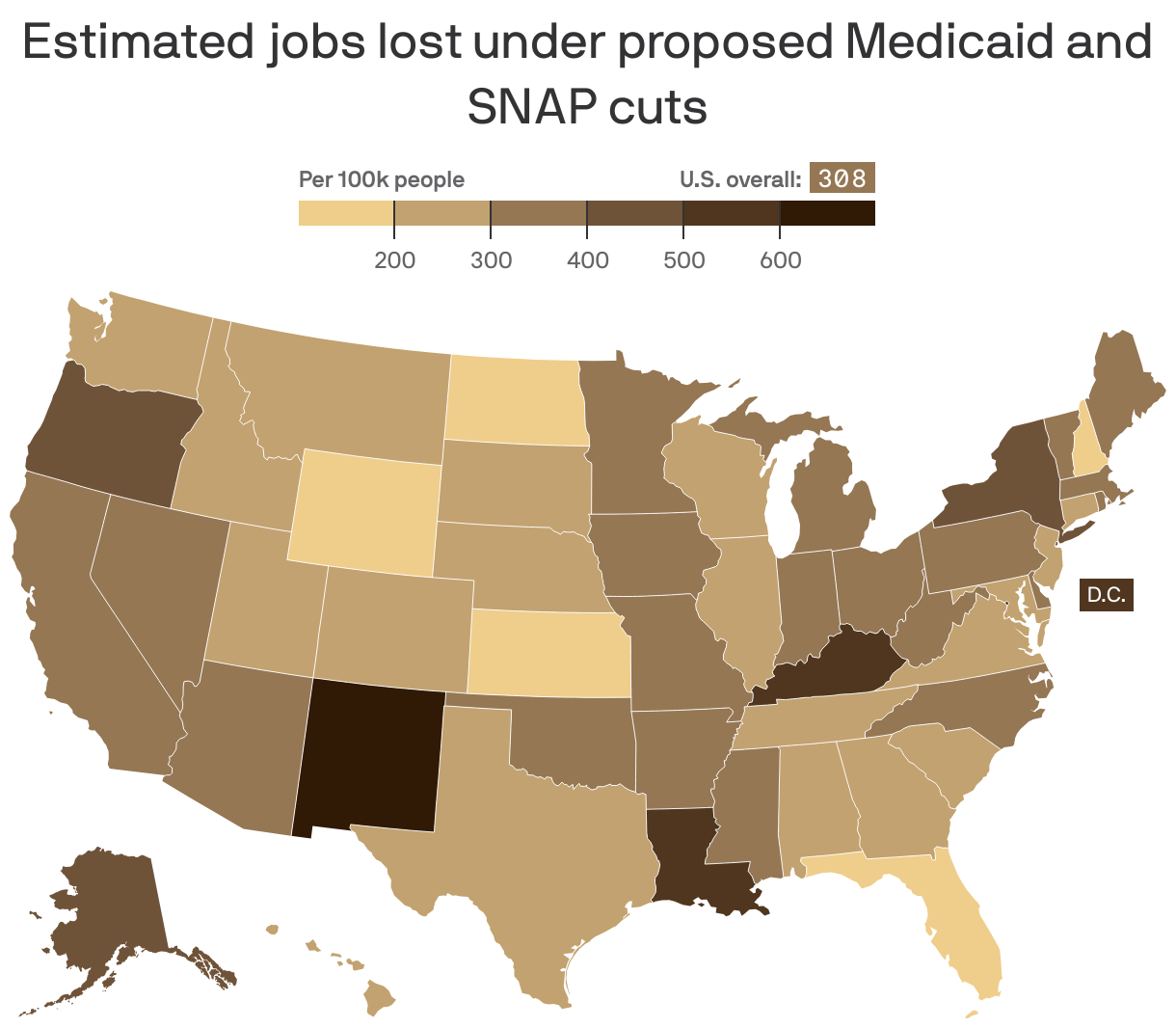
States could lose thousands of jobs and billions of dollars in economic output under potential Medicaid and food aid cuts, per a new analysis from the Commonwealth Fund and the George Washington University Milken Institute School of Public Health.
The researchers' estimates assume $880 billion and $230 billion in broad Medicaid and SNAP cuts over 10 years, respectively, spread out evenly over the decade and proportionately among states.
By the numbers: In 2026 alone, such cuts could cost more than 1 million jobs nationally, cause a $113 billion drop in combined state GDPs and result in nearly $9 billion in lost state and local tax revenue, the researchers estimate.
- The hit to state GDPs would exceed the estimated $95 billion in federal savings achieved through such cuts, the report finds.
- In terms of job losses, New Mexico (about 634 per 100,000 people), Kentucky (579) and Washington, D.C. (560) could be hit hardest.
Reality check: As mentioned above, it's not yet clear exactly where the cuts may come from.
- Any actual cuts to Medicaid and SNAP could wind up being smaller.
4. C-sections steady, episiotomies decline
The rate of Cesarean sections in America is not decreasing after seeing an increase after the start of the COVID pandemic, according to a report from hospital safety advocacy organization Leapfrog Group.
Why it matters: Major health organizations recommend reducing unnecessary C-sections, which can pose additional risks to mothers and their infants, including increased risk of infection.
What they found: 25.3% of deliveries in U.S. hospitals among first-time mothers carrying a single, full-term baby in a head-down position were via C-section in 2024.
- That's an improvement from 26.4% a decade ago, but up from a low of 24.5% in 2020.
- Leapfrog considers a C-section rate of 23.6% or lower among this group of pregnant people to be a benchmark. Roughly 40% of hospitals achieved that standard.
Some good news: There has been a 73% decrease in rates of episiotomies — or surgical incisions made during childbirth to help delivery — from 12.5% in 2012 to 3.4% in 2024, per the report. Medical guidelines discourage their routine use.
Yes, but: Major disparities remain as Black mothers with unscheduled deliveries are 25% more likely to deliver by C-section than non-Hispanic white mothers, per the National Bureau of Economic Research.
- Leapfrog's data found the racial disparities between Black and white patients at 1 in every 5 hospitals.
5. Catch up quick
✂️ The CDC is pulling back $11 billion in COVID funding sent to state health departments. (NBC News)
🚫 The Trump administration is closing HHS' long COVID office, according to an internal email. (Politico)
👉 The Senate Finance Committee advanced Mehmet Oz's nomination for CMS administrator. (Axios)
🧠 A new grassroots group is offering free therapy for federal workers. (Axios)
Thanks for reading Axios Vitals, and to senior health care editor Adriel Bettelheim, managing editor Alison Snyder and copy editor Matt Piper. Please ask your friends and colleagues to sign up.
Sign up for Axios Vitals