Axios Vitals

December 08, 2022

Good morning, Vitals readers. Today's newsletter is 935 words or a 3½-minute read.
1 big thing: Some red state hospitals pitch Medicaid expansion to solve rural health woes

Illustration: Natalie Peeples/Axios
Hospitals in some non-Medicaid expansion states are pitching expansion as a way to help solve the rural health crisis. But the industry is hardly speaking with one voice, Axios' Arielle Dreher writes.
Driving the news: Facilities with fewer commercially insured patients that treat a large number of uninsured people see expansion as a potential lifeline in tough economic times.
- In Mississippi, where up to 12 hospitals are in danger of closing, an expansion of the safety net program could generate $1 billion a year and create more than 11,000 jobs, according to one projection.
- Wyoming could realize $32 million in savings over the first two years of a limited expansion, per a state health department estimate.
- And in Texas, an expansion could reduce the $7 billion in uncompensated care hospitals there have to absorb each year, according to the state's hospital association.
Yes, but: Republican lawmakers in the holdout states continue to oppose enlarging their Medicaid rolls, citing higher state costs of covering a bigger population.
- And hospital associations in North Carolina and Florida have opposed expansion plans, either out of concern about alienating key lawmakers or because the plans could bring other changes that disrupt dollars flowing to their members.
State of play: South Dakota voters approved a Medicaid expansion ballot measure this fall, leaving 11 non-expansion states.
- Democratic governors in North Carolina and Kansas think they may be wearing down Republican opposition, Politico reports, but still face uphill battles when the new legislative sessions begin.
Yes, but: Medicaid expansion is not necessarily a silver bullet that will rescue every struggling facility.
- Some state hospital associations are seeking other types of relief, from cuts in hospital bed taxes or higher reimbursements for existing Medicaid beneficiaries.
The bottom line: While rural hospitals all over are facing headwinds, those in non-expansion states are bearing the brunt of the pain. And while there is a potential lever for those states, it doesn't appear likely their elected officials are willing to pull it.
2. Walensky calls for CDC authority from Congress
If Congress wants to see a more effective and modernized Centers for Disease Control and Prevention, it needs to give it more authority, CDC director Rochelle Walensky said at the Milken Institute Future of Health Summit on Wednesday.
Why it matters: Her call for more support from Congress comes as the Biden administration has continued to push for additional COVID funds that have, thus far, been batted down by Republicans and some Democrats for much of the year.
State of play: Walensky said she's been on Capitol Hill advocating for the agency to have the power to compel health data sharing from states, local health departments and providers.
- "We have to have the authorities to be more nimble. We cannot compel data to come to CDC," Walensky said. "I think people anticipate that we have access to data that we're somehow not transmitting or being transparent about."
Between the lines: The CDC has come under frequent fire for its response to public health threats and communications missteps and admitted it fell short of expectations.
- Yes, but: Its capabilities are often hindered, the director said, pointing to its hiring authorities as an example.
- "I have people working on the front lines in Uganda working on Ebola. I can't provide them with hazard pay or overtime pay," she said. "Those are some of the authorities that other agencies enjoy."
- In another example from Ebola, she said travelers from Uganda are being funneled through five different airports. But CDC doesn't have the authority to ask for final destination information to get follow-up data from those travelers.
- "It's really difficult to run a public health response that way," she said.
3. Amazon cuts Alexa's health capabilities

Illustration: Annelise Capossela/Axios
Amazon has ended its support for its HIPAA-compliant Alexa health tool, Modern Healthcare reported.
- Amazon rolled out the tools on Alexa in 2019, offering applications with a collection of hospitals, as well as telehealth company Teladoc Health and pharmacy benefits management company Express Scripts.
- The application allowed users to check the status of prescription refills, ask about their last blood-sugar reading, or even book a telemedicine appointment. Amazon has said all data will be deleted by the end of next week, per Modern Healthcare.
The big picture: Amid tech's biggest slump in two decades, companies are tightening their belts and decreasing investments in secondary devices and voice assistants, Axios' Peter Allen Clark recently reported.
Be smart: Amazon isn't going anywhere when it comes to health care, but it is making some strategic cuts as it maneuvers the current economic environment, as evidenced by its acquisition of One Medical followed by its shuttering of Amazon Care.
4. Tweet du jour: A new CPT code?
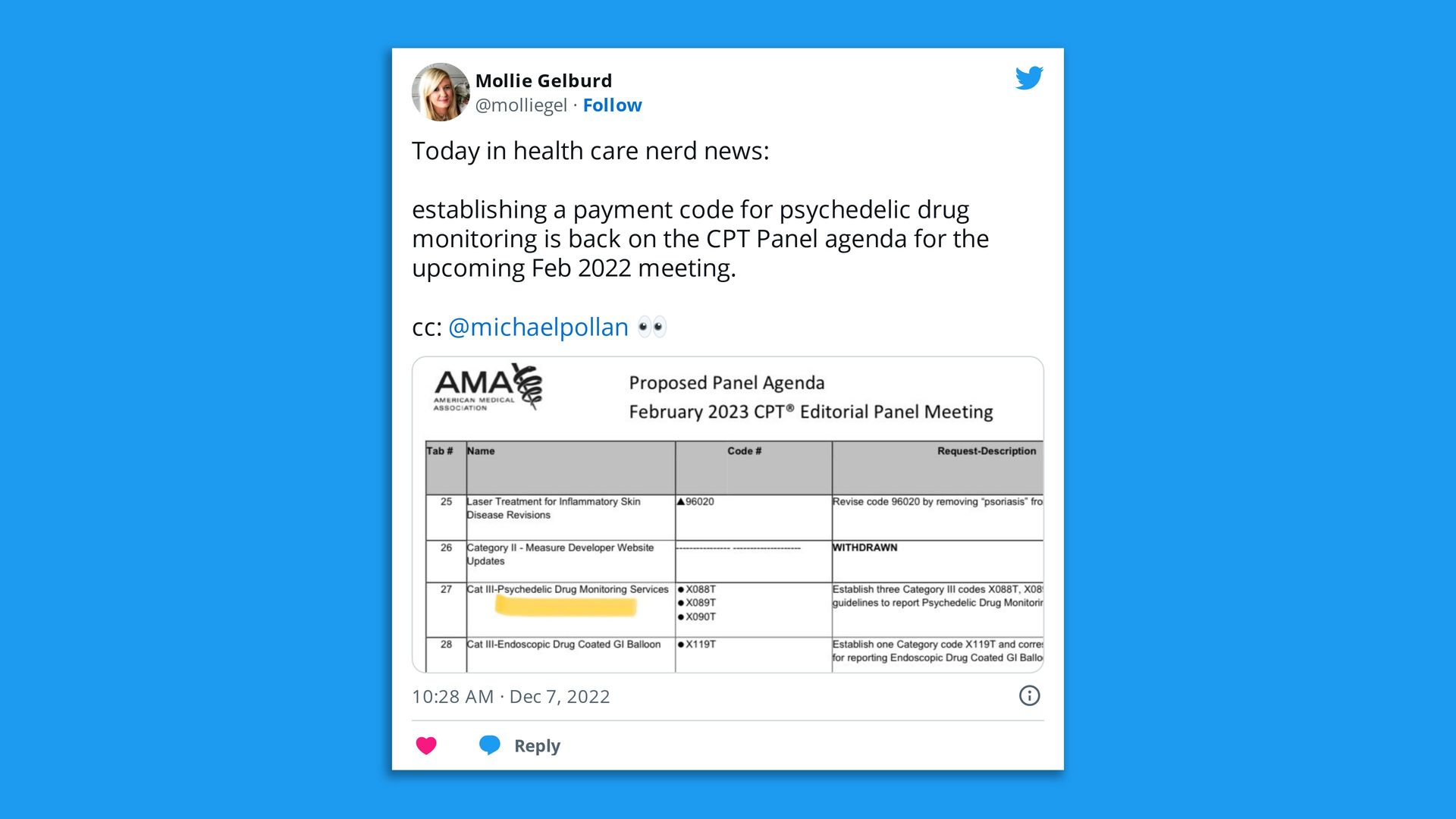
Screenshot: @molliegel (Twitter)
The American Medical Association is eyeing potential medical reimbursement codes for psychedelic drug monitoring services.
Why it matters: Psychedelic treatment has been gaining traction as a potential breakthrough in the behavioral health space and even getting interest as a potential health benefit.
- Compass Pathways, which has been testing psilocybin therapy, as well as MAPS Public Benefit Corp., which has been testing MDMA, submitted requests for a current procedural terminology, STAT reported.
- Those codes allow providers to bill for insurers for their services.
5. Catch up quick
👉 A GOP hill veteran with MS is launching a patient advocacy group. (Axios Pro)
💊 Speedier drug approvals have hit a slowdown as the FDA faces scrutiny. (Associated Press)
👀 Lasik patients should be warned of complications, an FDA draft says. (New York Times)
🧫 A new treatment could help patients with advanced melanoma. (NBC News)
🏛 In the wake of the sentencing of Theranos founder Elizabeth Holmes and now company executive Ramesh "Sunny" Balwani, Congress is negotiating a measure to close the regulatory loophole they benefited from. (STAT)
👋 Thanks for reading, and thanks to senior editor Adriel Bettelheim and senior copy editor Bryan McBournie for the edits. Did someone forward this email to you? Here's how to sign up.
Sign up for Axios Vitals

Healthcare policy and business analysis from Tina Reed, Maya Goldman, and Caitlin Owens.