
Axios Vitals

June 03, 2021
Thanks for reading Axios Vitals! Please ask your friends and colleagues to subscribe.
- In case you're not completely sick of cicada news, here's some more news about how cicadas can make you sick. Can we all just agree not to eat these bugs, already?
Today's word count 905 words, or a 3-minute read.
1 big thing: Coronavirus cases are at their lowest point


The U.S. has brought new coronavirus infections down to the lowest level since March 2020, when the pandemic began, Axios' Sam Baker and Andrew Witherspoon report.
The big picture: Nearly every week for the past 56 weeks, Axios has tracked the change — more often than not, the increase — in new COVID-19 infections. Those case counts are now so low, the virus is so well contained, that this will be our final weekly map.
By the numbers: The U.S. averaged roughly 16,500 new cases per day over the past week, a 30% improvement over the week before. New cases declined in 43 states and held steady in the other seven.
- The official case counts haven't been this low since Americans went into lockdown in March last year — when the pandemic was still new, no one knew how long this would go on, and inadequate testing meant that cases were undercounted.
Overall, roughly 33 million Americans — about 10% of the population — have tested positive for COVID-19.
- About 595,000 people have died from the virus in the U.S., making it deadlier for Americans than the past 80 years of wars and other armed military conflicts combined, including World War II.
The U.S. largely failed to contain the virus until the vaccines arrived.
But now, the virus really is under control, nationwide and in every state, thanks almost entirely to the vaccines. Just over half of American adults are now fully vaccinated, according to the CDC.
The bottom line: The vaccines work. They’ve brought cases to their lowest point yet, and because that improvement is the result of vaccines, there's no reason to believe the virus will start gaining significant ground again any time soon.
2. Reaching for "home run" in AIDS research
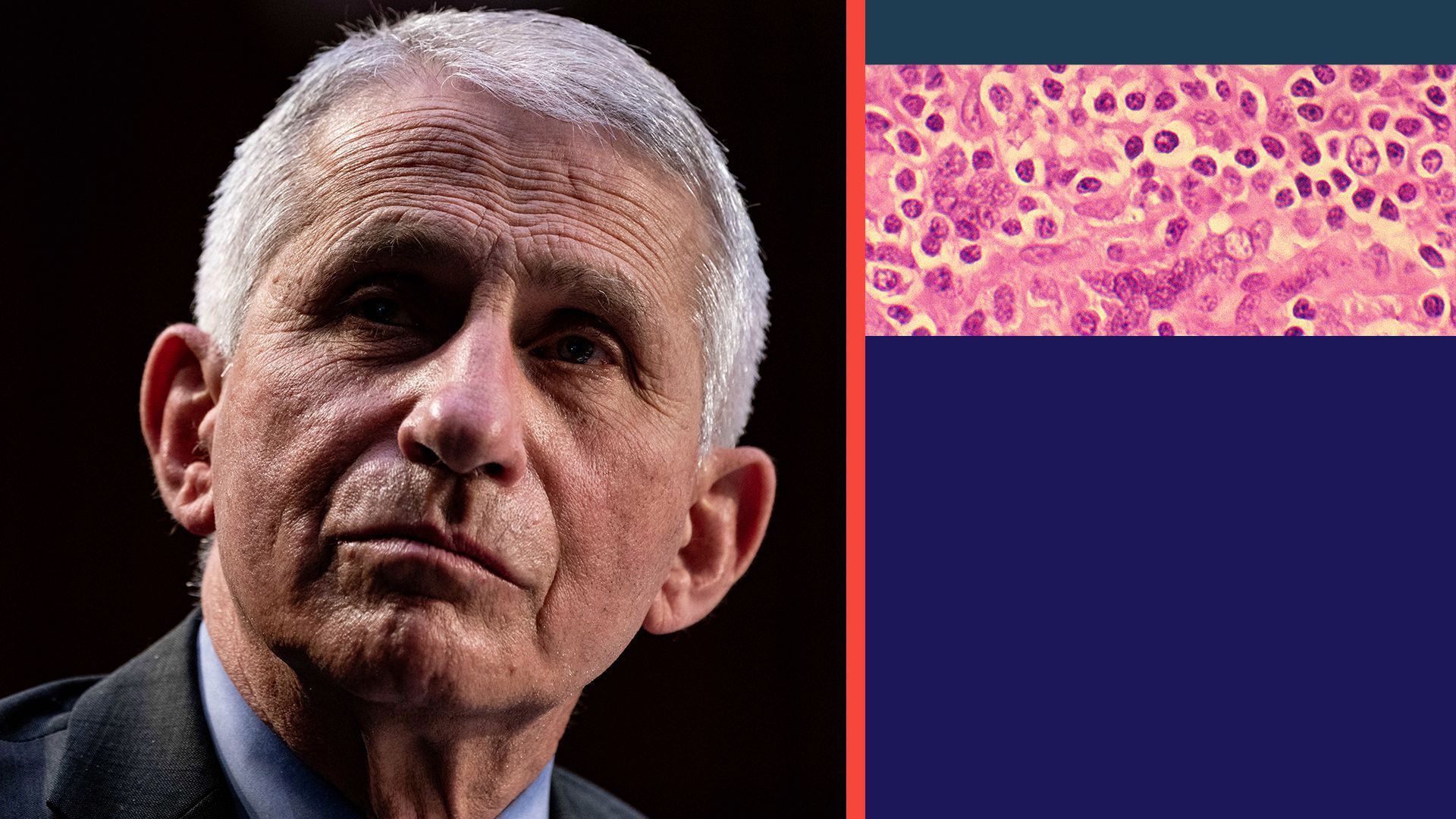
Photo illustration: Shoshana Gordon/Axios. Photos: Edwin P. Ewing, Jr./CDC, Anna Moneymaker-Pool/Getty Images
NIAID director Anthony Fauci aims to curb another epidemic: 40 years of HIV, a virus that has remained elusive to a vaccine, Axios' Eileen Drage O'Reilly writes.
Why it matters: About 1.2 million people in America are living with HIV, but Fauci tells Axios the goal of ending the AIDS epidemic by 2030 may be achievable.
Flashback: A good portion of Fauci's career has been directed at tackling the global AIDS epidemic, which appeared as a mysterious illness in June 1981.
- "I'm probably one of the few individuals who was there from the very first day that we realized we were dealing with a new disease," Fauci tells Axios. He says he remembers "very, very clearly" hearing about an unusual pneumonia found in five young gay men who had unusually low white blood cells called CD4.
- "That began a 40-year journey that I'm still on, because even though it's been sidetracked a fair amount by COVID-19, HIV/AIDS is still one of the most important things."
What's next: A vaccine for HIV remains elusive. But, "we may get a home run," Fauci said. "It may not necessarily be with a highly effective vaccine. It may be with a combination of things."
3. White House launches vaccine sprint
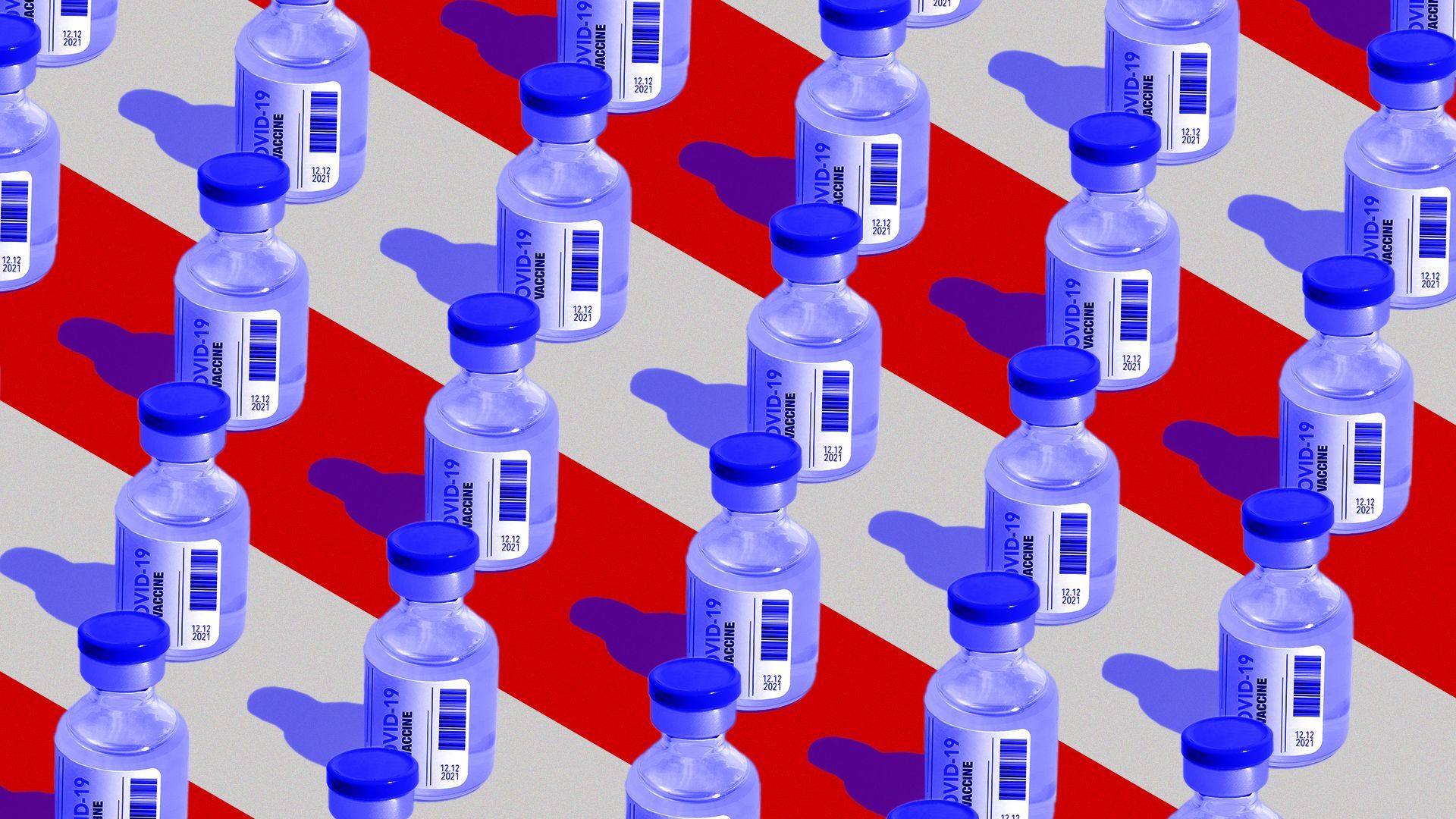
Illustration: Rae Cook/Axios
The White House on Wednesday announced a series of initiatives — with an array of partners including Black-owned barbershops, child care providers and colleges — to boost the nation's slowing COVID-19 vaccination rates.
The big picture: It's "an all-of-America sprint" to meet President Biden's goal of getting 70% of U.S. adults at least one vaccine dose, and 160 million people fully vaccinated, by the Fourth of July, Axios' Oriana Gonzalez writes.
What to watch: The initiative will focus on making vaccines more easily accessible, increasing education efforts around the vaccine and incentivizing vaccinations. That includes:
- Partnering with child care providers to give free services for parents and caregivers who wish to get vaccinated and extending pharmacy hours every Friday night in June.
- Creating competition between cities and teaming up with Black-owned barbershops and beauty salons to increase vaccine education in the "Shots at the Shop" initiative.
- Working with employers to set up vaccination clinics in workplaces.
4. NFL pledges to halt "race-norming"
Photo: Robin Alam/Icon Sportswire via Getty Images
The NFL on Wednesday pledged to halt its decades-old use of "race-norming" — a practice that assumes Black players have a lower baseline level of cognition — in its near-billion-dollar concussion settlement, AP reports.
Why it matters: The use of "race-norming" meant that Black players had to show a larger cognitive decline to qualify for the settlement. The NFL said Wednesday that it will also review previous scores for potential race bias, Axios' Shawna Chen writes.
- The announcement comes after two Black players filed a civil rights lawsuit and a group of NFL families filed 50,000 petitions at the federal courthouse in Philadelphia, per AP.
Catch up quick: In 2013, the NFL agreed to a $765 million settlement after facing a flood of lawsuits from retired players who alleged the league concealed what it knew about the dangers of repeated head trauma.
5. Catch up quick
The resting place of Robert Thomas Chick at Fort Smith National Cemetery in Fort Smith, Ark. Chick had lung cancer that was misdiagnosed by pathologist Robert Morris Levy at Veterans Health Care Center of the Ozarks. Photo: Bonnie Jo Mount/The Washington Post via Getty Images
- A federal watchdog found Veterans Affairs leaders in Arkansas had a pattern of oversight failures and lax quality standards which allowed a pathologist who was "routinely drunk on the job to misdiagnose thousands of veterans," Washington Post reports.
- The planned merger between Virginia-based health system Sentara and Cone Health, a hospital system based in North Carolina, was called off Wednesday, Triad Business Journal writes.
- California lawmakers are considering legislation to offer $10,000 in "hero pay" to health care workers in the state in 2022 to recognize their work during the pandemic — and potentially entice many to stay in their jobs, Los Angeles Times reports. Perhaps unsurprisingly, it has already hit pushback from some employers and business groups.
Sign up for Axios Vitals

Healthcare policy and business analysis from Tina Reed, Maya Goldman, and Caitlin Owens.