
Axios Twin Cities

January 20, 2026

Welcome back. Hope you're staying warm.
- There's a chance for light snow tonight, with a high of 13, NWS says.
🌻 Help keep local journalism thriving by becoming an Axios Twin Cities member today.
Today's newsletter is 1,213 words — a 4.5-minute read.
1 big thing: Billions at stake for MN
Billions of dollars in federal funding remain in limbo as Minnesota and the Trump administration tangle over fraud, immigration enforcement and other policies.
Why it matters: A recent onslaught of proposed payment freezes threatens to disrupt crucial services for Minnesotans — and strain the state budget.
The big picture: Since late November, Trump officials have issued dozens of letters and social posts outlining probes, data requests and funding pauses in response to concerns about widespread fraud in state programs.
- Last week, the president said he'll deny payments starting Feb. 1 to states that are home to cities with "sanctuary" policies that complicate his illegal immigration crackdown.
Threat level: While similarly sweeping attempts to halt spending have been stopped by the courts, state budget officials say the move could have devastating effects.
- That's because one in three dollars Minnesota spends comes from Washington.
- Schools, transportation projects, housing and health care all rely heavily on federal government aid.
Driving the news: Minnesota's Department of Human Services announced last week that it's appealing a separate Centers for Medicare and Medicaid Services (CMS) decision to withhold payments 14 Medicaid programs deemed at "high-risk" for fraud.
Zoom in: Federal officials say they plan to "defer payments" for those health and social services benefits until they can determine which reimbursement requests are "legitimate."
- While it remained unclear last week when that pause could start or how long it could last, state officials say a full, prolonged freeze could cost the state $2 billion annually.
Friction point: CMS administrator Mehmet Oz recently called Minnesota's proposed plan for tackling fraud "deeply insufficient," arguing it's short on "urgency" and enforceable timelines.
- Minnesota Medicaid director John Connolly pushed back on that claim, pointing out that the state already agreed to CMS' request to pause new provider enrollments.
Zoom out: Billions of dollars for child care and grocery assistance for low-income families nationwide have also been caught up in the political and legal tug-of-war between the Trump administration and Democratic-led states.
Reality check: Several of the proposed funding pauses — including those targeting child care and SNAP — have already been blocked by the courts for now.
Still, state officials, providers and people who rely on these services say the threats are causing confusion and uncertainty.
2. Tension still high as ICE surge continues
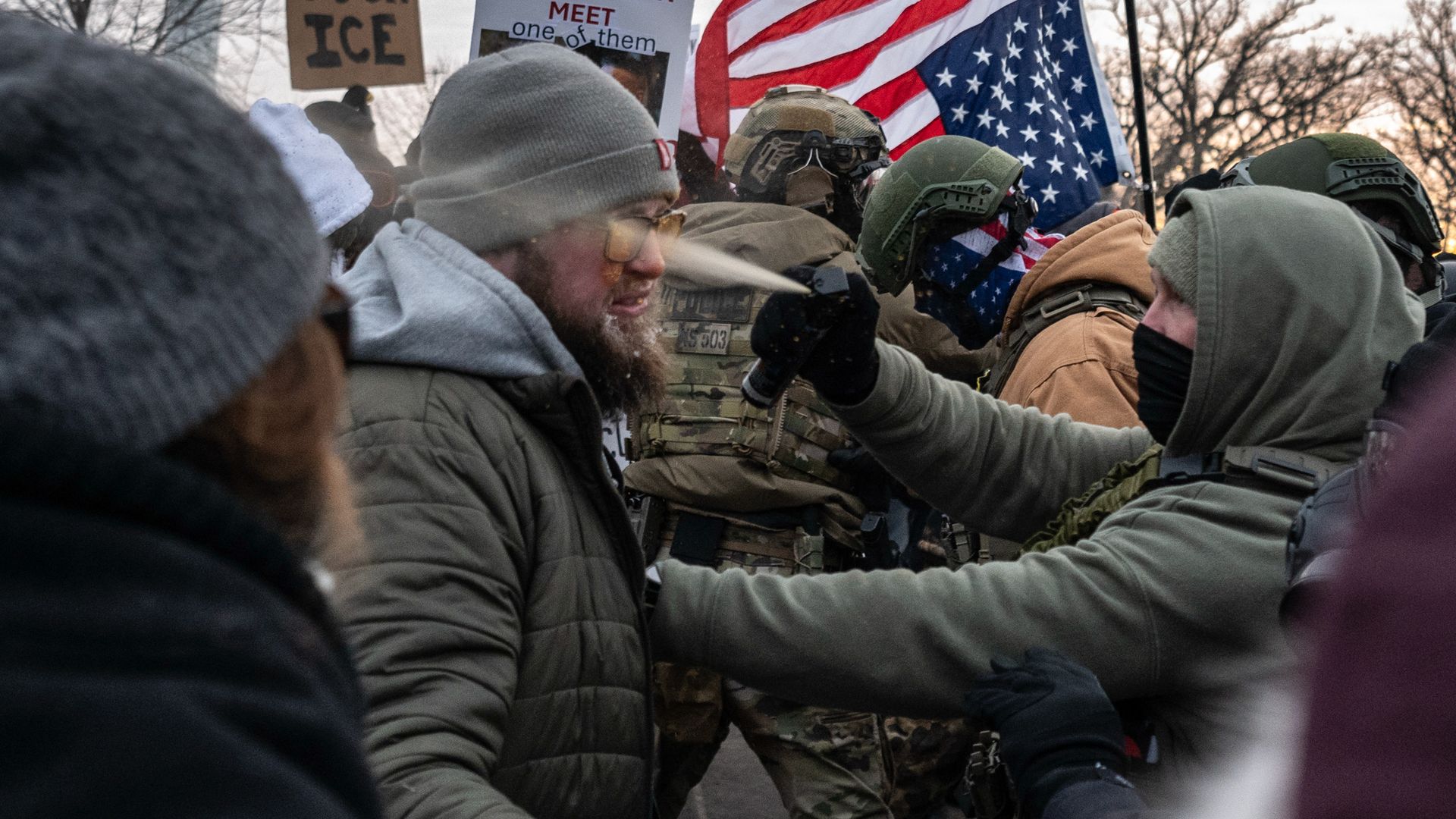
A long weekend of protests, counter protests, church disruption and more clashes has kept Minnesota on high anxiety.
The latest: The U.S. Department of Justice filed notice yesterday to appeal a federal court order handed down on Friday for ICE agents to stop retaliating against peaceful protesters and observers in Minnesota.
Despite the Friday night court order, observers continue to record videos of federal agents pepper spraying protesters and using questionable tactics.
- The family of a 57-year-old Hmong American man has filed a complaint after federal agents took him from his St. Paul home out into the cold, wearing only Crocs, boxers and a blanket, according to the Star Tribune.
- They say he was driven around for nearly an hour, only to be dropped off back at home without an explanation or apology. The family says he's a U.S. citizen, and the Star Tribune reported he has no criminal history in Minnesota.
Here's what else happened:
Attorney General Pam Bondi said the Justice Department is investigating a protest at Cities Church in St. Paul, where activists with the Racial Justice Network disrupted the service over one of the pastors who they said works for ICE.
- Bondi said the protest is a potential violation of the Freedom of Access to Clinic Entrances (FACE) Act, per ABC News.
The Justice Department is also investigating Gov. Tim Walz and Minneapolis Mayor Jacob Frey over possible obstruction of federal law enforcement.
- Walz said President Trump is weaponizing the justice system against his political opponents and criticized the administration for not investigating the federal agent who shot Renee Good nearly two weeks ago.
Deputy Attorney Todd Blanche confirmed to Fox News on Sunday there will be no federal investigation of the agent, Jonathan Ross.
- Several top prosecutors in the U.S. Attorney's Office in Minneapolis have resigned over the lack of an investigation, including Joe Thompson, the top fraud prosecutor in the state.
Protests and counter protests continued, including an anti-fraud demonstration in which a far-right provocateur and pardoned Jan. 6 rioter was cornered outside Minneapolis City Hall in frigid temperatures and hit by water balloons and water guns.
What we're watching: Trump ordered 1,500 active-duty troops in Alaska to stand by for a potential deployment to Minnesota, according to NPR.
3. The Spoon: More bad news for The Dayton's Project

🏢 The distressed Dayton's Project building in downtown Minneapolis lost its largest tenant, accounting firm EY, which is moving to the U.S. Bancorp Center next door. (Minneapolis/St. Paul Business Journal)
🏀 Anthony Edwards didn't make the cut to start for the Western Conference in the NBA All-Star Game, prompting some claims that the Wolves superstar was snubbed. (ESPN)
Quote du jour
"What I'm hoping is that we get away from the finger-pointing, the brinksmanship, the name-calling, the dehumanization of people — that we look at people and start to treat people like people. ... That's the reason why I want to stay engaged."— State Sen. John Hoffman (DFL-Champlin) who was shot nine times in June, on why he's running for another term, via the Star Tribune
4. Charted: Growth in weed growth


Minnesota is home to around 66,000 cannabis plants that are growing to supply the state's burgeoning recreational marijuana industry.
Why it matters: You can now keep tabs on the industry thanks to a new online dashboard created by the state's Office of Cannabis Management (OCM).
Between the lines: The state began issuing licenses to growers in June, but it wasn't until the fall that a surge of plantings occurred.
- It typically takes several months to get from seed to harvest, so most of those fall plantings are not ready for stores yet, which is why there's a shortage.
By the numbers: Since the first wave of non-tribal dispensaries opened in September, retail sales surpassed $31 million on 466,000 transactions, as of Dec. 31, per OCM.
Yes, but: It's expensive. According to OCM, the median price of a gram is $13.54, which works out to $48 before tax for a typical 3.5-gram container, roughly equivalent to what black market users call an eighth.
5. On this day: Minnesota hostage released by Iranians

After being held hostage in Iran for 444 days, Bruce Laingen, from southern Minnesota's town of Odin, was released on this day in 1981.
Flashback: The St. Olaf alum was the highest ranking American official in the Iran hostage crisis and continued to act as diplomat while in captivity with 51 others.
- He died in 2019 at age 96.
👟 Audrey bought YakTrax just for the Art Sled Rally and still slipped twice.
🎭 Kyle laughed a lot at a production of "Something Rotten" by the Unlabeled Theater Company, which puts on shows by adult actors with disabilities.
🐰 🦊 Torey took her son to "Zootopia 2" — his first movie on the big screen!
🌇 Nick took his kids to the Children's Museum and thinks downtown St. Paul deserves more love for being kid-friendly.
This newsletter was edited by Lindsey Erdody.
Sign up for Axios Twin Cities