Axios Twin Cities

October 20, 2025

Good morning and happy Diwali to those celebrating!
- βοΈ Showers are possible, with a high near 59, per NWS.
π Happy birthday to our Axios Twin Cities members Kate Lohnes and Mark Oyaas!
βοΈProgramming note: We've handed the keyboard over to our colleague Carly Mallenbaum for a special edition marking Breast Cancer Awareness month.
- We'll be back to regular programming tomorrow!
Today's newsletter is 1,041 words, a 4-minute read.
1 big thing: AI and breast cancer screening

For years, patients have had to navigate a maze of conflicting mammogram advice. Now, artificial intelligence could help cut through the noise.
The big picture: By analyzing thousands of mammograms and patient outcomes, new AI tools can help doctors better identify who's at highest risk β and when they should be screened.
What they're saying: "Using AI to develop individualized screening schedules rather than one-size-fits-all recommendations" is where the field is heading, says J. Pierre Sasson, the department chair of radiology at Mount Auburn Hospital and assistant professor of radiology at Harvard Medical School.
Zoom in: Mirai, Transpara, ProFound and Clairity Breast are emerging AI tools that use mammogram images to assess patient cancer risk.
Zoom out: The technology isn't just being applied to detection: University of Minnesota researchers won a $1.2 million federal grant to study whether AI could be used to help limit the risk of serious side effects from related to breast cancer treatment.
- "Complement, inform and augment doctors. That's what I think AI for health care can do," professor Ju Sun told WCCO.
Between the lines: Major health organizations still differ on when women at average risk should get screened.
- American Cancer Society: Annual screening is optional for ages 40β44; recommended for ages 45β54; every 1β2 years for ages 55+.
- American College of Radiology: Annual mammograms starting at 40.
- U.S. Preventive Services Task Force: Mammograms every other year for women ages 40β74.
In addition to mammograms, there are other available screening tests, including ultrasound and CEM, often useful for patients with dense breasts.
The latest: Sasson tells Axios that AI is already integrated into his hospital's workflow. For example, it flags suspicious areas on mammograms.
Yes, but: "The human connection β compassion, reassurance and judgment β is still the heart of medicine," he says.
2. Fertility coverage for cancer survivors

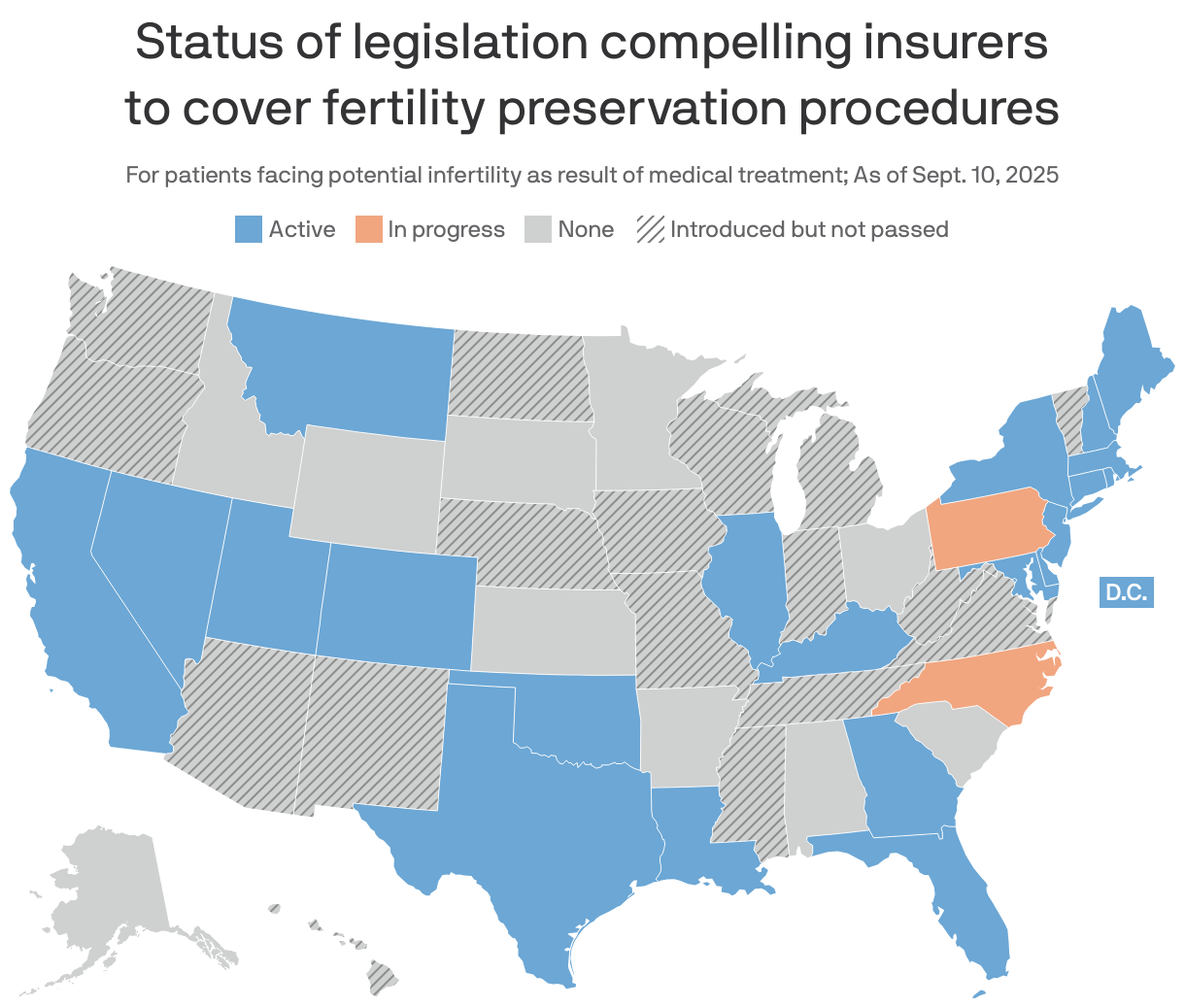
A wave of new state laws is making fertility preservation procedures a covered benefit for cancer patients.
Why it matters: Chemotherapy and radiation can cause reproductive problems, but procedures like egg freezing and emerging technology such as ovarian tissue freezing are costly and can be left out of cancer treatment conversations.
- As more Americans survive cancer at younger ages and delay parenthood, demand increases for these kinds of treatments.
By the numbers: 21 states and Washington, D.C., now require insurers to cover fertility preservation for medical reasons, per the Alliance for Fertility Preservation.
- There was legislative action this year in Georgia, Virginia and New York, and executive director Joyce Reinecke tells Axios she's "hopeful" that laws are passed in Hawaii and Washington next.
The fine print: Coverage rules vary by state, including which insurers must comply, which procedures are included, and which diagnoses qualify patients for coverage.
- "Experimental" procedures, such as uterine displacement and in vitro maturation, are rarely covered by insurance.
Between the lines: Some coverage mandates for private insurers have faced resistance at Minnesota's Legislature in the past, since such requirements also carry costs for the state.
What we're watching: Whether any Minnesota lawmakers introduce measures of their own when the Legislature returns in February.

3. Flat "freedom"
More breast cancer survivors are choosing not to reconstruct their chests after mastectomy and going flat instead.
Why it matters: The shift reflects a cultural change in how survivors define recovery, beauty and body autonomy.
State of play: "In years past, the assumption was you were gonna have a reconstruction," says Mary Gemignani, chief of breast surgery at NYU Langone Perlmutter Cancer Center.
- Now, there's a movement highlighting that it's OK not to have one, and patients increasingly ask for "flat aesthetic closure," she says.
- That's the term β promoted by breast cancer survivor advocacy groups like Not Putting on a Shirt (NPOAS) β for a flat chest with no excess skin after surgery.
The big picture: As celebrities remove implants and dissolve fillers, "there's a trend toward embracing your natural body," says Kim Bowles, president and founder of NPOAS.
- Even in the breast augmentation space, women are choosing smaller breasts.
Zoom in: Bowles, a breast cancer survivor who had a double mastectomy, said reconstruction didn't appeal to her β even though she was a candidate for DIEP flap surgery, which uses belly tissue to build new breasts.
- Going flat allowed her to avoid a major surgery and embrace the "freedom" of being bra-less. (But flat bras are also a thing.)
- When she first asked to go flat, however, her surgeon ignored the request and left extra chest tissue. She now works to prevent what she calls "flat denial" β when surgeons disregard patient preferences.
What we're hearing: Local survivors and doctors say the prospect of undergoing multiple surgeries can also be a factor for patients.
- "Reconstruction is not a boob job," oncologist Michaela Tsai told the Star Tribune in 2020. "Mastectomies are big surgeries and while reconstruction techniques have vastly improved, reconstruction is the hardest part and most painful part."
Become a Newsroom Insider
Knowledge is power, and we believe in empowering our community through reliable, local journalism.
Join our Axios Twin Cities membership with contributions starting at $25 a year, and you can support our efforts to keep you in the know of what's happening around town.
4. Tattoos help breast cancer survivors heal
Fifteen years ago, tattoo artist Amy Black got an unusual request: Could she ink a realistic-looking nipple?
Why it matters: That question came from a breast cancer survivor who'd undergone reconstruction. The answer was yes, and the results were life-changing β both for the client who loved the tattoo and also for Black.
- She built a new specialty in mastectomy tattoos.
What we're watching: Black's mastectomy ink "used to be 90% nipple tattoos," but now she sees an increasing number of survivor requests for decorative art, often on flat chests.
π A directory maintained by the group Personal Ink (P.ink) lists over two dozen vetted Twin Cities artists with experience in mastectomy and scar tissue tattooing.
βοΈKyle spent Saturday night playing a deeply-involved, hours-long board game and, no, he doesn't regret it.
πΊ Torey is glad "The Diplomat" is back.
π Audrey can confirm the fall colors on the drive to Madison are absolutely stunning
πΊ Nick is on vacation. We hope he's at a pub!
This newsletter was edited by Ashley May.
Editor's note: This newsletter was updated to show Michaela Tsai is no longer based in Minneapolis.
Sign up for Axios Twin Cities