Axios from Tel Aviv
November 24, 2021

Welcome back to Axios from Tel Aviv.
- I hope our American readers have a great Thanksgiving and our Jewish readers have a very happy Hanukkah.
- We'll be off next week and will return Dec. 8.
- Today's edition is 1,642 words (6 minutes).
New arrival? Subscribe.
1 big thing: Scoop... Saudis tried to stop UAE-Israel-Jordan solar deal
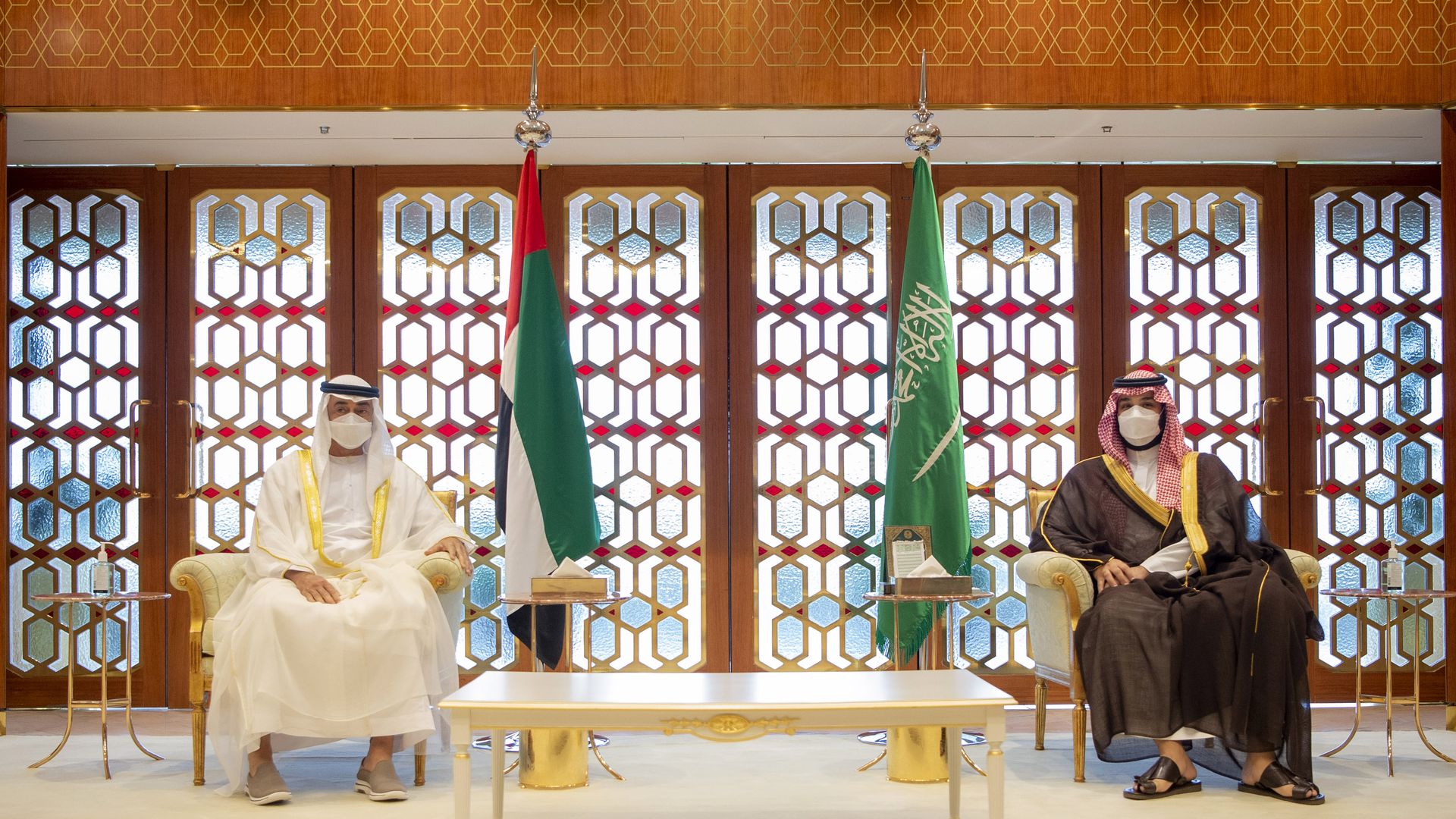
The crown princes of the UAE (left) and Saudi Arabia. Photo: Saudi handout via Getty
The Saudi government pressured the United Arab Emirates to back off a major solar energy deal with Israel and Jordan, two senior Israeli officials with direct knowledge and another source briefed on the matter tell me.
Why it matters: The agreement signed on Monday and helped across the finish line by U.S. climate envoy John Kerry is the biggest renewable energy project in the region. It will see the UAE build a massive solar farm in Jordan to supply electricity to Israel, and Israel in turn will build a desalination plant to provide water to Jordan.
- The Saudis were caught by surprise when Axios broke the news of the forthcoming deal last Wednesday, the Israeli officials say.
- All three sources say Saudi officials were upset because they felt the deal undermined Crown Prince Mohammed bin Salman's plans to lead the region on climate through his "Green Middle East" vision.
- Between the lines: The UAE and Israel were able to negotiate the deal due to the Abraham Accords, but the Saudis don't have diplomatic relations with Israel and were therefore were left out.
Behind the scenes: Senior Saudi officials called their Emirati counterparts to protest and push them to back off the deal. They even proposed an alternative Saudi-UAE-Jordan deal that would sideline Israel, a source briefed on the conversations tells me.
- The Emiratis notified Kerry and their Israeli and Jordanian counterparts of the Saudi pressure and asked for cosmetic changes to the language of the agreement to appease the Saudis. The other parties didn’t object.
- The signing of the agreement was delayed for several hours on Monday due to the Saudi intervention, the Israeli officials say. It was finally signed on Monday afternoon, with Kerry in attendance.
What they're saying: Four senior Israeli officials with direct involvement in the deal declined to comment on the record due to the sensitivity of the issue. Emirati officials also declined to comment. The Saudi Embassy in Washington hadn't provided a comment by the time of publication.
2. UN nuclear chief leaves Iran empty-handed ahead of Vienna talks
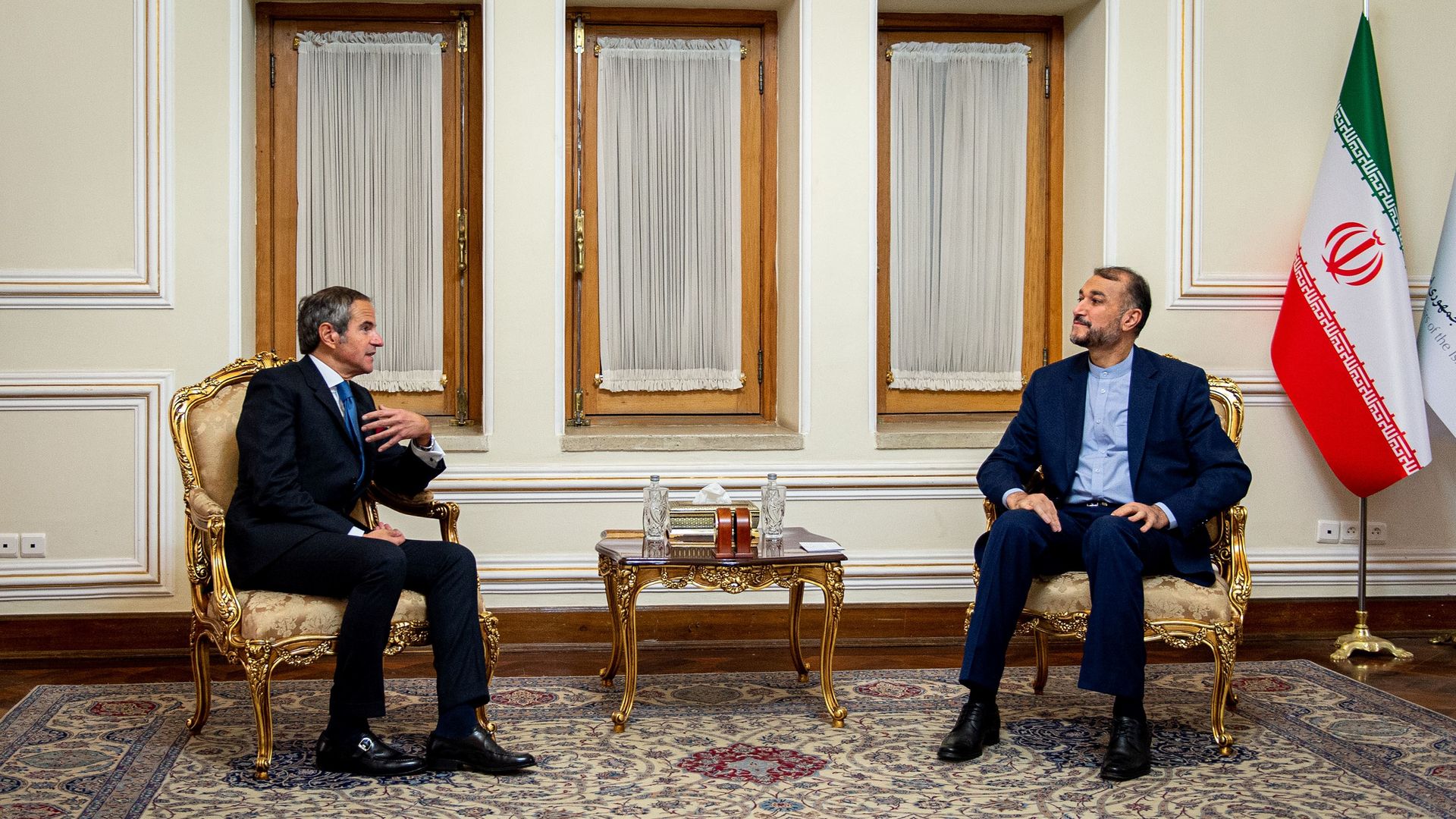
IAEA chief Rafael Grossi (left) meets with Iranian Foreign Minister Hossein Amir-Abdollahian. Photo: Xinhua via Getty
A visit to Tehran by the head of the UN’s nuclear watchdog ahead of renewed nuclear talks in Vienna ended without any agreement on resuming inspections in key nuclear sites in Iran.
Driving the news: At a press conference in Vienna on Wednesday, International Atomic Energy Agency (IAEA) director general Raphael Grossi said the talks had “proved inconclusive” and warned, “We are getting closer to the point where I can’t promise that we have continuity of knowledge about Iran’s nuclear program.”
- The Iranians delayed the visit until the day before the IAEA board convenes to discuss Iran’s violations and several days before the Vienna talks resume.
- Grossi met with Iran’s foreign minister and the head of the Iranian Atomic Energy Organization and was seeking an agreement to reinstate several verification measures and reinstall cameras at the Karaj centrifuge production facility. Grossi said the Iranians rejected those requests.
What’s next: Iranian negotiators will sit down once again on Nov. 29 with representatives of Russia, China, France, Germany, the U.K. and the EU.
- U.S. Iran envoy Rob Malley and his team will be in Vienna but will communicate with the Iranians indirectly through European mediators.
- U.S. officials say they’re very skeptical about the prospects of progress in the upcoming round of talks and expect Iran to arrive with maximalist positions. The talks may only last a day or two, after which the diplomats will return to their capitals for further consultations.
3. Interview: What an Israel-Bahrain alliance means for Iran
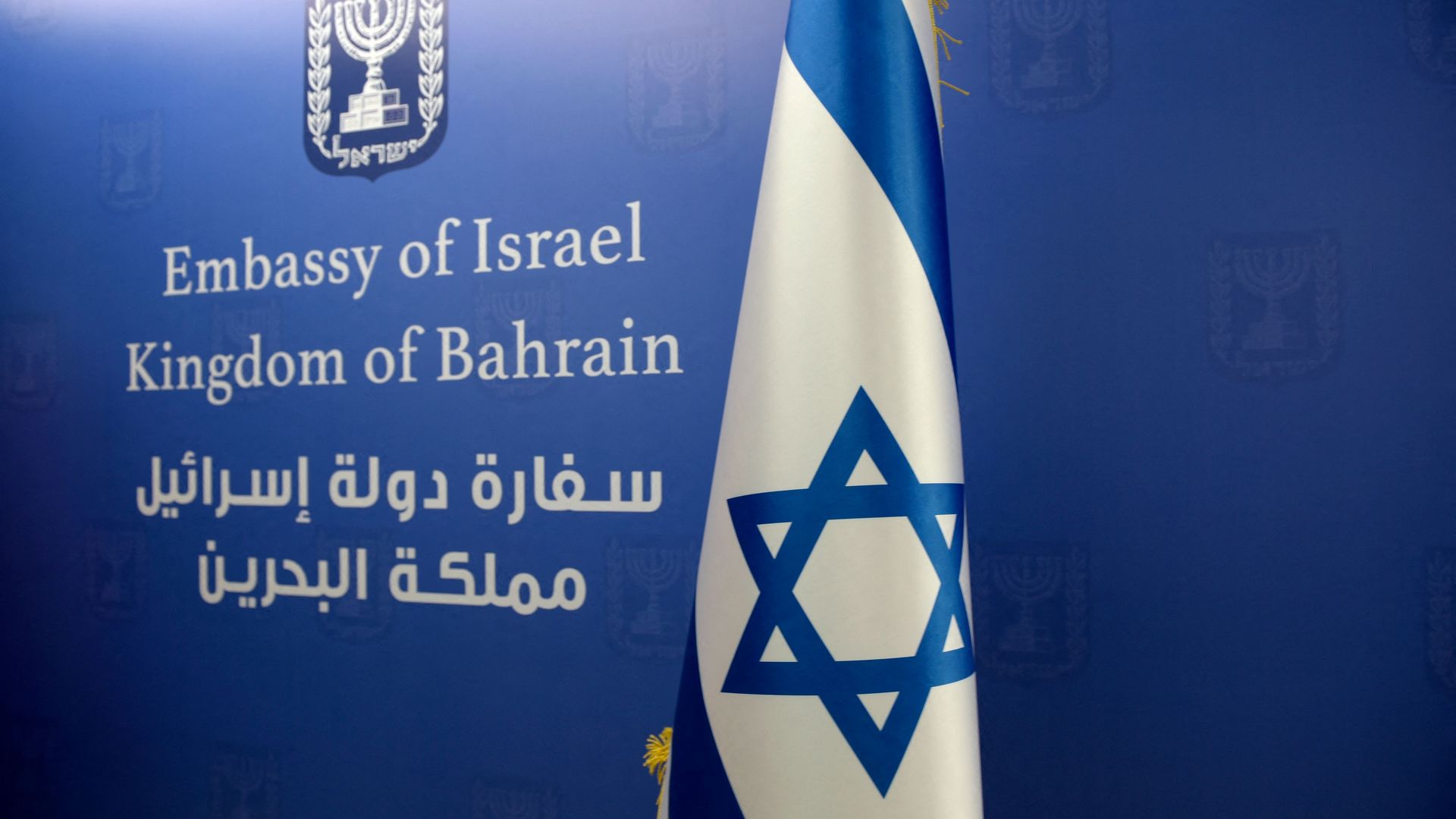
Photo: Mazen Mahdi AFP via Getty
MANAMA, Bahrain — The diplomat who transitioned Israel's secret relationship with Bahrain into a public one tells Axios that Israel's burgeoning partnerships in the region "keep the Iranians up at night."
What he's saying: "The Iranians opened a front against us in Syria and Lebanon, but now when they look across the Gulf, they see us there with our allies very close to them," says Itay Tagner, the outgoing head of mission at the new Israeli Embassy in Bahrain who previously led the secret Israeli diplomatic mission in Manama.
- Since the Abraham Accords, the countries have focused primarily on economic cooperation, but the Bahrainis have made clear they “will not shy away” from coordinating on Iran, Tagner told me when we met on Friday on the sidelines of the Manama Dialogue, a security forum focused largely on Iran.
- Relations with Israel are part of Bahrain's security strategy due to the threat from Tehran, Tagner says.
- “When we speak about Iran, the Bahrainis know what we are talking about. Iran is 90 miles away. There are Iranian drones that are flying above their heads on the way to attack Saudi Arabia," he said.
One clear signal came in August when the undersecretary of the Bahraini Foreign Ministry, Abdullah bin Ahmad Al Khalifa, visited Israel and released a photo from a meeting with the Israeli general in charge of operations against Iran.
- “A picture is worth a thousand words, but Sheikh Abdulla personally approved the press release that accompanied the photo and stressed that both countries agreed to enhance security cooperation," Tagner tells me.
- When I met Sheikh Abdullah on Friday, he told me Bahrain had put forward a comprehensive strategy for “warm peace” with Israel in all dimensions of the relationship.
Flashback: Tagner recalled watching the signing ceremony of the Abraham Accords alongside a Bahraini friend who had just paid $250,000 to book a seat on a flight to space in 2024.
- “He told me that until a few weeks before, he was sure he would be able to travel to space before he ever traveled to Israel. This tells you all you need to know about what happened here in the last year," Tagner said.
What's next: Tagner leaves Bahrain this week after 15 months and will be replaced by Ambassador Eitan Na'eh at the embassy that was inaugurated in September on the 29th floor of the Manama World Trade Center.
4. The view from Manama: Skepticism of U.S. resolve
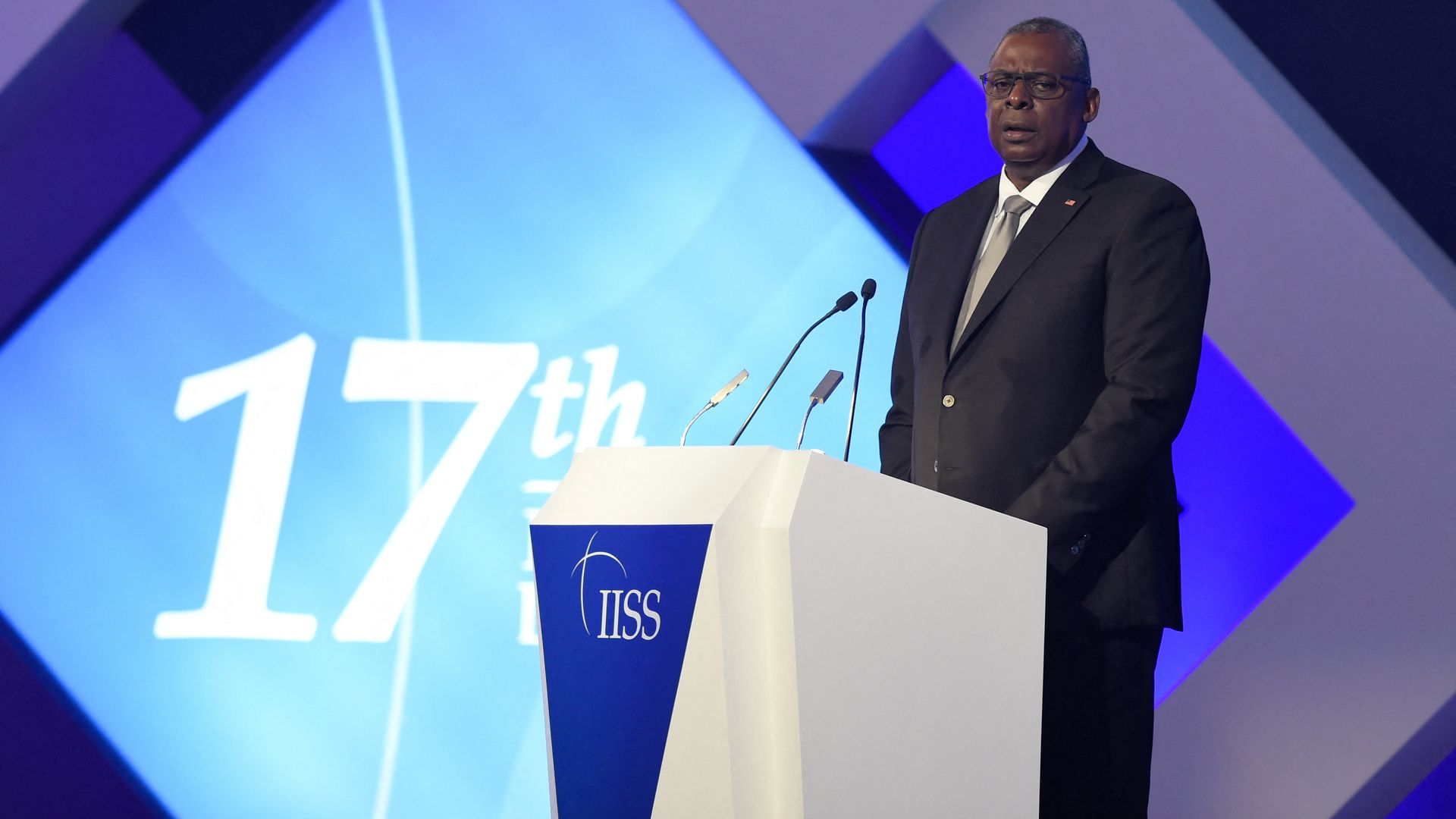
Lloyd Austin addresses the Manama Dialogue. Photo: Mazen Mahdi/AFP via Getty
MANAMA, Bahrain — Secretary of Defense Lloyd Austin was among top U.S. officials who spoke at the Manama Dialogue last weekend about the U.S. commitment to stand up to Iran, but their words were met with skepticism.
Why it matters: In the public sessions and in private conversations, many of the Arab and Israeli participants discussed the perception that the U.S. is leaving the region and not projecting sufficient power to deter Iran.
Driving the news: Austin, Iran envoy Rob Malley and White House Middle East coordinator Brett McGurk sought to dispel that notion, stressing that the U.S. is willing to use other means if diplomacy with Iran fails, and it's not pulling away from the Middle East or abandoning its allies.
- They encountered many interventions from officials, experts and journalists in the audience who questioned the Biden administration’s resolve and credibility.
- One senior U.S. defense official expressed frustration to me that Austin faced several different versions of the same skeptical questions.
What they're saying: The U.S. commitment shouldn't be measured in terms of troop numbers, the Pentagon official contended.
- Instead, the administration is trying to build a new framework based on security cooperation between the countries of the region, the official said.
What’s next: The senior Pentagon official told me there will be more joint military exercises between the U.S., Israel and Arab countries, including on countering drones, which have become the weapon of choice for Iran and its proxies.
- "We want to enhance this security cooperation so that when a need arises, we will know how to work together. Everybody will benefit from this. And yes, in addition to our diplomatic efforts on returning to the nuclear deal, those joint exercises are a way to send a signal to Iran," the Pentagon official said.
5. Israel and Morocco sign defense deal
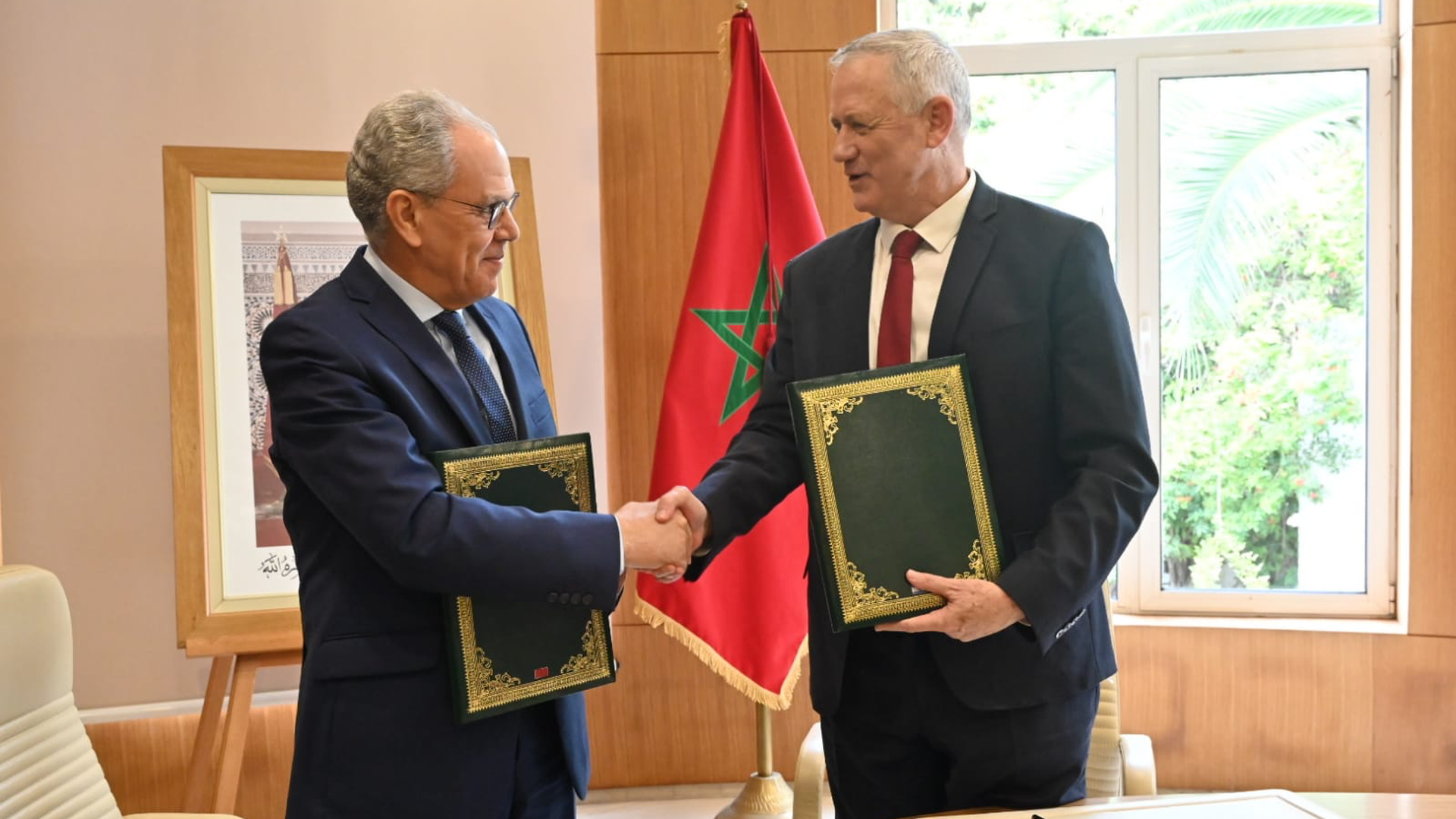
Benny Gantz (right) signs the agreement with Abdellatif Loudiyi. Photo: Ariel Hermony/Israeli Ministry of Defense
Israeli Defense Minister Benny Gantz signed a defense cooperation agreement with Morocco on Wednesday during the first-ever public visit to the country by an Israeli defense minister.
Why it matters: Israel and Morocco had a secret defense, security and intelligence relationship for decades, but after establishing diplomatic relations, the countries are making it broader and more public.
- A senior Israeli official tells me the Moroccans wanted to give Gantz’s visit a very high public profile to send a signal both to the U.S. and to Algeria.
- The Biden administration has thus far signaled it has no intention of rolling back the dramatic step made by former President Donald Trump to secure the Israel-Morocco normalization deal: recognition of Moroccan sovereignty over the disputed Western Sahara.
- But tensions are rising over that issue between Morocco and Algeria, which backs the Polisario Front that is fighting for an independent Western Sahara.
State of play: Relations between the North African rivals have gone from bad to worse since Algeria cut diplomatic ties with Morocco last August over alleged "hostile actions" from Rabat.
- In early November, Algeria blamed Morocco for an airstrike on a truck convoy that traveled from Mauritania to Algeria through an area of Western Sahara controlled by the Polisario rebels. Three Algerians were killed.
Driving the news: Gantz landed in Morocco on Tuesday night. In addition to signing the defense agreement alongside his counterpart Abdellatif Loudiyi, he visited a paratrooper unit and met with senior Moroccan defense and intelligence officials, including the military chief of staff.
- Gantz also met with Moroccan Foreign Minister Nasser Bourita, who arrived back in Morocco on Wednesday after a visit to Washington in which he met with Secretary of State Tony Blinken.
- State Department spokesperson Ned Price said Blinken and Bourita expressed strong support for the new UN envoy for Western Sahara and that Blinken considered Morocco's autonomy plan for the territory as "serious, credible and realistic."
What they're saying: While the Moroccans wanted to send signals to the U.S. and Algeria, "our message in this visit is strengthening the Abraham Accords and building a unified front in the region against Iran," the senior Israeli official said.
What to watch: The new defense cooperation agreement is expected to increase arms sales from Israel to Morocco. Israeli officials say they will focus mainly on defensive systems.