Axios Sneak Peek

April 09, 2023

Josh Kraushaar here. Thanks for joining Sunday Sneak Peek, our weekly look ahead at the forces shaping American politics.
- Smart Brevity™ count: 1,482 words ... 5½ minutes.
1 big thing: GOP's stormy 2024 outlook
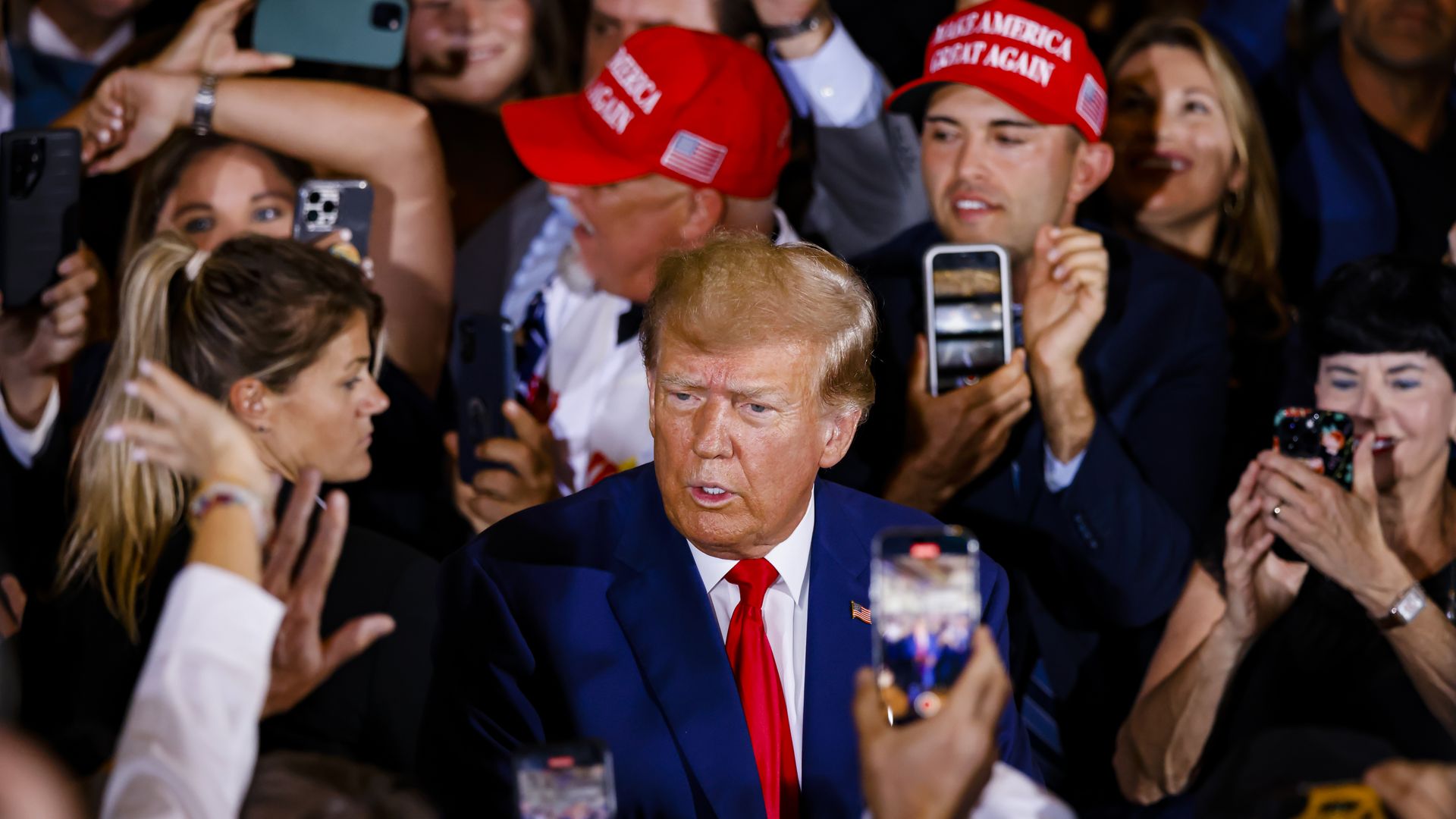
Photo: Eva Marie Uzcategui/Bloomberg via Getty Images
This week marked a low point for Republicans as they prepare for the 2024 elections:
- Former President Trump is once again the dominant force in the party, which is showing little indication of trying to appeal to swing voters.
Why it matters: By aligning with Trump's grievances and promoting tougher abortion restrictions, it's increasingly difficult for the GOP to win outside of deep-red strongholds.
Driving the news: Every potential Republican challenger to Trump (with the exception of former Govs. Asa Hutchinson and Chris Christie) has adopted the MAGA narrative that Trump is being treated unfairly by a politicized justice system — even when it's in their interest to criticize the GOP frontrunner.
- Trump won three new congressional endorsements after he was indicted — from Sen. Cindy Hyde-Smith (R-Miss.), Rep. Byron Donalds (R-Fla.) and Rep. Jim Banks (R-Ind.), who's running for a U.S. Senate seat.
- Rep. Marjorie Taylor Greene (R-Ga.), one of the leaders of the MAGA movement in Congress, was featured on "60 Minutes" as one of her party's leading power players.
Zoom in: On the same day as Trump's arraignment, voters in swing-state Wisconsin decisively rejected a right-wing judicial candidate in favor of a progressive one.
- The election was fought predominantly over abortion rights, as Republicans continue to push for restrictions beyond what the public supports.
- In the run-up to his likely presidential campaign, Florida Gov. Ron DeSantis — the leading Trump alternative in the GOP — is expected to sign a six-week abortion ban that just passed Florida's Senate.
- The Cook Political Report's David Wasserman noted that Democratic gains in pivotal swing states — namely Michigan, Wisconsin and Pennsylvania — have been driven by an uptick in support from white working-class voters over abortion rights.
Between the lines: To hold Republicans' narrow House majority, Speaker Kevin McCarthy will need to hang on to suburban districts where voters are open to backing Republicans but have grown tired of extreme politics.
- Of the 33 GOP-held seats that the DCCC announced as top targets, two-thirds are in urban and suburban areas. President Biden carried 18 of those 33 House districts in 2020.
- The GOP's path to a Senate majority runs through redder turf, but some Republicans already are concerned that far-right candidates (such as Rep. Matt Rosendale in Montana or Rep. Alex Mooney in West Virginia) could hurt the GOP's prospects against vulnerable Democratic incumbents.
The bottom line: We're a deeply divided and polarized country, split closely between left and right.
- But Trump's legal predicament combined with the GOP's exposure on abortion is giving the Democrats a small but important advantage heading into a pivotal election year.
- Biden holds historically low approval ratings himself. Democrats are vulnerable on the economy, crime and immigration. But they have shown an ability to moderate when necessary.
- Until Republican voters show they're capable of doing the same, Democrats will hold the edge in 2024.
2. 💰 First big fundraising test
Illustration: Shoshana Gordon/Axios
The first fundraising quarter for presidential and congressional candidates, which ended March 31, provides many clues about the trajectory of pivotal campaigns.
Why it matters: Reports are due April 15, but many of the top fundraisers already have released their numbers for bragging rights.
Driving the news: Former UN Ambassador Nikki Haley announced she raised $11 million in the six weeks after announcing her campaign — a solid total that positions her as a credible alternative to Trump and DeSantis (if he runs).
- Haley ended March with $7.8 million cash on hand, according to her campaign.
- Her fundraising compares favorably to the top GOP candidates in 2015: Jeb Bush raised $11.4 million in his first fundraising quarter, Marco Rubio raised $12 million in his first two quarters, and Ted Cruz brought in $10 million in his first full quarter.
- Trump's campaign hasn't yet released its full fundraising for the quarter but announced that it's raised more than $12 million since his indictment. (About $4 million came before the first quarter fundraising deadline.)
What we're watching: The wave of congressional fundraising reports will also separate the fundraising dynamos from the stragglers.
- Is Sen. Joe Manchin (D-W.V.) raising money as if he's preparing for a tough re-election or presidential campaign, or is his fundraising tapering off in anticipation of retirement?
- Are there any other senators slowing down their fundraising and looking for the exits? We'll be looking closely at the reports from Sens. Mitt Romney (R-Utah) and Ben Cardin (D-Md.).
- How much cash are the vulnerable freshman Republicans in Biden districts pulling in?
Go deeper: Several Democratic members of the House looking for a promotion raised huge amounts of money in preparation for their Senate races.
- Rep. Adam Schiff (D-Calif.) announced he raised $6.5 million in the first three months of his California Senate campaign — the highest total any Democratic Senate candidate has ever raised in the first quarter.
- That outpaces Rep. Katie Porter (D-Calif.), a progressive favorite, who brought in $4.5 million. Rep. Barbara Lee (D-Calif.), the third lawmaker in the race, brought in $1.4 million.
- Rep. Elissa Slotkin (D-Mich.) brought in $3 million for the quarter, showcasing her fundraising prowess as the clear frontrunner to succeed retiring Sen. Debbie Stabenow (D-Mich.).
3. 🏙️ Politics of crime in blue cities
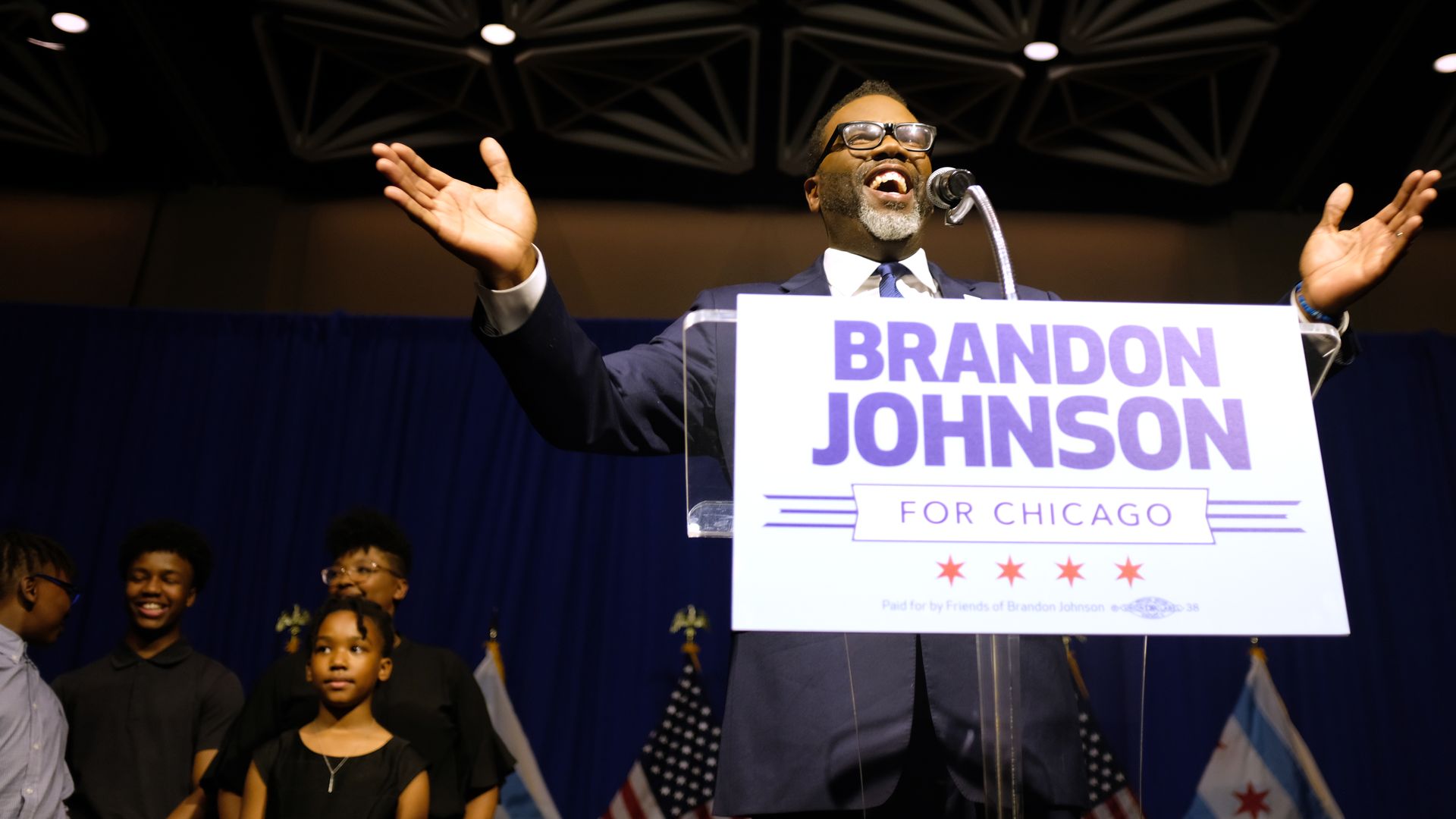
Photo: Alex Wroblewski/Getty Images
The biggest reason for progressive Chicago Mayor-elect Brandon Johnson's come-from-behind victory over moderate Paul Vallas: Black voters living in high-crime parts of the city overwhelmingly rejected Vallas, who ran on a tough-on-crime message.
- Crime was by far the top issue in the race, according to pre-election polling. Vallas, who is white, called for hiring more police officers to stem the crime wave, while Johnson campaigned on alternatives to policing.
Why it matters: Having a shared identity is a powerful pull in politics, sometimes more than policy preferences. Black voters backed Mayor Lori Lightfoot in the first round of balloting and mostly shifted to Johnson in the runoff, for which Lightfoot didn't qualify.
- Johnson, who is African American, won about 80% of the vote in majority-Black wards in Chicago's South and West sides.
- Johnson was able to combine strong Black support with a political base in the mostly white, affluent communities along Chicago's lakefront.
- “He has the support of the progressive North Siders and the Black wards on the South Side, which is the most enduring coalition in Chicago politics," Chicago-based Democratic strategist Tom Bowen told the New York Times.
Zoom in: White mayoral candidates running tough-on-crime platforms have struggled against Black opponents in recent elections in Los Angeles and now Chicago.
- But African American candidates talking tough on crime have defeated more liberal challengers. New York City Mayor Eric Adams surged to victory in 2021 by touting a crackdown on crime as his top issue.
- In last year's Washington, D.C., mayoral primary, Mayor Muriel Bowser easily fended off challengers running to her left on criminal justice issues.
- And in San Francisco, progressive prosecutor Chesa Boudin, who is white, was recalled by 55% of voters and replaced with Brooke Jenkins, who is Black and Latina (and who was appointed by San Francisco Mayor London Breed).
4. 📖 Reads of the week: Spoiler time

Illustration: Brendan Lynch/Axios
1. "Kyrsten Sinema Is Preparing for a 2024 Re-Election Campaign as an Independent" (WSJ)
Why it matters: Sinema's decision to run as an independent will force Senate Democrats to take a stand on whether they're supporting the Democratic candidate (Rep. Ruben Gallego) or the Democrat-turned-independent senator.
- Sinema's independent candidacy could help open up a path for a right-wing Republican, such as 2022 gubernatorial nominee Kari Lake.
- Public polls show Sinema lagging in third place on a three-way ballot. An O.H. Predictive Insights survey from February found Sinema winning 19% of the vote in a race against Gallego and Lake.
- Gallego announced raising an impressive $3.7 million in the first quarter. Sinema didn't release her fundraising total but announced she has $9.9 million cash on hand — a $1.7 million uptick from her last quarterly total.
2. “GOP lawmakers target Tester re-election bid with 'jungle primary' bill” (Helena Independent Record)
Why it matters: The point of this partisan legislation, which would create an all-party primary just for the Montana Senate race next year, is to deny the Libertarian candidate a spot on the general election ballot.
- Libertarian candidates can play spoiler, particularly in Mountain West races. Tester won re-election by just over 3 points in 2018, as the Libertarian nominee tallied just under 3% of the vote. If the conservative vote is united, Tester faces tougher odds of winning re-election.
3. "Sen. Baldwin to announce whether she'll seek re-election next week" (WISN-TV)
Why it matters: Wisconsin Sen. Tammy Baldwin is expected to seek a third term, and she has the political winds at her back after the double-digit victory by liberal Wisconsin Supreme Court candidate Janet Protasiewicz.
📬 Thanks for starting your week with us. This newsletter was edited by Zachary Basu and copy edited by Brad Bonhall.