Axios Seattle

April 14, 2026


It's Tuesday!
🌧️ Today's weather: Rain, with a high of 48 and a low of 40.
🎂 Happy birthday to our Axios Seattle member David Reiner!
🚀 Help power the stories shaping your community by becoming a member today.
Today's newsletter is 884 words, a 3.5-minute read.
1 big thing: 👀 El Niño signs strengthening


A potentially powerful "super" El Niño may be taking shape, raising the chances for a longer and drier wildfire season in the Pacific Northwest this year.
Why it matters: El Niños — driven by unusually warm Pacific Ocean temperatures — can reshape global weather patterns, push temperatures to record highs, and create conditions for the devastating wildfires and smoke that have increasingly come to define West Coast summers.
Driving the news: One European climate model —the European Centre for Medium-Range Weather Forecasts (ECMWF) — shows ocean temperatures rising steadily toward El Niño conditions, with some projections suggesting the potential for a very strong event later this year.
- There's "real potential for the strongest El Nino event in 140 years," said atmospheric scientist Paul Roundy on X.
- The National Oceanic and Atmospheric Administration's Climate Prediction Center forecast a 61% chance of El Niño developing May through July and lasting through the end of the year.
- A strong El Niño could also push global temperatures toward record highs in 2027.
The big picture: El Niño's effects tend to build over time, but on average, weather conditions in the Pacific Northwest are warm and dry during El Niño events, Erica Fleishman, director of the Oregon Climate Change Research Institute, told Axios.
- That kind of pattern can help dry out vegetation earlier in the season, setting the stage for wildfire risk as summer heat builds.
Yes, but: Recent years haven't always followed the script. A La Niña forecast for the 2025–26 winter fizzled, with parts of the region seeing much lower-than-expected snowpack.
- That unpredictability is part of the challenge, said Washington's deputy state climatologist, Karin Bumbaco.
- "It's likely to be an El Niño, but the strength is still unknown," she told Axios.
Zoom in: Washington has already declared a statewide drought emergency for a fourth straight year, with snowpack at roughly half of normal levels and melting early.
What they're doing: Washington officials say they are ramping up for fire season: monitoring fuel conditions, staffing crews, and preparing for a range of scenarios as summer approaches.
- The biggest near-term factor in Washington will be how much rain falls in the coming weeks, Department of Natural Resources spokesperson Thomas Kyle-Milward told Axios.
The bottom line: A potentially powerful El Niño is drawing global attention — and for the Pacific Northwest, the focus is on how a shifting climate pattern could shape wildfire season.
2. 📮 Tax postmark shift


Mailing your tax return this year comes with a key change: A new postmark rule is redefining what qualifies as "on time."
Why it matters: The IRS treats the postmark date — not the day you dropped the envelope into the mail — as proof of filing, meaning delays in postmarking could trigger penalties even if you sent your return on time.
How it works: Under the new system, a postmark is applied when the U.S. Postal Service processes the mail at a sorting facility, not when you send it.
- Under the old system, the postmark usually matched the drop-off date.
- Now, a return mailed on April 15 could be stamped April 16, which could expose some taxpayers to penalties or interest.
Threat level: The penalty is 5% of the unpaid tax — after subtracting any timely payments and eligible credits — for each month or partial month that the return is filed late, according to the IRS.
What's next: Taxpayers mailing returns should build in more time, per the latest guidance from H&R Block.
- Ask for a manual postmark at the counter to ensure your return receives an immediate "round date" postmark even if it's sent on April 15.
Pro tip: Consider filing electronically instead or ask for a six-month extension.
- E-filing remains the safest option because it creates an immediate timestamp and avoids postmark delays.
3. Morning Buzz: 🌋 Observatory access returns

🏗️ Crews are starting work this week to replace Spirit Lake Outlet Bridge, which was destroyed in a 2023 landslide, restoring road access to Mount St. Helens' Johnston Ridge Observatory. (Washington State Standard)
🏛️ The Seattle Department of Construction and Inspections issued a hazard correction order requiring Seattle Parks to remove unsafe ladders, piping and catwalks from Gas Works Park by May 15 or face fines.
- The order allows the parks department to bypass preservation board hurdles following a teen's fatal fall last year. (Seattle Times)
🛼 Seattle will close part of Lake Washington Boulevard to cars every weekend from Memorial Day to Labor Day to create a car-free space for biking, walking and rolling. (City of Seattle)
4. Pic to go: 🌸 Leschi in bloom
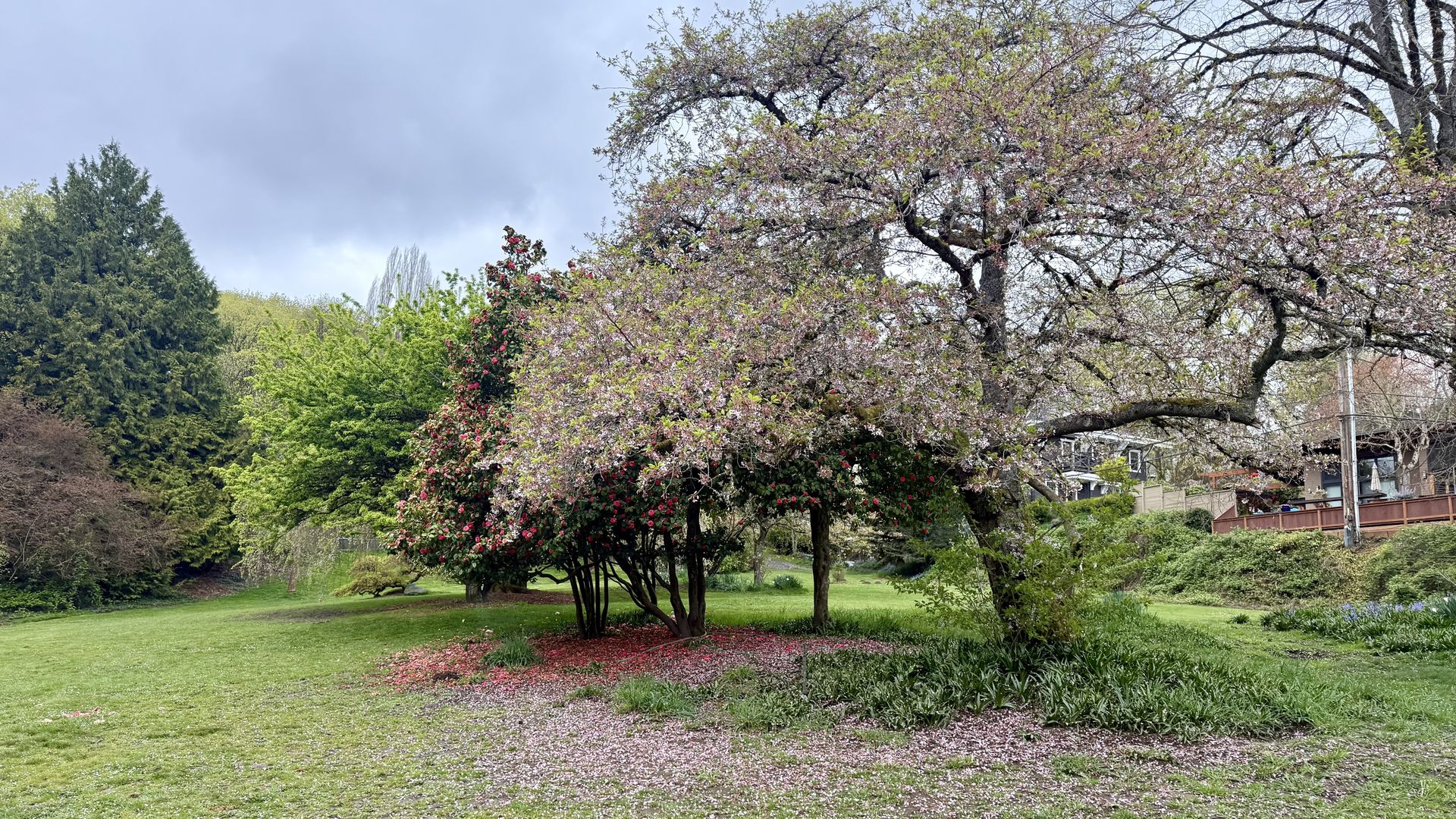
Spring is showing off at Leschi Park, one of Seattle's prettiest low-key spots for a picnic, a stroll, or just soaking in the season.
- Melissa took her family on a practice hike here before heading to the Olympics, where the kids' new boots will get a workout on the trails.
🌳 Melissa is trying to time an early morning visit to the Hoh Rain Forest.
🍔 Clarridge is enjoying a Dick's special.
This newsletter was edited by Geoff Ziezulewicz.
Sign up for Axios Seattle
