Axios Seattle

May 15, 2025

Hello, friends! It's Thursday, and we're pretending we're on a beach somewhere. But still glad to see you.
🌦️ Today's weather: Mostly cloudy. High near 58.
🎂 Happy birthday to our Axios Seattle member Dylan Zehr!
Today's newsletter is 689 words, a 3-minute read.
1 big thing: 🛠️ Embracing everyday prepping
Amid concerns about inflation and a potential recession, more Seattle-area residents are adopting a pragmatic approach to preparedness, eschewing doomsday scenarios in favor of everyday resilience, local preppers say.
Why it matters: Seattle's economy has historically been among the strongest in the nation, but concerns about rising costs locally and interest rates and economic policy nationally have left many feeling vulnerable.
What they're doing: Residents across the region are taking small, steady steps to shore up their stability, according to a conversation with Axios on a recent thread in r/CascadianPreppers, a subreddit focused on preparedness in the Pacific Northwest. That includes:
- Paying down debt while jobs are still stable.
- Stockpiling basics like food, toiletries, and clothes — one Redditor is buying kids' shoes in the next several sizes, Thomas James, a moderator of the group, told Axios.
- Expanding gardens and switching to more calorie-dense crops.
Between the lines: The movement is shedding its fringe reputation with more everyday people preparing for common hardships and natural disasters rather than doomsday scenarios, said James.
- "We're not preparing for a Mad Max scenario — we're preparing for layoffs, earthquakes, rent spikes. The things that happen every year," said James.
- His own off-grid setup in Mason County includes creek filtration, solar panels and fruit trees, but many local preppers are just trying to stretch their dollars and reduce reliance on unstable systems, he said.
What they're saying: Len Skiena, financial planner and CEO of S.R. Schill & Associates on Mercer Island, told Axios many of his clients — especially those nearing retirement — are anxious about market swings, inflation, and Social Security.
Yes, but: Some people are preparing for more extreme outcomes. Redditor u/Chief Kief told Axios they are brushing up on CPR and self-defense, organizing life documents, and prepping a "go bag."
The bottom line: Prepping in the Pacific Northwest these days isn't about bunkers or bugging out, said James.
- "It just feels smarter to be ready if the power goes out, the paychecks stop, or the prices keep climbing," he said.
2. Seattle's coldest days are getting warmer

Thirty-year average coldest temperatures are rising almost universally nationwide, including in the Seattle metro area, a new analysis found.
Why it matters: Such a shift can affect us in a variety of ways — changing which plants and insects thrive in our neighborhoods, for example, amid other impacts of climate change.
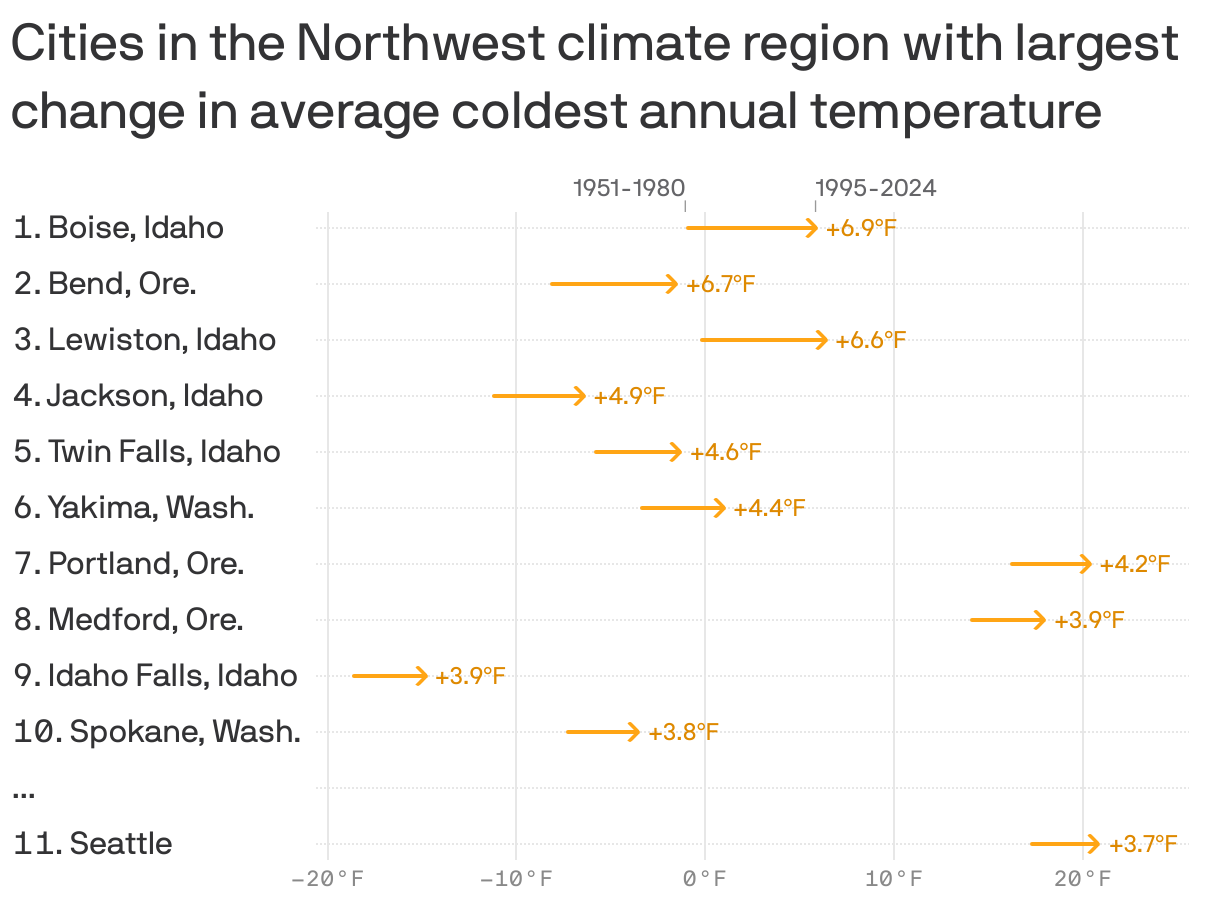
Driving the news: The 30-year average coldest temperature for 1995-2024 compared with 1951-1980 was higher in 97% of the 243 locations analyzed by Climate Central, a research and communications group.
- Among the locations with an increase, the coldest annual temperature was 3.7°F higher on average.
- The group's analysis is based on data from NOAA's Regional Climate Centers.
Zoom in: The Seattle metro area saw a 3.7°F increase in average coldest temperature between the two 30-year periods.
- Spring is also getting warmer, with the region experiencing a greater number of hotter days as extreme heat events become more frequent and intense.
Zoom out: In the Northwest, Boise, Idaho (6.9°F), had the biggest increase, followed by Bend, Oregon (6.7), and Lewiston, Idaho (6.6).
3. Morning Buzz: 🚘 Higher tunnel tolls

💸 Tolls on the Highway 99 tunnel are set to rise by 3% in July, after the state Transportation Commission approved the increase this week. (KING 5)
⚖️ Washington and 19 other states filed two separate lawsuits yesterday over the Trump administration's threats to withhold federal funding from states that do not assist with immigration enforcement. (Axios)
- Washington has now filed or joined 19 legal challenges against the administration since January.
📸 The Seattle City Council approved legislation yesterday to expand speed zone cameras to parks, hospitals, construction zones, ferry lines, and other high-crash areas. (KOMO)
The three climbers who died after falling hundreds of feet in the North Cascades have been identified. (AP)
4. 📍 Where are we?
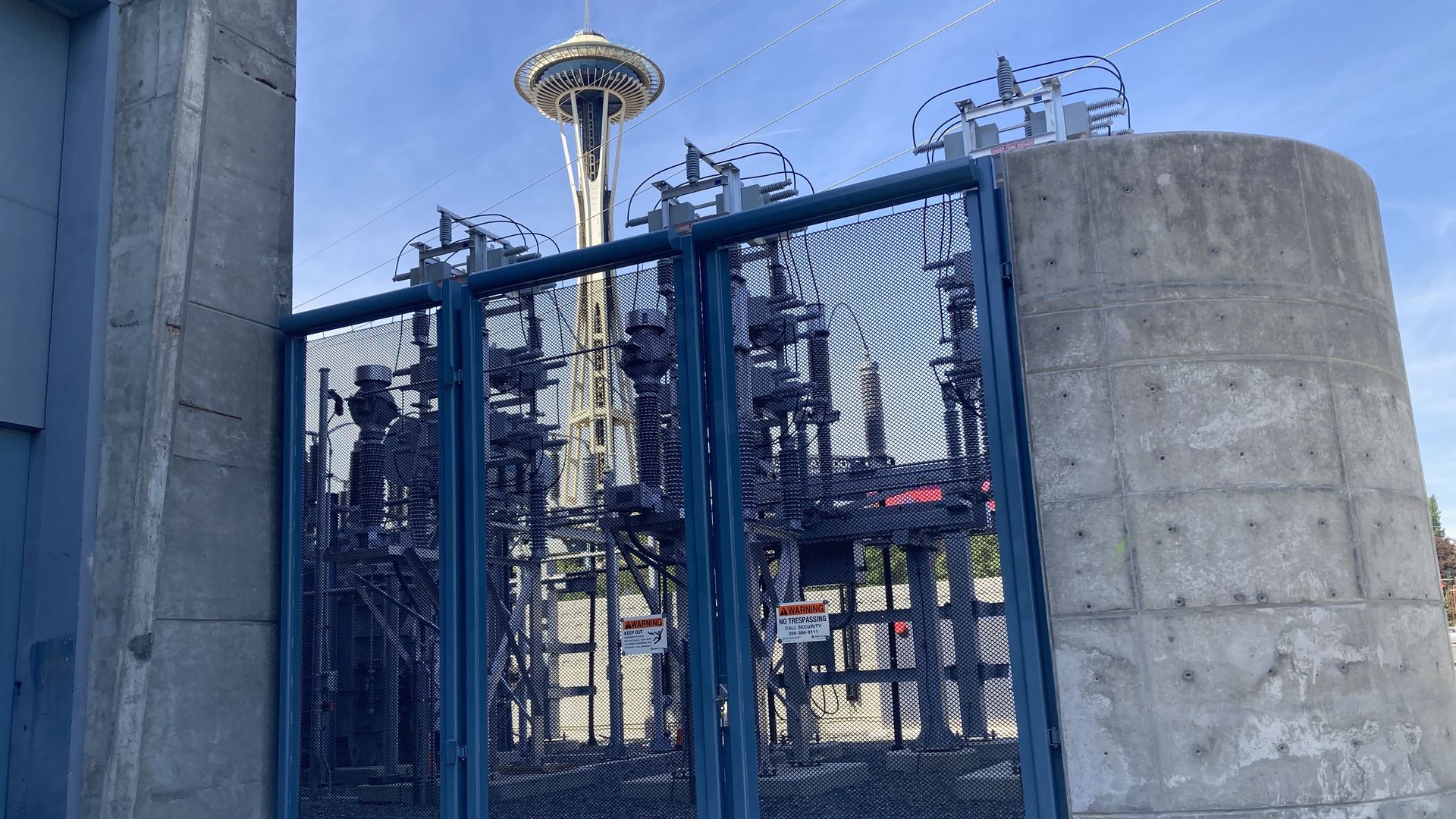
Think you know Seattle? Crack the clues and tell us where we're standing.
Mysterious, curved concrete shell
Where quiet grids of windows dwell
The buzz is low, the purpose clear
Though few take time to linger near
A little jaunt from crowds and play
Power pulses night and day
Just hit reply or email us to submit your guess!
🤫 Clarridge keeps her prep plans close after someone told her their plan was to rob her if times got hard.
🗂️ Melissa is embracing a new filing system — mostly, one in which she actually puts things away.
This newsletter was edited by Rachel La Corte.
Sign up for Axios Seattle