Axios Seattle

August 13, 2025

πͺ Happy Hump Day!
βοΈ Today's weather: Sunny. High near 77. Hang in there β rain is in the Friday forecast.
π Happy birthday to our Axios Seattle members Mike Donovan and Beverly Rechkoff!
Today's newsletter is 948 words, a 3.5-minute read.
1 big thing: π Our thin blue line
Washington state ranks last in law enforcement staffing for the 15th year in a row, according to FBI data analyzed by the Washington Association of Sheriffs & Police Chiefs (WASPC).
Why it matters: Low staffing levels stretch departments thin, impact officer safety, slow response times and, according to law enforcement leaders, create a cycle that pushes more officers out of the profession.
- "Tired officers, running from call to call by themselves, are the worst possible outcome β for wellness, for victims, and for de-escalation," Steve Strachan, executive director of WASPC, tells Axios.
Driving the news: WASPC released its annual Crime in Washington report on July 28, offering a snapshot of crime and policing in 2024.
By the numbers: Washington added 292 officers statewide last year and the number of officers per capita rose slightly from 1.34 in 2023 to 1.36, according to FBI data.
- But Washington is still in 51st place, behind all 50 states and D.C., according to WASPC's analysis.
Zoom in: After losing 355 officers through resignations, retirements and other exits, the Seattle Police Department's force is growing for the first time in years.
- The city has hired more than 100 new recruits this year, with a goal of 150 by December β part of a push to rebuild toward around 1,300 deployable officers, according to the department.
What they're saying: "Public safety is a core function of government, and for too long we have not treated it that way," Strachan says.
- There are always so many competing worthy programs and initiatives for public dollars, he says, and "a lack of understanding that we need both programs for prevention as well as accountability for criminals."
The big picture: WASPC tells Axios it would cost more than $1 billion annually to bring Washington up to the national average for police staffing β based on the state Department of Commerce's $154,704 per-officer estimate.
- To lead the nation? We'd need 30,589 more officers β and nearly $5 billion a year.
The bottom line: Washington's policing gap has become a systemic crisis β and closing it could cost billions.
2. π§πΌ Renters get older

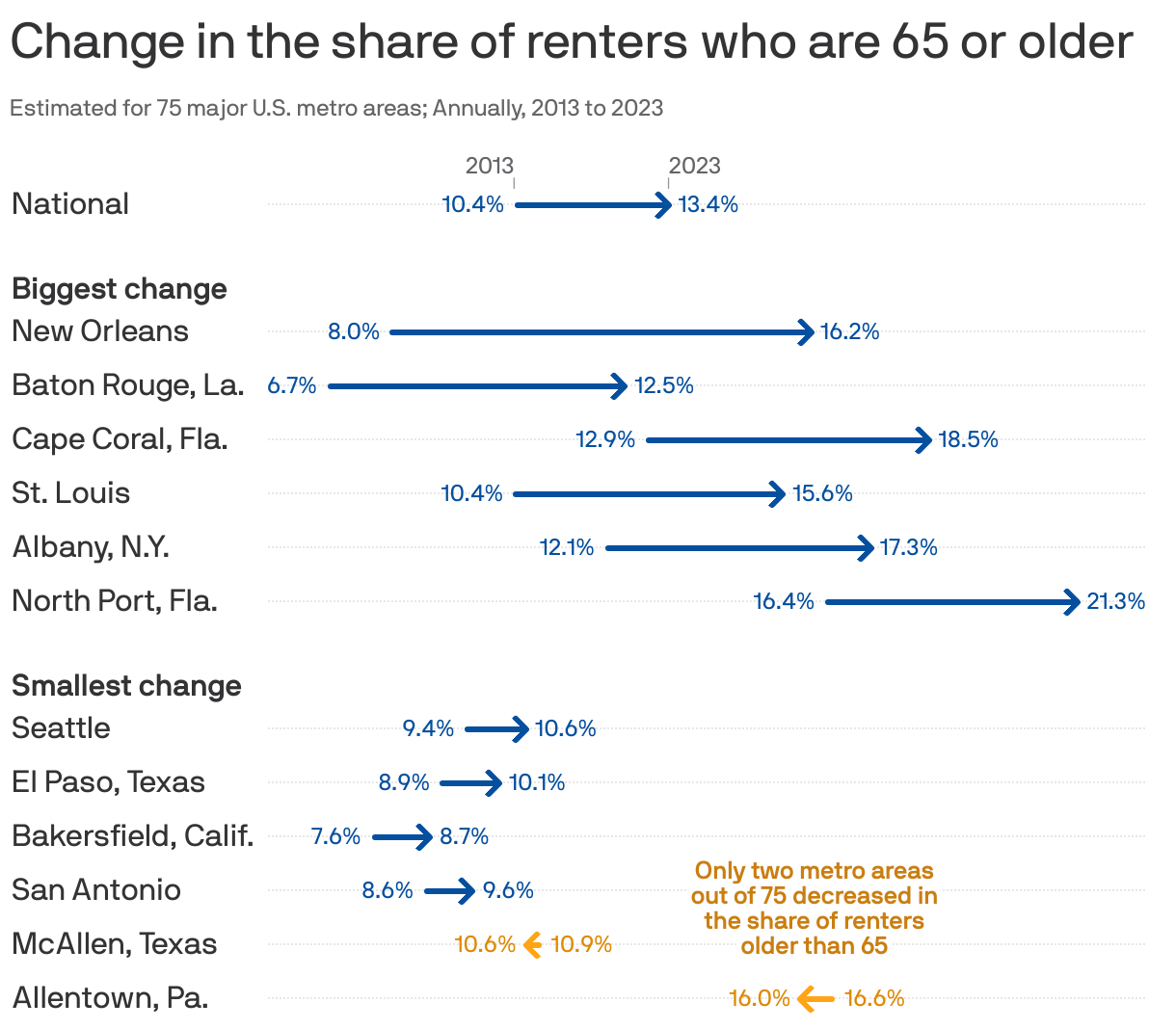
Roughly 10.6% of Seattle-area renters were 65 or older in 2023, up from 9.4% a decade earlier, according to a report by rental listing site Point2Homes.
Why it matters: More older Americans are renting, trading ownership for flexibility.
By the numbers: Nationwide, the share of renters 65 or older rose to 13.4% in 2023 from 10.4% in 2013.
- That age group saw the biggest jump of any group: 2.4 million more renters over the decade, researchers found.
The big picture: Many older adults are on fixed incomes and stay in their homes because they're mortgage-free or have a low interest rate.
- But others are renting for less upkeep, to be closer to family, or for walkable neighborhoods.
- Many are also putting off retirement and want the flexibility to move for a job.
What we're watching: "With record numbers turning 65, the shift not only echoes the broader aging of the nation, but also may signal a new approach to housing," Point2Homes researchers wrote.
3. Morning Buzz: π§³ Tourism takes a hit
π° Seattle is bracing for the economic hit of an anticipated 27% drop in international tourists this year β the steepest dip among major U.S. cities. (The Center Square)
- The decline is largely driven by fewer Canadian visitors, according to an Oxford Economics report.
βΎοΈ After last night's win, the Seattle Mariners are tied with the Houston Astros for first place in the American League West. (Yahoo! Sports)
- Earlier this week, ESPN Bet ranked the M's odds of winning the World Series as the third-best in Major League Baseball. (Seattle Times)
π³οΈ John Braun, the Republican leader in the Washington State Senate, plans to challenge Democratic U.S. Rep. Marie Gluesenkamp Perez next year in the state's most competitive swing district: the 3rd Congressional District in Southwest Washington. (Washington State Standard)
4. π€¨ Lost in translation
Gen Z is rewriting the emoji rulebook, and it's stumping everyone else.
Catch up quick: The Wall Street Journal called the smiley emoji an "intergenerational minefield" back in 2021 β and it's still making people second-guess their texts and Slack messages.
The big picture: ββEmojis simplify and liven up our conversations, but when meanings clash, it can lead to awkward moments.
Before you hit send, here's how Gen Z reads some of the most common (and misused) emojis.
π Soft smiley: What looks like a reassuring smile can come across to Gen Z as sarcasm or passive aggression.
- For example, "My air conditioning just went out. π"
π Painted nails: This can signify luxury, beauty and confidence or add a dash of sass.
- For example, "Dinner's on me. π "
β¨ Sparkles: This can be used to emphasize something, usually ironically, or to show genuine excitement.
- For example, "I'm β¨stressed.β¨"
What we're watching: Expect more emoji creativity β and confusion, as iPhone's new AI feature lets users invent custom icons.
5. Pic to go: π Moonrise over Suquamish

Reader Chris Hanacek caught this image of the rising full moon from his beach neighborhood in Suquamish, where he and his wife moved after raising their family on Bainbridge.
What they're saying: "We are routinely dazzled by sunrises and moonrises," he said.
Plus: They've been hosting Ellison, a giant elephant seal, on their beach for the last few weeks.
What's next: We've been loving all the photos. Keep 'em coming!
πͺ Clarridge is wiping down with rubbing alcohol and sitting in front of a fan.
π Melissa is sorting through her open records requests.
This newsletter was edited by Geoff Ziezulewicz.
Sign up for Axios Seattle