Axios Seattle

April 11, 2023

It's Tuesday!
⛈️ Today's weather: Showers, with a thunderstorm possible. High near 50. Southerly wind with gusts as high as 28 mph.
Today's newsletter is 934 words — a 3.5-minute read.
1 big thing: Global fusion industry emerging in Seattle’s backyard

Illustration: Natalie Peeples/Axios
Seattle-area companies are at the forefront of the race to develop and commercialize fusion energy, the clean, green and potentially world-changing "holy grail" of renewable power.
Why it matters: Nuclear fusion does not rely on fossil fuels like oil or gas, and produces none of the greenhouse gasses which drive global warming.
Also, it is not dependent on beneficial weather conditions like solar and wind power, and carries none of the meltdown risks or millennia-long need to store the nuclear waste that's a byproduct of nuclear fission, Zap Energy spokesperson Josh Farley told Axios.
Driving the news: Zap Energy, along with Helion, in Everett, have become two of the world's largest commercial fusion companies, having each raised hundreds of millions of dollars in venture capital, Farley said.
- Other companies in the region include Avalanche, founded by former Blue Origin engineers in Seattle, and General Fusion in British Columbia.
- The game-changing tech could achieve a potential $40 trillion valuation, Bloomberg estimated, and the promise of on-demand, clean energy is attracting attention from high-profile investors including Bill Gates and Sam Altman.
The big picture: The companies are all racing to crack the code: a method of creating fusion that produces more energy than expended to create the initial reaction, a way to capture and contain the energy created by the plasma, and the means to make it to market.
- Chris Keane, the vice president for research at Washington State University, told WSU Insider the university and other Pacific Northwest businesses and researchers are well positioned to help develop the technology as an actual energy source.
Be smart: Fusion is the opposite of fission, the process involved in creating energy at nuclear power plants.
- Fission, which involves the splitting of atoms, does not occur normally in nature and has to be carefully controlled to prevent runaway reactions.
- Fusion, in which the nuclei of atoms are fused or joined, is naturally occurring and found in the sun and stars.
Take your career to the next level
💼 Check out who's hiring on our Job Board.
- Child Nutrition Policy Senior Researcher, Deputy Area Director at Mathematica.
- Director, GTM Financial Planning & Strategy at Checkr.
- Corporate Controller at Inrix.
Want more opportunities? Check out our Job Board.
Hiring? Post a Job.
2. Legislature votes to repeal death penalty statute

Illustration: Brendan Lynch/Axios
Nearly five years after Washington's death penalty law was ruled unconstitutional, the Legislature has voted to permanently repeal capital punishment in the state.
Driving the news: The state House voted 58-39 on Friday to remove remaining references to the death penalty from Washington law.
- The measure, which was approved by the state Senate in February, now heads to Gov. Jay Inslee.
Why it matters: The Legislature's action has no immediate effect, since a 2018 court ruling already took the death penalty off the table for prosecutors. Yet the law's formal repeal makes "a profound moral statement," state Sen. Jamie Pedersen (D-Seattle), the bill's sponsor, told Axios yesterday.
Background: State executions have long been rare in Washington, with the last one carried out in 2010.
- In 2014, Inslee issued a moratorium on executions, saying he "was not convinced equal justice is being served."
- Four years later, the state Supreme Court struck down the state's death penalty law, saying it was "imposed in an arbitrary and racially biased manner."
- Still, the law has remained on the books, with several efforts to remove it for good fizzling out in the Legislature in recent years.
Details: The death penalty repeal is part of a broader measure to purge statutes that have been ruled unconstitutional, yet never officially eliminated.
The other side: Opponents of the bill said they wanted to see the state enact a constitutional version of the death penalty, a possibility the state Supreme Court left open in its 2018 ruling.
3. Morning Buzz: Bikini barista settlement

Illustration: Brendan Lynch/Axios
👙 Everett is poised to pay a $500,000 settlement to resolve a yearslong dispute with the owner of a bikini barista stand over the city's dress code. (KUOW)
🏛 A ban on the sale of assault weapons has passed both chambers of Washington's Legislature, though the measure still needs to go back to the state House for a final vote. (KING 5)
📉 Amazon plans to reduce employee stock awards starting in 2025. (Seattle Times)
4. Chainsaw the whale returns
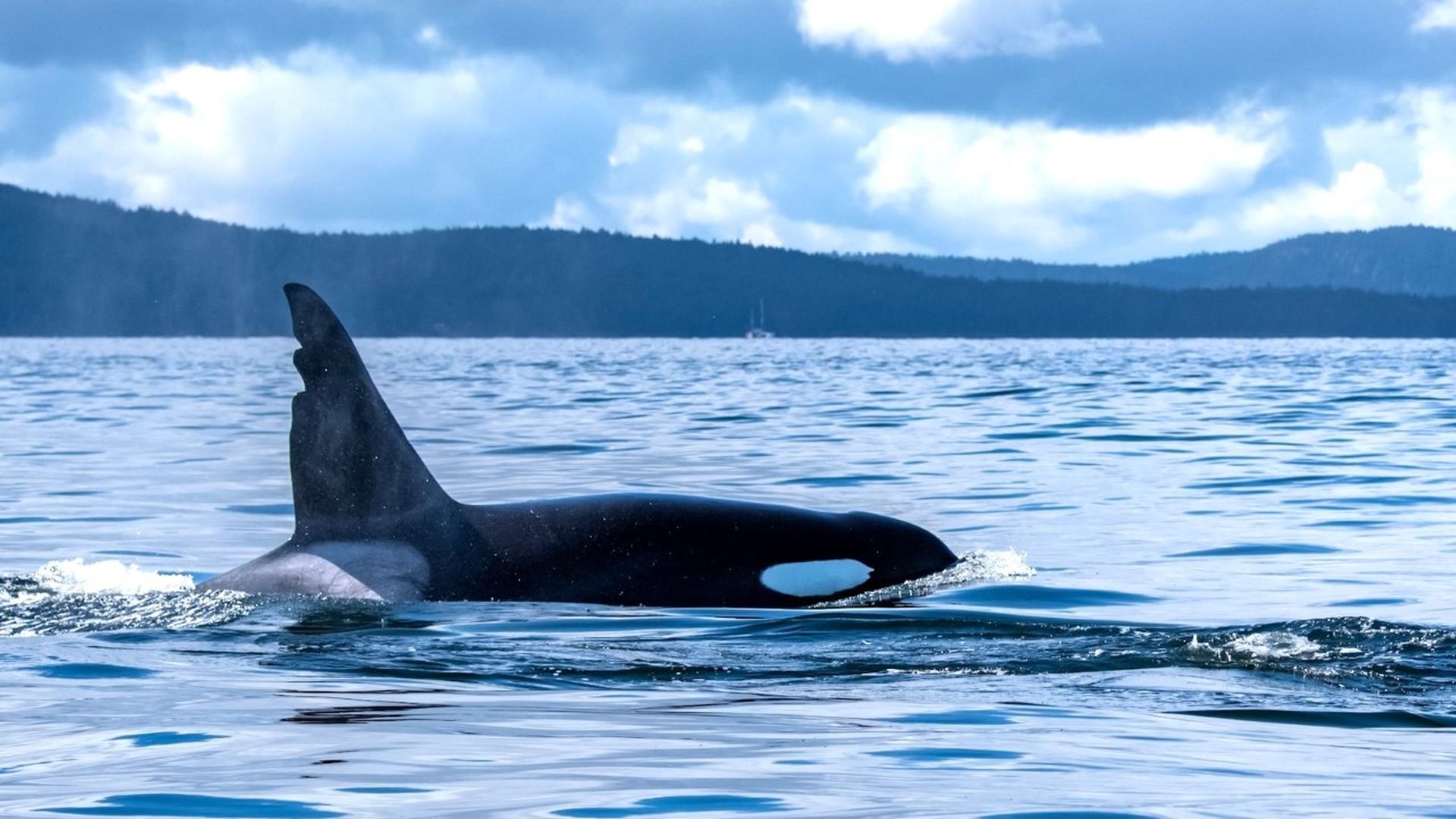
T63, "Chainsaw,” has been spotted in the Salish Sea. Photo courtesy of April Ryan, Maya’s Legacy Whale Watching
One of the most recognizable members of the coastal Bigg’s killer whale population — T63, aka "Chainsaw" — has returned to the Salish Sea, the Pacific Whale Watch Association (PWWA) announced.
Driving the (good) news: Chainsaw's appearance is a telltale sign of spring as "the local celebrity" arrives roughly the same time each year, said Erin Gless, PWWA's executive director.
- Named for its distinctive jagged dorsal fin, the killer whale was first spotted in Washington waters this season at Boundary Pass near the San Juan Islands last week.
- Gless told Axios it's not uncommon for Bigg's killer whales, also known as transients, to have wounds or cuts like Chainsaw's. "We think it's because of their prey fighting back," she said.
Details: Chainsaw was traveling with his presumed mother, T65 "Whidbey," and another family, the T49As led by matriarch "Nan," according to Mark Malleson, a local whale researcher and captain for Prince of Whales Whale & Marine Wildlife Adventures.
Of note: At 45, Chainsaw is considered one of the oldest males in the Bigg's population, according to PWWA.
- Chainsaw’s visits to local inland waters are predictable, but typically brief, lasting just a few weeks at a time.
- Beyond the Salish Sea, Chainsaw is often seen traveling throughout southeast Alaska where he is also referred to as "Zorro."
The big picture: Unlike their endangered relatives — the Southern Residents who rely solely on salmon for food — Bigg's orcas can be seen almost daily in the Salish Sea and are increasing in numbers due to the abundance of seals and sea lions in the area.
- PWWA said there are nearly 400 Bigg's killer whales that feed in the waters of Washington and British Columbia.
🩹Melissa cut her fingertip in exactly the wrong place for someone who types things for a living.
🥮 Clarridge is wondering whether she should have added a tiny bit of vinegar to a chocolate cake that turned out a little bland despite a lot of good, dark cocoa powder.
This newsletter was edited by Rachel La Corte and copy edited by David Chiu.
Sign up for Axios Seattle

Get smarter, faster on what matters in Seattle with Melissa Santos and Christine Clarridge.