Axios Science

June 13, 2024
Thanks for reading Axios Science. This week's newsletter is 1,474 words, about a 5½-minute read.
- Send your feedback and ideas to me at [email protected].
1 big thing: Dads' nurturing nature
Dads today are spending more time on average changing diapers, tying shoes and pushing swings — nurturing acts that a new book argues have long been part of men's biological nature.
Why it matters: Scientific findings are expanding our understanding of parenting and underscoring a need for fathers to have more social support — and acceptance, primatologist Sarah Blaffer Hrdy writes in "Father Time: A Natural History of Men and Babies."
The big picture: Fathers are relatively new scientific subjects.
- Hrdy spent decades studying primate mothers, what it means to be "maternal," and the role of alloparents, which are male or female group members who care for young who aren't their offspring, and their part in human evolution.
Seen through the lens of sexual selection, fathers weren't considered as direct caregivers for babies and instead seemed to be spending their time in a struggle against one another "for possession of the females," as Charles Darwin described it in the mid-1800s.
- The deep investments that fathers are making now in raising their children presented a new scientific puzzle.
"How on Darwin's Earth could these men have these nurturing potentials?" Hrdy says.
- The punchline: "It's always been there, ever since 400 million years ago."
What they found: "The same molecules and neural circuits that played pivotal roles when mammalian mothers first began birthing helpless babies, and then instinctively tending them, can become operational in males," Hrdy writes.
- Studies have found gradual drops in testosterone when partnered men become fathers who devote hours each day to caring for babies.
- Others documented increases in levels of oxytocin — the "love hormone" — in new fathers and mothers. (Though when it was released is different in mothers and fathers: Mothers' levels were tied to affectionate contact, whereas fathers' seem to correlate with play and other behaviors, Hrdy writes.)
- Expectant fathers have also been found to have higher levels of prolactin, the "supposedly female" hormone responsible for lactation, after a baby's birth.
- It's unclear how pronounced these changes that mirror those in mothers are or if they persist as long in fathers as they do in mothers.
The intrigue: Hrdy returns to an especially "exciting" study throughout the book.
- Researchers analyzed the brains of parents using MRI and found circuits in the prefrontal cortex were active in the brains of fathers who helped mothers care for children. (The mothers were still primary caregivers.)
- The prefrontal cortex, a brain region that went through a rapid evolution near the end of the Pleistocene era as modern humans became established on Earth, is where we do our "cost-benefit trade-offs," Hrdy says.
But what the researchers saw next is "unprecedented in 200 million years of mammalian evolution," Hrdy says.
- They analyzed the brains of fathers in same-sex couples who were — through surrogacy or adoption — primary caretakers starting at their child's birth.
- They saw "the very ancient limbic regions of their brain," including the hypothalamus and the amygdala, being activated, Hrdy says. "When my baby would stir at night and I'd jump up to go get her, that was my amygdala."
2. Part II: Pleistocene parenting
What are these networks of ancient peptides and hormones doing there? Hrdy says.
- And when were they "stashed away in Mother Nature's cupboard for possible repurposing later on?"
Zoom out: Hrdy traces these chemical messengers and male investment in the young deep into the natural history of birds, fish and other animals that came long before humans.
- Seahorse males — which give birth — have early versions of prolactin. Elevated levels of the hormone were also found in male California mice and cotton-top tamarins caring for babies.
- About 28% of fish species care for their eggs, but males provide the bulk of care in those that do.
- But direct male care is rare in mammals — it's been observed in about 5% of the roughly 5,400 species of mammals in the world, Hrdy writes.
Yes, but: Even the males of some rodents that are commonly infanticidal can become caregivers after spending time with offspring, their brains responding similarly to mothers, she writes.
Flashback: Hrdy tries to answer when in the course of human evolution male investment in infants and children emerged. She lands at the end of the Pleistocene era and on hunter-gatherer societies in which people were interdependent for survival and their reputations mattered, she says.
- As men spent more time near infants and children (who themselves try to ingratiate themselves to adults), their predisposition for nurturing was unlocked, she proposes.
- And when males in hunter-gatherer societies shared food with the group — helping their own offspring to survive as well — they garnered a good reputation that made them potentially more attractive mates, Hrdy argues.
Fast forward to the late 20th century, when cultural changes again set the stage for fathers to provide more direct care to children, activating their nurturing nature.
- Hrdy writes that she hopes that as it becomes "increasingly clear" men are "equipped to develop caring priorities," more people in a position of power — who are still largely men — will pursue policies with an eye toward future generations rather than a focus on retaining power.
What to watch: Hrdy predicts future studies might reveal an ancient alloparenting substrate in the brain across all members of our species that evolved in the Pleistocene era of parenting.
The bottom line: "It's time to set aside misguided notions about nurturing responses being the exclusive preserve of mothers," Hrdy writes.
3. Where the women scientists are


The share of women researchers grew over the past two decades — but geography is a key factor, according to a new report from publishing giant Elsevier.
Why it matters: National policies and cultural norms that support women in science shape who gets to do research and what research is done.
What they found: Women made up 41% of researchers in 2022 compared to 29% twenty years before, per the Progress Toward Gender Equality in Research & Innovation 2024 review. The report looked at citations, grant awards, publications and other indicators.
- The highest share of women researchers from 2018 to 2022 was in Latin American and Hispanic countries — Portugal, Spain, Argentina and Brazil.
- In the U.S., it was 42% — just above the world average of 41%. Women make up 33% of researchers in India, one of the world's most active research countries. China wasn't included in the analysis.
- Women achieved parity in psychology, immunology, molecular biology, chemistry and other fields.
Yes, but: The share of women in mathematics and engineering between 2018 and 2022 remained low — just 27% and 28%, respectively.
- And the proportion of women scientists goes down as seniority goes up. They make up 39% of early-career researchers and 27% of those who are most established. "The leaky pipeline prevails," said Mirit Eldor, a managing director at Elsevier.
- Fewer papers involving women are being published than those involving men — a gap that has remained for more than two decades, the report says.
- Publications authored by men are cited by other researchers more than papers authored by women — but that gap closes for the most senior researchers. Women at these stages actually do better than men in terms of citations, Eldor said.
- Men or teams of only men filed more than three-quarters of patents, according to the report.
Between the lines: The report authors found women are more cited in policy documents and media.
- The challenge is these are longer-term indicators that may not be captured in assessments of women researchers' work, Eldor said.
5. Something wondrous
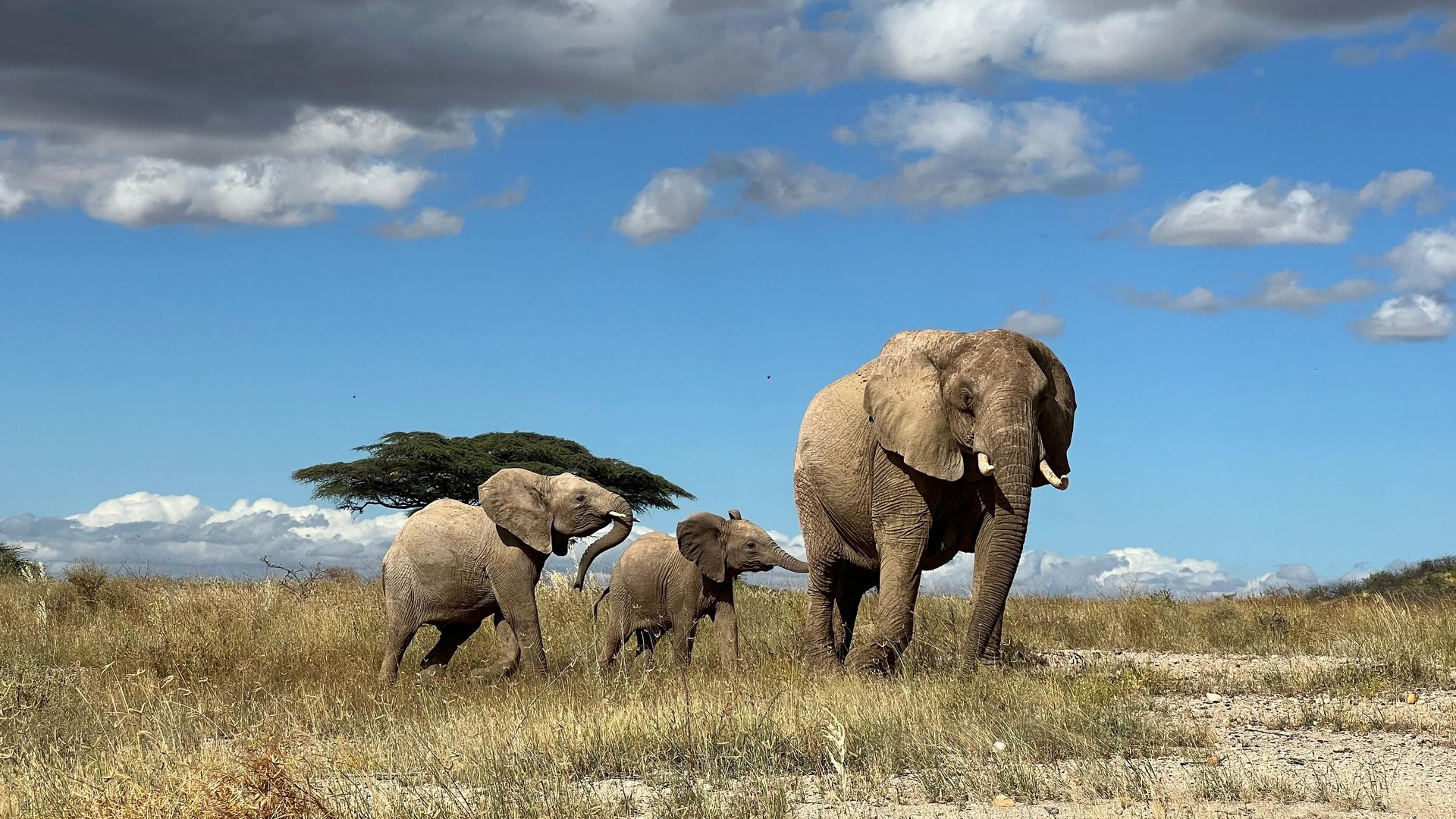
Elephants address each other with name-like calls, according to a study published this week.
The big picture: Elephants and primates diverged more than 90 million years ago, but the new findings suggest elephants and humans may communicate in a similar way.
- "Dolphins and parrots call one another by 'name' by imitating the signature call of the addressee," the study's lead author, Michael Pardo of Colorado State University and Save the Elephants, said in a press statement.
- "By contrast, our data suggest that elephants do not rely on imitation of the receiver's calls to address one another, which is more similar to the way in which human names work."
What they found: Researchers used AI to analyze 469 wild African elephant calls to spot subtle differences between the rumbles.
- They found "individual vocal labels" that elephants on the receiving end recognized and later responded to when the calls were played back to them, the team reports in the journal Nature Ecology and Evolution.
Yes, but: The team couldn't decipher individual elephant names or determine whether different elephants "name other things they interact with, like food, water and places," according to the press release.
Big thanks to Tiffany Herring on the Axios Visuals team and to copy editor Carolyn DiPaolo.
Sign up for Axios Science