Axios Science

March 07, 2024
Thanks for reading Axios Science. This week's newsletter is 1,525 words, about a 6-minute read.
- Send your feedback and ideas to me at [email protected].
- Sign up here to receive this newsletter.
1 big thing: Antarctic ambitions are intersecting with science

Illustration: Sarah Grillo/Axios
Expanding Antarctic ambitions, coupled with the impact of the pandemic and geopolitics, are reshaping science at the planet's southern pole.
Why it matters: Scientific research has for decades guided the governance of Antarctica, offering access to scientific frontiers and a say in the course of the continent. But as countries grow their presence on Antarctica, more countries — and their politics and goals — are intersecting with science.
Driving the news: China opened its fifth research station on Antarctica last month, the country's latest move as it expands its presence and influence on the continent.
- The station's location south of Australia has raised concerns among some analysts that it could be used for intelligence gathering from U.S. allies.
- Others argue there are places far more suited to that task. The 1959 Antarctic Treaty prohibits using the continent for military purposes.
- Iran recently claimed it has "property rights in the South Pole" and plans to "carry out military and scientific work" on the continent.
How it works: The treaty emphasized non-militarization and peaceful purposes on the continent, which were "purposefully reinforced by the prioritization of scientific research and cooperation," says Marigold Black of Norfolk Advisory. She is a co-author of a RAND report about Antarctic geopolitics published last year.
- But today, scientific research in Antarctica is being used "to assert legitimacy ... and as a tool to gain a 'right to speak' in regional affairs," she says.
- There's a myth that Antarctica is isolated from politics but "politics is just done through science," says science historian Peder Roberts of KTH Royal Institute of Technology in Norway.
The big picture: Antarctica is governed by consensus by 12 signatories of the treaty as well as other consultative parties that "conduct substantial scientific research" on the continent, each effectively having veto power.
- Climate change, astronomy, geology, oceanography, marine biology and other research take place at 70 research stations run by 29 different countries on the continent.
- "Science and scientific collaboration have been recognized as a key raison d'être for human presence in the Antarctic and are considered to represent the currency of Antarctic diplomacy," Daniela Liggett, a social scientist and professor at Gateway Antarctica at the University of Canterbury | Te Whare Wānanga o Waitaha in Christchurch, New Zealand, and her colleagues write in a new paper.
2. Part II: Pandemic disruptions
The COVID-19 pandemic disrupted scientific research on Antarctica in several ways the researchers detail in Science Advances.
- The pandemic put a pause on international station inspections and monitoring. Governance meetings and decisions were also canceled or punted.
- It also delayed scientific research by several years, leaving a gap in scientific knowledge that is used to inform governance of the continent, they write.
- Yes, but: It wasn't all bad news for science. There was increased data-sharing, remote mentoring and online — and more accessible — conferences, Liggett says.
Zoom out: Pandemic impacts were coupled with other pressures on Antarctic science — climate change, increased tourism, and "a broader range of interests and motivations" by countries, which posed challenges to governing by consensus, they write. There are also:
- Geopolitical tensions: Russia's invasion of Ukraine added more stress to the system. Both have a vote under the treaty.
- China's growing influence: China and Russia, which has operated stations on Antarctica since the 1950s, have in recent years blocked the establishment of marine protected areas in the Southern Ocean. China didn't support the designation of emperor penguins as a special protected species.
- Protectionism is also raising concerns about reducing cooperation on Antarctica, the authors write.
What they're saying: "China's new Antarctic station is built and operated in full compliance with international rules and procedures," Liu Pengyu, spokesperson for the Chinese embassy in Washington, D.C., told Axios in a statement.
- China is a consultative party to the treaty, and its "activities are consistent with the stipulations of the Antarctic Treaty System," Liu added.
A key concern on Antarctica is dual-use technologies that can be used for scientific research as well as military activities.
- For example, ground stations that provide communications and can be used to position reconnaissance satellites also support scientific research and are acceptable under the treaty, former Australian government analyst Claire Young recently wrote. China, the U.S., Norway and others have ground stations on Antarctica.
- Young and others argue inspections allowed under the treaty are the best means for verifying military activities aren't taking place on Antarctica.
- "Just because something is dual use doesn't necessarily mean that that use is a necessary consequence," Roberts says, noting the U.S.S.R. for many years didn't want Norway to build a runway in Svalbard in the Arctic because it could support military operations.
- But at its core, "the Antarctic Treaty is also a form of security agreement," Black says, adding that attention needs to be paid to potential military activities on Antarctica.
What to watch: If research continues to be the ticket to prestige in Antarctica and more research means a louder voice, states are going to build infrastructure and maintain scientific programs, Roberts says.
- That could mean more sophisticated science is done on Antarctica.
- It could "potentially also have an arms race effect," he says.
- But, "if you've got lots of people with lots of expensive kits and lots of support staff, the chance they will be able to do lots of good science improves."
3. Women inventors rise

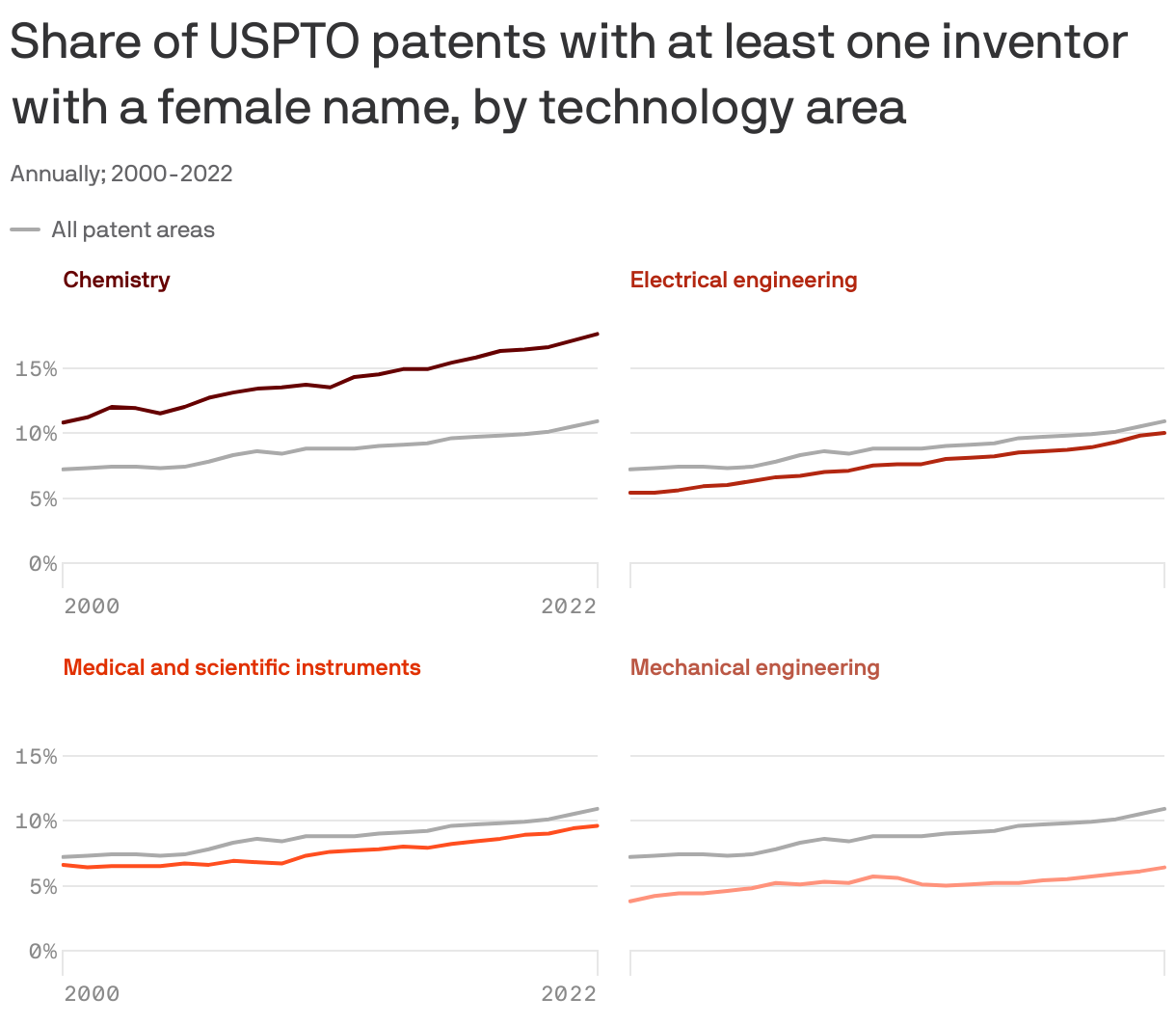
Women's participation in scientific patents has increased since 2000, according to new data analyzing patents granted by the U.S. Patent and Trademark Office.
The big picture: Men still dominate the patents granted in the U.S. and worldwide, but the share of women inventors has grown over the last four decades.
By the numbers: In 2022, the share of inventors who were women was highest (about 18%) in chemistry and lowest in mechanical engineering (roughly 6%), per the report from the National Science Foundation's National Center for Science and Engineering Statistics.
- The fastest increase in the share between 2000 and 2022 was in electrical engineering.
Between the lines: Women's increased participation in patenting may stem from collaboration with university advisers in graduate programs, according to the report.
- Those collaborations are "associated with higher rates of first-time patenting by women, identifying a role for mentorship at universities in the invention process," they write.
How they did it: Female names on patents were used as a proxy for women's participation in the invention.
- Inventor names from patents granted in the U.S. were matched to their most likely gender using a gender name dictionary. The information was verified using data sets of known inventors and their gender.
4. Worthy of your time
Organoids grown from amniotic fluid could shed light on rare diseases (Lilly Tozer — Nature)
Menstrual blood as a diagnostic tool (Niala Boodhoo — Axios)
Europa may have less oxygen to fuel life in its seas than thought (Leah Crane — New Scientist)
Scientists take a step closer to resurrecting the woolly mammoth (Rob Stein — NPR)
5. Something wondrous
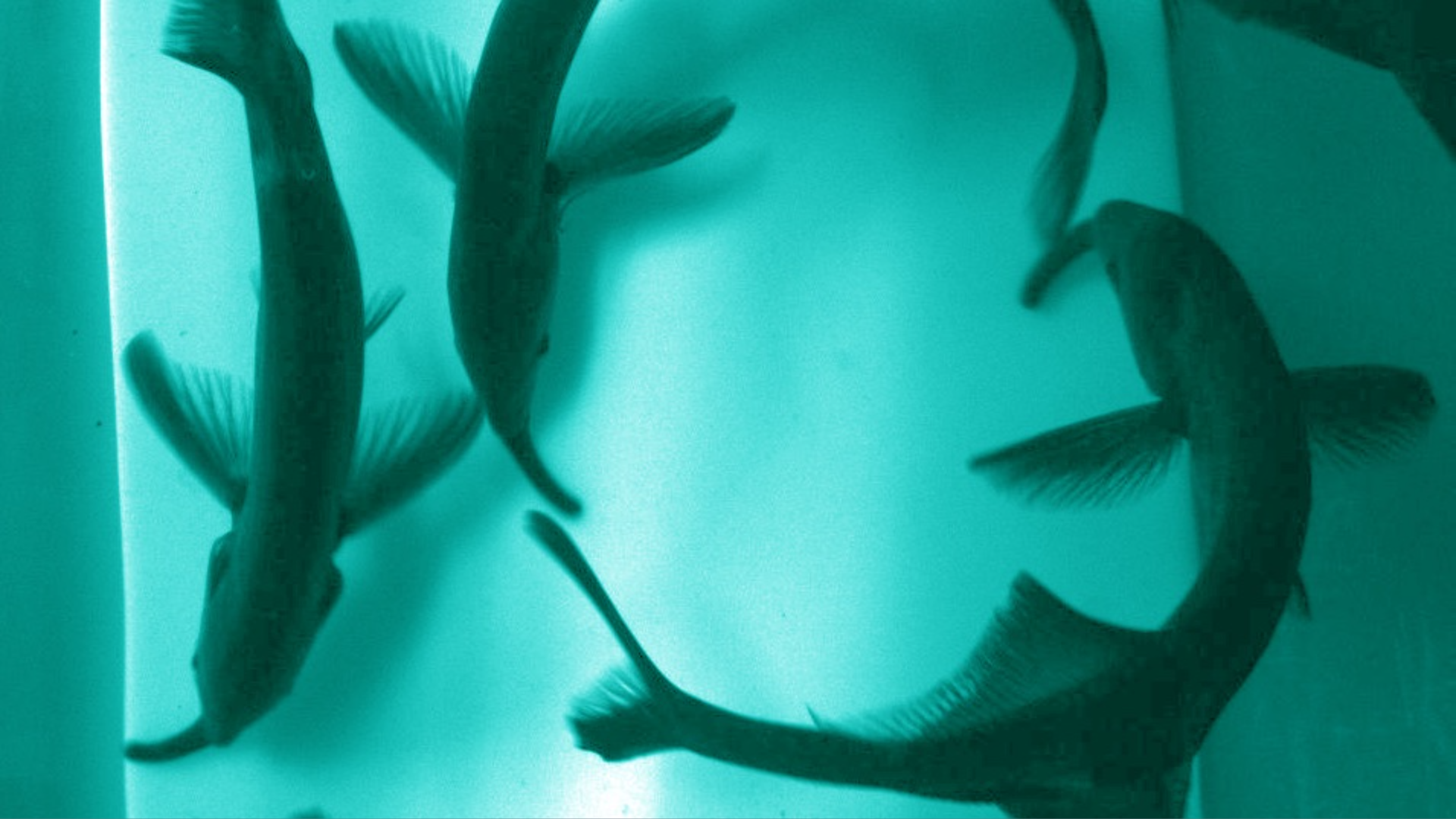
Weakly electric fish Gnathonemus petersii. Photo: Sawtell Lab/Columbia University Zuckerman Institute
African electric fish can use electric signals from other fish to collectively sense predators and prey as they move through dark, murky waters, researchers reported this week.
Why it matters: This sensing and other highly specialized behavior can reveal different information about the brain than studies done in rats, mice and other laboratory model animals.
How it works: Scientists knew African electric fish, Gnathonemus petersii, had receptors on their skin that are sensitive to electricity.
- The fish emit electric pulses that hit objects and return a signal that the fish senses. Objects that are alive cause more current to flow than rocks and other objects, a difference the fish can detect.
- The fish are social animals that hunt in groups, and some scientists thought when the fish got together, their electric signals would interfere with one another and essentially jam their sensing ability.
- But Nathaniel Sawtell, a professor of neuroscience at the Zuckerman Institute at Columbia University, and post-doctoral researcher Federico Pedraja found the fish actually benefit from the pulses of other fish.
What they found: Pedraja and Sawtell used computer modeling to simulate the electrical environment of the fish and found having other group members doubled or even tripled the sensing range of about one body length for an individual fish, they report in Nature.
- That finding was confirmed with brain recordings from fish as they responded to their own signals and other fish.
- The researchers also observed the fish in a tank positioning themselves in ways the simulations suggested would support sensing and they alternated emitting electric signals.
- Sawtell says the fish sensing system is similar to radar or sonar that uses multiple emitters and receivers to improve sensing.
What they're saying: Finding that these fish "evolved a remarkable way in which they can their use own predictable input and unpredictable input [from other fish] to detect prey when they are hunting together" is "completely new," says Leonard Maler, a neuroscientist at the University of Ottawa who wasn't involved in the study.
The intrigue: African electric fish have one of the biggest brain-to-body mass ratios of any animal — including humans, Sawtell says.
- "We're just beginning to understand how this giant brain of this fish actually makes sense of these different streams of information coming in from different animals," he says.
Big thanks to Carolyn DiPaolo for copy editing this edition.
Sign up for Axios Science

Gather the facts on the latest scientific advances