Axios San Francisco

August 03, 2025

⚽️ It's Sunday! Today we bring you a special edition on the 2026 FIFA World Cup, which is expected to drive massive economic growth for the Bay Area.
- Levi's Stadium in Santa Clara will host, putting the region on the global stage.
- We're diving deep into the preparations, how we got here and why soccer is having its moment.
🔍 Find these stories on our new Business Brief page.
Today's newsletter is 950 words — a 3.5-minute read.
1 big thing: ⚽️ Bay Area gears up for 2026 World Cup
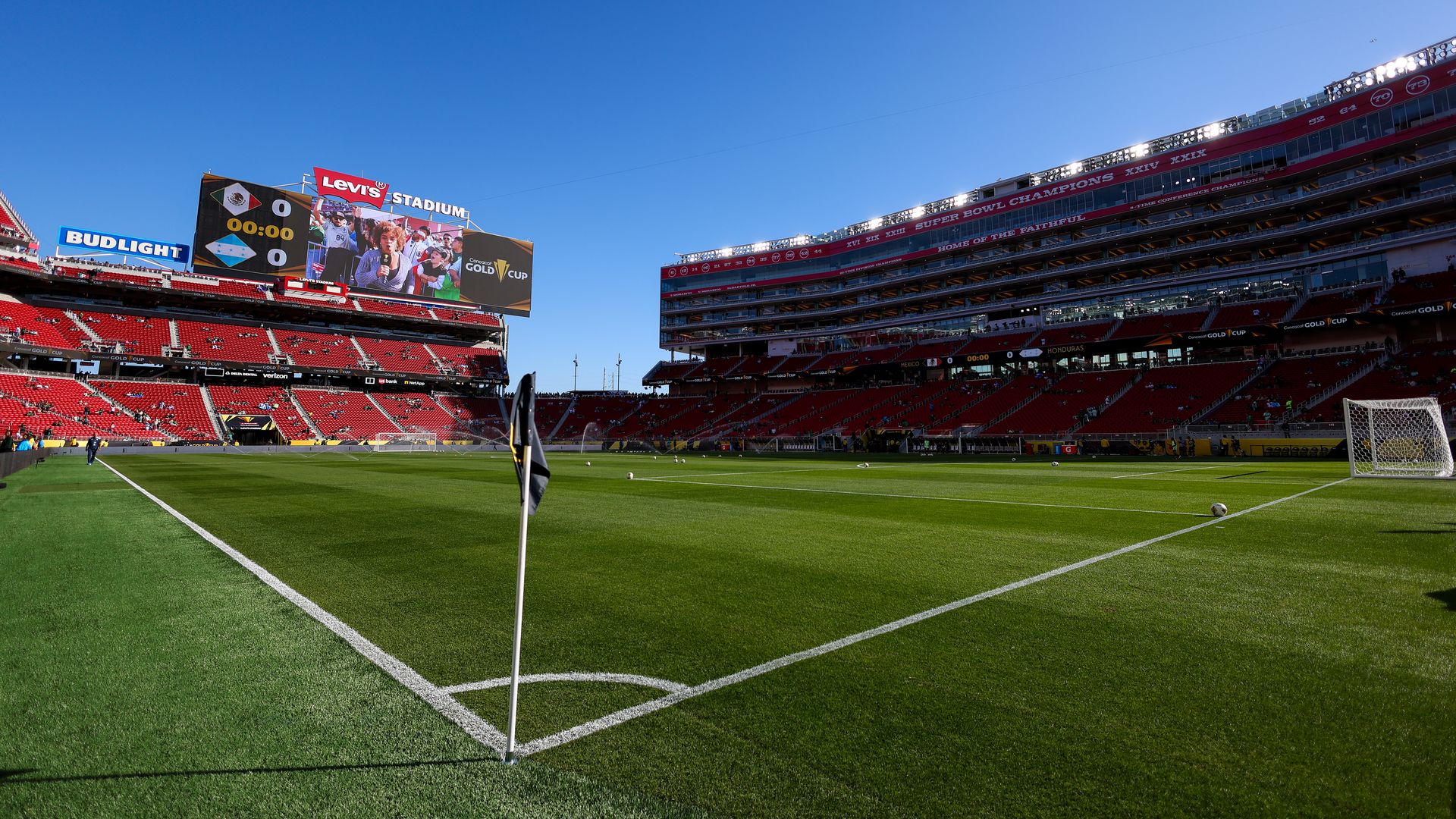
Over half a million people are expected to descend upon the Bay Area next summer for six FIFA World Cup matches at Levi's Stadium in Santa Clara and local officials are working to ensure everything runs smoothly.
Why it matters: The games, set for months after the Bay Area hosts the Super Bowl, could bring in between $370 million-$620 million in economic activity across the region.
State of play: The Bay Area Host Committee (BAHC) — originally formed ahead of the 2016 Super Bowl — is now leading the charge for World Cup events, which include five group stage matches and one round of 32 knockout match.
- Their goal is twofold: Raise enough money for all expenses and work with nine counties and more than 100 cities to maximize economic impact, BAHC president and CEO Zaileen Janmohamed told Axios.
Behind the scenes: Officials last December said the World Cup will cost Santa Clara an estimated $45 to 50 million. BAHC will cover those costs, including stadium upgrades, security and equipment needs, per an agreement with the city.
- The 49ers have agreed to backstop funds related to stadium renovations if BAHC is unable to cover all costs.
- BAHC is also receiving $10 million in state funding, shared with Los Angeles, for public safety needs.
What they're saying: "This is historic and unprecedented, and no one has ever done it before, and therefore there's no template on how to do it," Janmohamed told Axios. "We will be the epicenter of sport."
- Janmohamed declined to provide a specific target fundraising total, but added that there's "a lot of energy in the marketplace."
Zoom in: San José, which borders Santa Clara, is working to raise a few million dollars for concerts, drone shows and watch parties downtown, which will serve as a "centerpiece for the fan experience," Mayor Matt Mahan told Axios.
- Local officials are also developing a QR code and app to help visitors navigate community events, Mahan said.
- "We want to build a seamless experience" from San Francisco to South Bay, he added.
- Charles Lutvak, spokesperson for San Francisco Mayor Daniel Lurie, did not provide details about the city's World Cup preparations but said they "expect to welcome tens of thousands of fans."
2. 🏟️ Revisiting the 1994 tournament

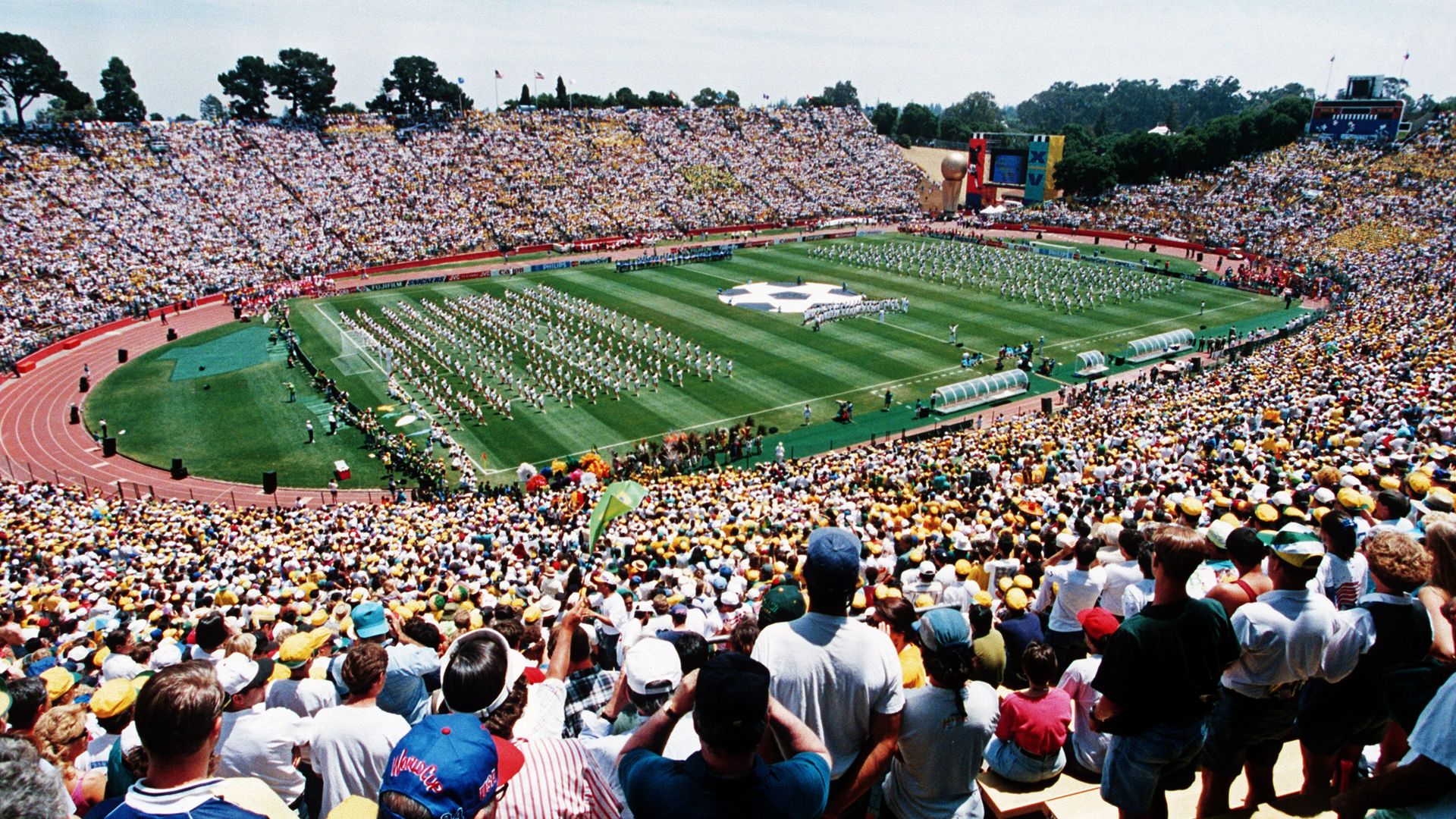
The Bay Area played a starring role in the United States' first time hosting the World Cup, providing pitches for six games during the 1994 tournament.
Why it matters: The global sporting event, which ran from June 17 to July 17, helped ignite American interest in soccer and paved the way for Major League Soccer's debut two years later.
State of play: Stanford Stadium, located on the Stanford campus, just 35 miles south of San Francisco, hosted three Brazil group stage matches, a July 4 showdown and a nail-biting quarterfinal.
- Brazil dominated with wins over Russia (2–0) and Cameroon (3–0) and tied Sweden (1–1) before eliminating the U.S. with a 1–0 win on Independence Day.
- Sweden beat Romania on penalties after a 2–2 draw during the quarterfinal.
Zoom in: Despite soccer's lower profile in the U.S., World Cup games drew massive sold-out crowds.
- Nearly half a million fans attended the Stanford Stadium matches, contributing to the total attendance of more than 3.5 million — which broke a record for the World Cup at the time.
Between the lines: The stadium, built in 1921 for American football, was retrofitted with $5.4 million in infrastructure upgrades to host 86,000 fans.
- Candlestick Park, the former longtime home of the San Francisco Giants, was ruled out due to scheduling conflicts with baseball games.
The big picture: The 1994 championship ended with Brazil claiming victory after defeating Italy 3–2 on penalties at the Rose Bowl in Pasadena.
3. 👟 Adult sports are booming
Team sports have become one of the fastest-growing types of exercise, with 20% of U.S. adults — up from 11% in 2020 — now saying they participate, according to a CivicScience survey obtained by Axios.
Why it matters: Adult sports are booming, with leagues expanding to keep pace with rising demand for active, social ways to connect.
Zoom in: San Francisco is home to a growing lineup of adult leagues, including Volo Sports, Play in the Bay, ZogSports and Play Recess.
What we're hearing: "No one's going out of business because people aren't playing. In fact, it's the opposite," says California-based Galen Beers, executive director of the Sport & Social Industry Association.
State of play: Volleyball (30% of total players), soccer (18%) and softball (15%) were the most popular sports last year, per preliminary data from the trade group, which counts roughly 150 leagues as members.
The vibe: The social aspect is just as important as the sport. Players are often city newcomers or looking to meet people outside of work. Some even find romance, club organizers say.
The big picture: Many adults don't get enough exercise — and report feeling lonely.
- Getting outside with friends — and without screens — has become especially important to younger adults, Beers said.
4. 💰 Our resale market


Soccer fans are shelling out big for Bay Area matches — $89 a ticket on average in 2025, per ticket tech company Victory Live.
Why it matters: That's the eighth-highest among U.S. metros and the priciest in California.
State of play: Victory Live analyzed ticket sales on the secondary market for the Club World Cup, international friendlies and matches in the USL, MLS and NWSL.
- Tickets in New York, Houston and Miami sold for the most.
- Tickets to see Lionel Messi and Inter Miami against the San José Earthquakes in May sold for an average of $474.
By the numbers: The average prices of major soccer matches in the Bay Area sold from Jan. 1 through July 19 were:
- San Jose Earthquakes (12 matches) — $114
- CONCACAF Gold Cup (5) — $112
- Oakland Roots SC (10) — $40
- Bay FC (7) — $24
Editor's note: This newsletter was corrected to show that over half a million (not a million) people are expected to visit the Bay Area, that the games are projected to bring in $370 million–$630 million (not up to $360 million) in economic activity, and that the $10 million in public safety funding will be shared with Los Angeles (not designated only for BAHC).
😎 Shawna is excited to see the Bay Area's immigrant communities turn up for all the World Cup programming.
⚽️ Nadia can't wait to attend her first live pro soccer game and all the fun watch parties! Plus, she's reading about why Americans call the sport soccer — unlike the rest of the world.
🦘 Claire loves living in America, but at heart she's always going to be cheering for the Socceroos.
This newsletter was edited by Geoff Ziezulewicz, who was in Germany for the 2006 World Cup when Germany hosted. He nearly had too much fun.
Sign up for Axios San Francisco