Axios San Diego

February 09, 2026

1 big thing: AI is changing childhood. The guardrails aren't ready
Most teens now use generative AI, even as parents and schools struggle to keep up with guidance on how to keep kids safe.
Why it matters: Kids' AI habits are outpacing adult oversight, raising concerns about privacy, development and online safety.
By the numbers: Seven in 10 teens used generative AI last year, and 83% of parents said schools haven't addressed it, a Common Sense Media survey found.
- A 2025 Pew survey shows that among teens who reported using chatbots, about 3 in 10 do so every day.
State of play: Conversations about children's safety and AI are just now coming to the forefront.
- OpenAI just launched parental controls this fall.
- Character.AI launched "parental insights" in March and then tightened them in October, saying users under 18 won't be allowed to have open-ended chats.
On the policy front, the landscape recently shifted.
- Trump signed an executive order to override state AI laws — including those aimed at protecting children — in favor of a single national framework. The move could weaken or delay emerging state protections, like California's, and sets up high-stakes legal battles.
What they're saying: "There really does need to be more overarching policy to move the needle towards safer online experiences for kids, including AI," Tiffany Munzer, a developmental behavioral pediatrician, tells Axios.
- Munzer is working on the American Academy of Pediatrics' AI policy. It's expected to publish at the end of 2026.
Flashback: Kids' online safety has been a flashpoint since the early days of the internet.
- A 1998 FTC survey found nearly 90% of kids' websites collected personal data — a catalyst for the Children's Online Privacy Protection Act and the Children's Internet Protection Act.
The bottom line: What we're protecting children from keeps shifting.
- Early worries centered on nude photos, data-hungry sites and chatroom strangers. The 2010s brought smartphones, screen time, cyberbullying and algorithmic rabbit holes. Today, concerns extend to how AI and other digital interactions may shape kids' brains, attention and emotional development.
- Families are navigating these questions now, even as guidance from policymakers, researchers and tech companies catches up.
2. AI's darkest turn: Supercharging child sextortion and self-harm


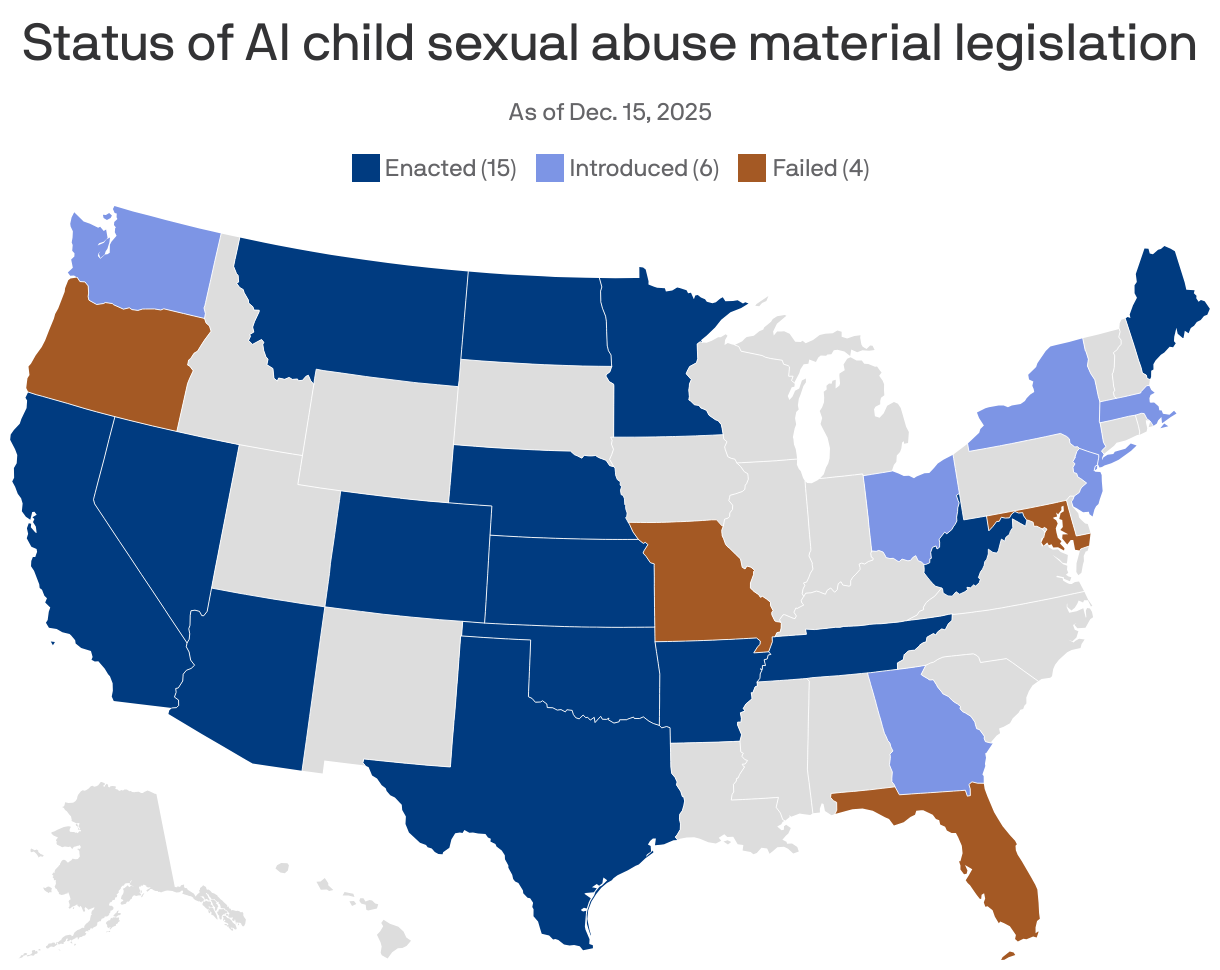
The National Center for Missing & Exploited Children's CyberTipline saw a 1,325% increase in reports involving generative AI from 2023 to 2024.
Why it matters: This dramatic increase shows how AI tools are being weaponized to accelerate and scale child exploitation tactics.
- It's also a sign of how fast gen AI is scaling overall.
Catch up quick: In late 2023, NCMEC noticed that blackmailing children was getting a lot faster, Fallon McNulty of NCMEC's exploited children division told Axios.
- Previously, interactions lasted days or even years. Now, financial sextortion (using nude images to coerce someone to send money) with a teen could be a matter of hours.
- And children who have never spoken to a scammer, sent a photo or shared personal information are being contacted with sexually explicit images created using AI and a profile picture. The scammer will say: "No one is going to believe this isn't you. You might as well do what I say." It looks scary real, McNulty says.
What we're hearing: Now, "the most alarming trend that we are seeing is reports related to sadistic online exploitations," McNulty said. Children are coerced to engage in self-harm, self-mutilation, suicide, mass violence and harm to animals. The motivation offenders have here is simply to gain fame in a group by causing chaos, she said.
- First interactions often occur on gaming platforms like Roblox or over social media and then move into a private messaging environment.
Educating parents and children about these dangers is key to protecting families, McNulty says. NCMIC resources include:
- Take It Down: A free, anonymous service to remove or stop the online sharing of nude, partially nude, or sexually explicit images or videos taken of someone when they were under 18 years old.
- No Escape Room: An interactive experience for parents and guardians to see how fast this crime can happen.
- More resources can be found at NetSmartz, NCMEC's online child safety program.
3. AI companions: "The new imaginary friend" redefining children's friendships

Axios San Diego
