Axios Pro Rata

April 10, 2023

Top of the Morning

Illustration: Sarah Grillo/Axios
Last month we reported that Stifel poached three top venture bankers from Silicon Valley Bank, while the FDIC was still seeking a buyer.
- Last week I spoke with two of them, Jake Moseley and Matt Trotter, about the last days of SVB, the decision to leave, and how they believe the venture debt market has been forever changed. Some excerpts from our conversation:
Before the fall, per Moseley: "We were aware of the held-to-maturity investments ... We listened to the earnings calls and had discussions across our team and more broadly at SVB about that portfolio. But [management] also had justifications about the capital ratios, and we had visibility into analyst reports that were almost all buy or hold ratings. Did we foresee what was coming? No, we were blindsided."
Bank run, per Moseley: "That Thursday was probably the toughest day in my career, and 22 years at SVB ... We kept having conversations with concerned clients, but the best way to describe it is engaging in hand-to-hand combat when an avalanche or tsunami is coming at you."
- Trotter: "Our job had been to build relationships, so people kept calling and texting us. The best we could do was present them with the wide range of outcomes... You had investors and CEOs with fiduciary responsibilities to take care of their companies and employees. I don't hold them accountable for [withdrawals] or blame them."
Departures, per Trotter: "We had a lot of loyalty and love for SVB ... But we quickly came to the realization that no matter what happened — if SVB continued as a standalone or was bought or wound down — the SVB we'd known was going to be very different on the backside, and we needed to decide where we wanted to spend the next 10 years of our careers."
Future, per Trotter: "The industry standard was that when you got a loan you had to have primary accounts and cash or investments with the lender, whether it be SVB or another lender. Not minimum balance requirements, but as an element of risk management, because you were able to monitor liquidity in a more dynamic way than through monthly financials. Also, though, it brought down lending costs for lots of early-stage companies, because the lender could make money off of credit cards or other things... I think the deposit rules and costs are going to change."
- Moseley: There's going to be a need to diversify banking that wasn't felt before, which will lead to market share being split out across the industry. We see that as being forever changed. Just like the days of keeping 100% of your cash on balance sheet with one bank is forever gone."
The BFD

Illustration: Aïda Amer/Axios
Emirates Telecommunications Group agreed to pay $400 million for a 50.03% stake in the super app of Careem, the Middle East subsidiary of Uber (NYSE: UBER). The deal is being structured as an independent spinout, with Uber retaining full ownership of Careem's ride-hail business.
Why it's the BFD: This reflects restructuring efforts by both companies.
- ETG, a 47-year-old group formerly known as Etisalat and now as e&, is seeking to transform from a regional telecom giant into a global tech and investment group.
- Uber, which bought Careem for $3.1 billion in late 2019, continues to divest noncore assets. Last month, Bloomberg reported that Uber is considering a spinoff of its freight logistics unit, while a few years back it spun out the delivery robots business and sold its flying taxi business.
The bottom line: "Careem Technologies will focus on the growth of the company’s 'super app,' which offers dozens of services beyond ride hailing in one app. Some of those services include Careem Quik grocery delivery in 15 minutes or less, food delivery, PCR test booking, digital payments and remittances transfers, bicycle rentals, laundry and cleaning services and event ticket booking." — Natasha Turak, CNBC
Venture Capital Deals
• Fire, a browser extension for prevening crypto fraud, raised $3.5m led by Atomic, per Axios Pro. https://axios.link/3Kom0B0
• Perfection42, a Lithuanian AI imagery startup, raised €1.1m in seed funding from backers like CoInvest Capital and OCC. https://axios.link/3Mvzfma
Public Offerings
🚑 Inspire Veterinary Partners, a Virginia Beach, Va.-based vet practice network, filed for an IPO that would raise $28m at its midpoint price. It plans to list on the Nasdaq (IVP) and reports a $4.9m net loss on $9.8m of revenue for 2022. https://axios.link/3ZVsSvn
• TypTap Insurance Group, a Tampa, Fla.-based homeowners insurance provider being spun out of HCI Group (NYSE: HCI), withdrew IPO registration. https://axios.link/3nXV8A8
Liquidity Events
• Sleep Country Canada (TSX: ZZZ) agreed to buy the Canadian assets of mattress maker Casper Sleep, which was taken private last year by Durational Capital Management. The deal includes US$20.6m in cash, plus a $4.5m marketing transition fee and a $20m purchase of convertible notes in Casper Sleep. https://axios.link/3KMi9yU
More M&A
⚡ Enel (Milan: ENEL) agreed to sell its Peruvian assets for around $2.9b to China Southern Power Grid. https://axios.link/43hAlaO
⚡ Exxon Mobil (NYSE: XOM) has had preliminary talks to buy Pioneer Natural Resources (NYSE: PXD), an Irving, Texas-based fracking company with a market cap north of $48b, per the WSJ. https://axios.link/3miv7et
⚡ Pierre Lassonde, co-founder of Franco-Nevada (TSX: FNV), plans to buy a stake in Teck Resources’ (TSE: TECK) coal company spinoff, per the Globe & Mail. The move is designed to protect the business from a foreign takeover and comes after Teck rejected a $23b takeover offer from Switzerland’s Glencore. https://axios.link/3zJfYFZ
• Sunday Natural, a German online retailer of vitamins and food supplements, is considering a sale that could value the company at €600m-€800m, per Reuters. https://axios.link/40W2v9J
Fundraising
• Bitget, a crypto derivatives exchange operator, launched a $100m VC fund that will focus primarily on Asia. https://axios.link/417kmuo
Final Numbers: U.S. IPO proceeds
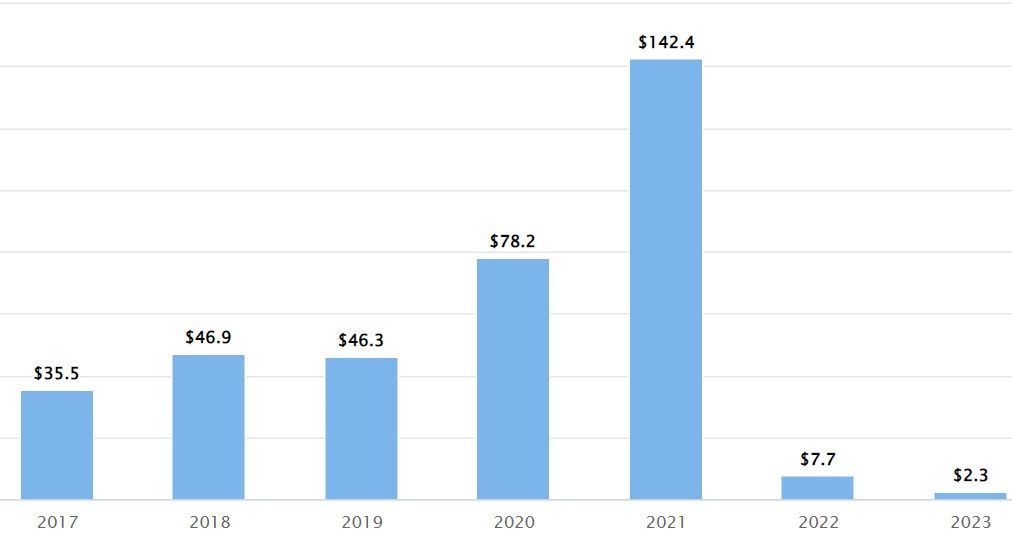
The IPO window continues to feel nailed shut, with a fresh coat of lacquer on top for good measure. But there is at least some very slight improvement over 2022, per data from Renaissance Capital.
- U.S. IPO proceeds are up 12.5% year-to-date and pricings are up 77.8%. Yes, that obviously means that average IPO sizes have tumbled.
- Filing activity climbed 15.7%.
Thanks for reading Axios Pro Rata, and to copy editor Mickey Meece! Please ask your friends, colleagues and media mogul grievers to sign up.
Sign up for Axios Pro Rata

Dan Primack’s briefing on VC, PE & M&A for dealmakers.