Axios Pro Rata

March 02, 2024

Happy Saturday! This week's edition comes to you from the Upfront Summit in Los Angeles. Thanks to all of you there who said hi!
- Programming note: I'll be in your inbox Monday morning because of a conflict in Dan's schedule, but he'll be back at the helm the rest of the week.
- 👋 Reminder: Feel free to send me tips or comments by replying to this email or on X: @imkialikethecar. (Or ask me for my Telegram or Signal number.)
Today's Smart Brevity™ count is 779 words — a 3-minute read.
1 big thing: VCs seek their own AI investment strategies

Illustration: Natalie Peeples/Axios
There's no one-size-fits-all strategy when it comes to VC investments in the booming AI sector.
State of play: Large language model companies are still making headlines for raising piles of cash at eye-popping valuations, but it also appears a growing number of VCs are slinging some of their checks in other directions.
The big picture: At Upfront Ventures' annual confab in Los Angeles this week, a number of top VCs took the stage to share their thoughts on investing in AI.
Zoom in:
- General Catalyst: "We've decided not to invest too much at the [foundational] language model layer, to focus much more on … how do these models interface with different verticals? So what are the modern vertical [software as a service] companies gonna look like, and what are the modern vertical business function companies gonna look like," explained CEO Hemant Taneja.
- Menlo Ventures: "In the near term, it's that it's more about picks and shovels. So really the surrounding infrastructure that helps everyone build at the application layer," said partner Matt Murphy. "You have to be really careful about getting into a crowded category … [and] things that feel like a bolt-on … like if generative AI didn't exist, this application shouldn't be built."
- Lightspeed Ventures: Partner Nicole Quinn said that "on the application layer, it generally starts with entertainment, companionship, escapism.…And then once it reaches critical mass at that point, you then move to the more utility sides of applications … an AI financial manager, or an AI interior designer or a travel planner … and so when we're sifting through, that's when we get excited." She and fellow partner Mike Mignano later warned that big corporate investors don't have the same incentives and investment models as traditional VCs, making those funding rounds and their valuations tricky.
- Founders Fund: "Anything not AI," partner Brian Singerman replied when asked about contrarian areas worth investing in. He compared the current wave of self-proclaimed AI startups to the pre-IPO internet companies of the dotcom era. He cautioned that many startups today aren't really AI companies, but rather are just using the tech.
The bottom line: As in any technologic boom, some will dive in to plant their flag in what they see as the companies that will control how the industry evolves, while others will focus on clever applications once the froth dissipates.
2. What they're saying: Yahoo CEO Jim Lanzone

Illustration: Shoshana Gordon/Axios
Yahoo CEO (and turnaround veteran) Jim Lanzone shared some thoughts on the company's M&A strategy:
On Yahoo's acquisitions:
Everything we've done so far, it's been on the smaller end … about $30 million in … common stock, which is a community platform for Yahoo Finance, [that's] the biggest we've done so far. But we've actually been in the game for much larger deals that … we weren't the highest bid for.
I would look at two ways for us. One is categorically: What are other categories that are adjacent to what we do today, where Yahoo is the trusted guide, and these categories or other ones that we could also participate in or that we already do, but just that we could be much larger in.…
The other is: What can accelerate our product roadmaps? So you won't really see us doing acqui-hires, like we're not in the position or don't really believe in doing that just to bring on talent.… But to bring on products that can accelerate our roadmap by a year or more — we're very interested in that. And we've done a couple of those. We have more I think that we will be announcing shortly like those; those are the two main buckets for us.
On an IPO down the line:
I don't think we need to think too far ahead about what the exit strategy is. We kind of just got here, and our focus [is] on how do we get everything moving here the way that we believe in.… I think good things will happen. And we're not writing that next chapter yet.
I will say I don't think it's healthy for us to worry about [what] these trillion-dollar companies [are] doing.… We were bought for $5 billion.… We are still top five, or hundreds of millions of users a month. We have a footprint that's, you know, very unusually big.
🧩 Trivia
As usual, the Upfront Summit was chockful of celebrity entrepreneurs.
- Question: What products (aside from their entertainment endeavors) do the following folks have businesses in: Lady Gaga, Cameron Diaz, Jonathan Van Ness, Katy Perry? (Answer at the bottom.)
🧮 Final Numbers
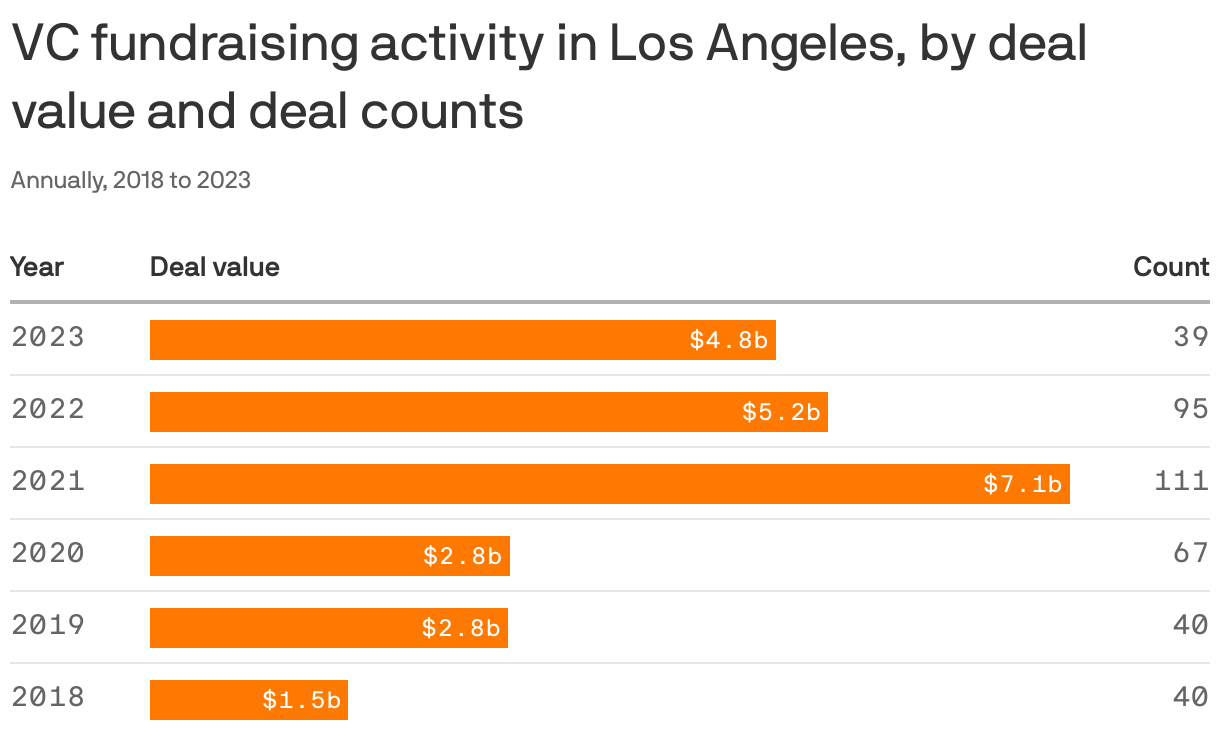
🙏 Thanks for reading! And to Javier E. David and Brad Bonhall for editing. See you Monday for Pro Rata's weekday programming, and please ask your friends, colleagues and contrarian AI investors to sign up.
Trivia: Lady Gaga has Haus Labs, a beauty company; Cameron Diaz has Avaline, an organic wine company; Jonathan Van Ness has Yummers, a pet food company (in addition to his hair care line); and Katy Perry has De Soi, a nonalcoholic apéritif brand.
Sign up for Axios Pro Rata

Dan Primack’s briefing on VC, PE & M&A for dealmakers.