Axios Portland

December 15, 2025

🥖 Welcome back, Monday. Let's get this bread, or whatever the kids say now.
Today's weather: Rainy and breezy. High around 59, low near 48.
🎂 Happy belated birthday to our Axios Portland members Luba Cherbakov, Michael Radway and Karen Mapes!
⏮️ Programming note: All this week, we're going to be reflecting on the biggest news events of the year, starting with the mayor's ambitious homelessness goals.
Today's newsletter is 1,038 words — a 4-minute read.
1 big thing: 🏛️ Year in reflection: Wilson on homelessness

Mayor Keith Wilson ran for office with a singular focus: ending unsheltered homelessness in Portland in his first year.
Why it matters: He isn't on track to meet that goal.
The big picture: Wilson claimed victory Dec. 1 on reaching his goal of creating 1,500 new overnight shelter beds.
- But critics say it's unclear how the mayor's strategy will result in fewer people experiencing homelessness.
What they're saying: "My stated goal is to have a bed available for anyone who wants one, and we've delivered on that," Wilson told Axios in an email. "Since January, we've opened 1,566 shelter beds across Portland."
Yes, but: It takes some creative math to get to that number.
- When he made the announcement, just 890 of those beds were actually available, per OPB, with locations for another 600 or so identified but not yet open.
- And a walk through downtown shows that there are still plenty of people — nearly 7,500 as of September — living without shelter in Multnomah County.
The other side: Marisa Zapata, director of the Homelessness Research & Action Collaborative at Portland State University, said she's been confused by Wilson's strategy from the start.
- "Ending homelessness is not about providing shelter," Zapata told Axios. "It's about providing housing."
- She noted that many of the new shelter beds don't offer access to services — behavioral health, addiction treatment or case workers — so they act more like a Band-Aid than a cure.
What's next: Wilson intends to shift his focus to housing, noting that he created a strike team to find city-owned sites that can be converted to homes, move more quickly on permitting and development, and fill existing vacancies in affordable housing.
- A real estate analytics firm found earlier this month that some 1,900 affordable housing units were vacant despite thousands of people in need.
- Wilson said his administration is working to match people in shelters with available housing and "expanding rental assistance to help with deposits and move-in costs."
Zapata cautioned that the city will need to go big.
- "Our affordable housing measures have outperformed, and we still don't have enough housing."
Invest in Local Journalism
Quality journalism is essential for a thriving community.
Support local journalism by becoming an Axios Portland member.
- Starting at $25 a year, you'll help us expand our coverage of the issues that matter most to you.
Together, we can make a difference in keeping our community informed and engaged.
Thank you for your consideration.
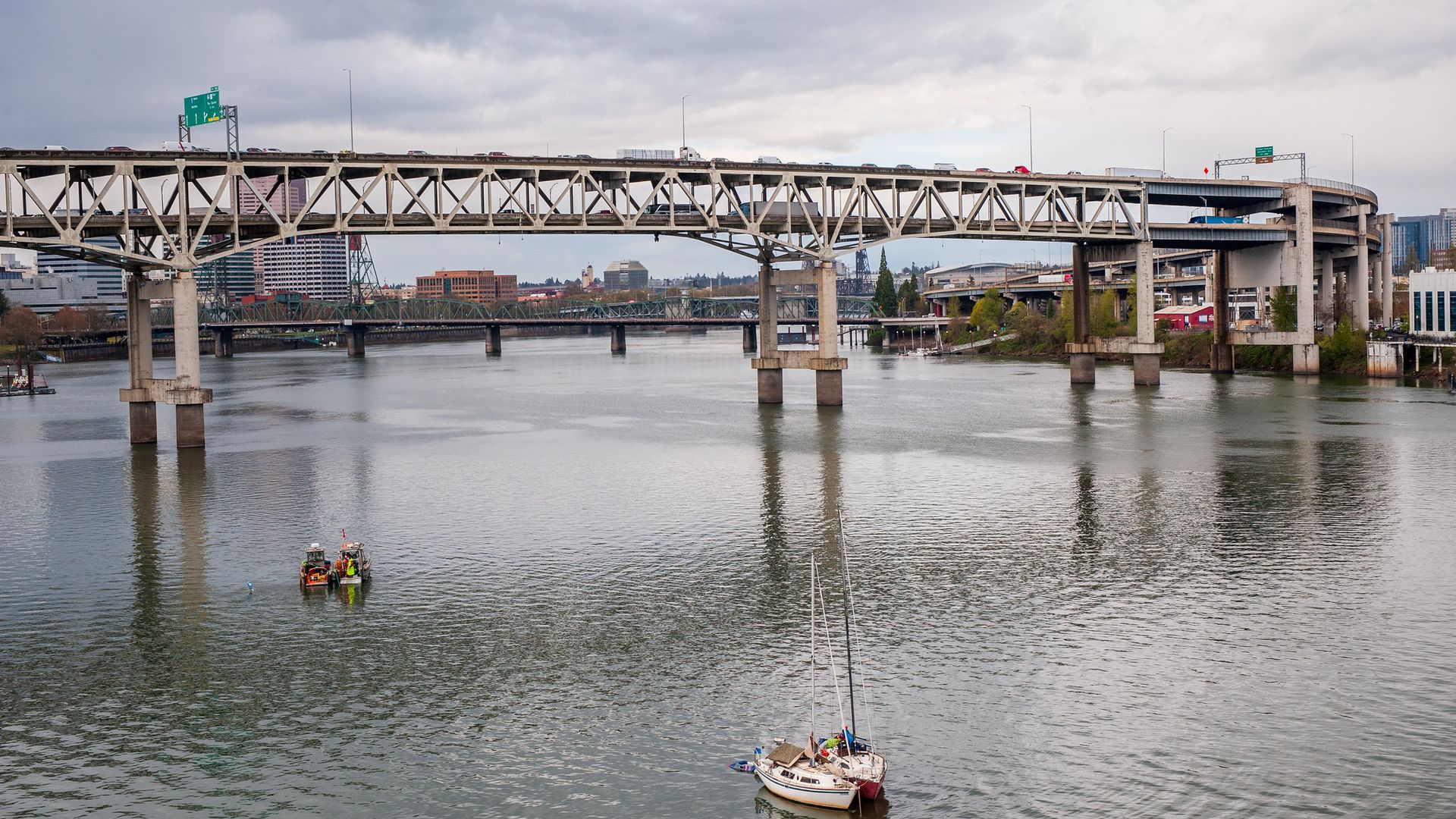
2. 🌁 Get to know the Marquam Bridge
The Marquam Bridge may be the ugly duckling among Portland's other river-spanning beauties, but she does the heavy lifting.
The big picture: The bridge was the state's first double-deck freeway bridge, and now it carries more than 140,000 vehicles every day, making it the busiest in Oregon.
Flashback: Built in 1966, the vehicle-only Marquam Bridge's sole purpose was to complete the entire 310-mile Interstate 5 corridor across Oregon and connect other major highways, I-84 and I-405, to I-5.
- The bridge was designed by Oregon Department of Transportation engineers. They settled on a 5,280-foot-long double-deck steel-truss cantilever design to allow for practical interchanges.
- While other bridges crossing the Willamette have movable spans, the Marquam is fixed. There's roughly 130 feet of clearance below deck to allow river traffic to pass seamlessly.
Follow the money: Construction of the bridge cost roughly $11 million, which at the time made it the costliest in Portland history.
The intrigue: Depending on who you ask, the bridge was named after either judge and lawmaker Philip Marquam or the Marquam Gulch, a nearby spring.
What they're saying: Everyone seemed to hate the bridge's blasé appearance.
- The Portland Art Commission called it "so gross, so lacking in grace, so utterly inconsistent with any concept of aesthetics."
- Meanwhile, former Mayor Vera Katz said it had "all the subtle charm of the Daytona 500 smack dab in the middle of our city."
The haters got their way in the design of Portland's next bridge a few years later, which is arguably the city's crown jewel.
3. Rose City Rundown
📚 Oregon is building out a new education accountability system that will track metrics like attendance, graduation rates, and english and math proficiency for the more than 200 school districts, charter schools and other educational settings across the state. (OPB)
🚨 Multnomah County is the latest of several Oregon jurisdictions to declare a state of emergency over the impact of federal immigration enforcement. (KGW)
🤞🏼 A changing weather pattern could drop temperatures and bring significant snow to the Cascades next week. (KOIN)
👀 The Oregon Nurses Association accused Legacy Health of jeopardizing patient safety by allowing immigration agents to stay in treatment rooms while detainees undergo sensitive exams.
- Legacy Health denied any wrongdoing and said it has followed all of its own health and safety protocols. (OPB)
4. 🤒 Chart du jour: When flu orders spike


Instacart orders for cold and flu medicine, cough suppressants and other sick-day essentials tend to spike around Christmas, per new data the company shared with Axios.
Why it matters: It's a way of seeing how our shopping patterns are affected by outside factors — in this case, cold and flu season.
What they found: Orders for cold and flu medicine and cough suppressants both peaked on Dec. 26 last winter, per Instacart.
- Facial tissues peaked on Dec. 27, while "immune support" products peaked on Dec. 28.
How it works: That's based on each category's daily order share between July 1, 2024, and June 30, 2025.
Between the lines: Some relevant items had definite wintertime spikes, but others — like hand sanitizer and wipes — saw steadier demand over the covered period.
What's next: Experts are warning of a new flu outbreak tied to an emerging version of strain H3N2.

5. 🍔 Reader callout: Your fave cheap eats
Times are tough lately and food is expensive. So where are you going to snag cheap — but most importantly, delicious — eats these days?
😋 Send us your favorite happy hours, discount meal deals, to-go bites and underrated neighborhood gems that won't break the bank.
- We may feature your recommendations (and photos if you send 'em!) in an upcoming newsletter.
Hit reply or email us at [email protected]
💃 Meira is booking her New Year's Eve reservations.
🏂 Kale is hoping that sharpening his edges didn't jinx us.
This newsletter was edited by Hadley Malcolm.
Sign up for Axios Portland