Axios Portland

October 05, 2026

🏫 It's Monday. Today we're bringing you an in-depth look at the changing role of college from our national colleagues.
🌤️ Today's weather: Patchy fog then mostly sunny. High 77, low 55.
🎸 Sounds like: "Sweater Weather" by The Neighbourhood, who play Moda tonight.
Today’s newsletter is 1,029 words — a 4-minute read.
1 big thing: 🎓 College pipeline tested

Whether framed on an office wall, collecting dust in a box or still a distant dream, the college diploma is getting a hard reappraisal.
Why it matters: College was once sold as a ticket to the American dream. But students today are taking a tougher look at the college tradeoff: burdensome debt and no guarantee of a dream career — or employment at all, as AI threatens the jobs the degrees were meant to unlock.
"People didn't ask whether college mattered 20 years ago," says Courtney Brown, the vice president of impact and planning at Lumina Foundation. Now, "they're asking: Are today's students going to be prepared for tomorrow's jobs? Is it really helping them out?"
- Confidence in higher education slipped among both parties and all levels of educational attainment this year, according to June Gallup polling.
But there's a college confidence paradox: Even as Americans sour on higher education, they keep sending their kids to campus.
- "There is still massive pressure on them from their high schools, the educators at their schools, their parents, their peers, and just the broader culture to still go to college," says The Up & Up founder and Gen Z researcher Rachel Janfaza.
The anxiety isn't new — but the reality is. Today's concerns fall into three big buckets: Affordability, getting your money's worth and outcomes.
The bottom line: High schools and colleges need to adapt to the changing job market, Janfaza says, giving more weight to extracurriculars and soft skills.
- "It's not a marketing campaign — I'm not saying go make another billboard," Brown tells Axios. "But show it really in the outcomes of your students."
2. 💭 The big college major rethink

Students and their parents are searching for future-proof college majors for an AI-powered world.
Why it matters: AI is changing the skills employers expect from entry-level workers, while colleges are rethinking how to prepare students for the transition.
The big picture: Rumors of the death of jobs might be greatly exaggerated, but college students and graduates are still worried about what comes next.
By the numbers: Nearly seven in 10 (69%) college students worry AI will make it harder to find a job, per a recent survey of 2,000 U.S. higher education students by Superhuman (formerly Grammarly).
- Fewer than half (45%) say they feel optimistic about the job market after graduation,
- One in five (22%) students say they've changed their major or concentration because of concerns about the job market.
Zoom out: Today's college majors aren't necessarily built for the future labor market.
- Transferable skills like critical thinking, AI literacy, leadership and collaboration will be the skills employers are looking for, according to Leah Belsky, VP of education for OpenAI.
Reality check: Accounting firms are still heavily recruiting students, with demand currently outpacing supply, Evans tells Axios.
- But employers "are expecting more from students coming out of college than they have ever before — in accounting and elsewhere."
3. Rose City Rundown
🎨 Portland Metro Chamber CEO Andrew Hoan and Bison Coffeehouse owner Loretta Guzman sued the city last week over its 43% arts tax increase, arguing the City Council lacked authority to raise the voter-approved tax without another public vote. (OPB)
👟 Nike announced another round of restructuring and pending layoffs after quarterly sales missed analysts' expectations.
- The company's stock fell more than 8% in after-hours trading last week, hitting its lowest level in 13 years. (The Oregonian)
The Blazers fired newly hired play-by-play announcer Braiden Bell just hours after announcing him Thursday, following old, resurfaced social media posts from when he was an adolescent containing racist and sexist language.
- The team apologized and said it would restart the search. (KGW)
🏠 Supportive-housing providers say rising property damage tied to tenants with severe mental health and addiction needs is driving up insurance costs, prompting calls for more intermediate treatment options. (Willamette Week)
4. 📉 Enrollment shift

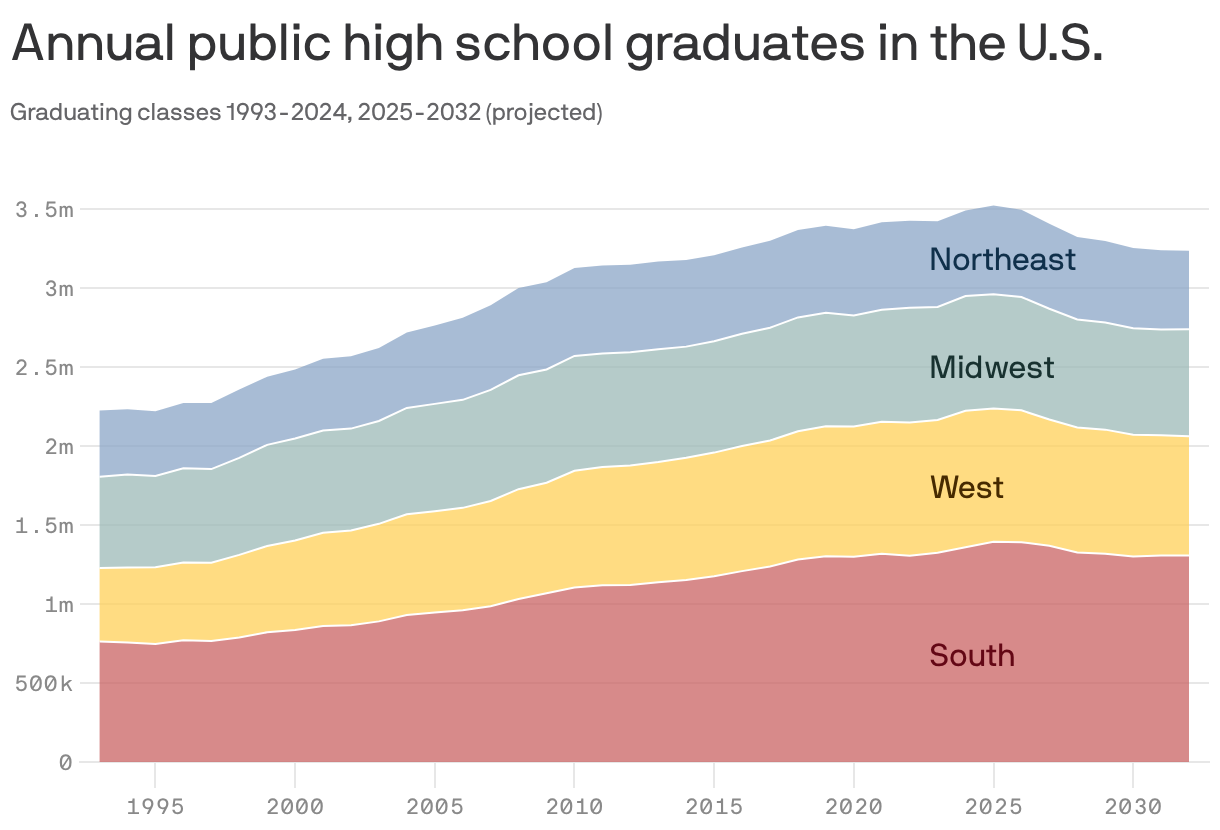
America's future college pipeline is shrinking in Oregon.
Why it matters: America's next higher-ed reckoning won't hit regions evenly. Colleges in shrinking markets will face a fierce fight for students, while those in growing regions will have to adapt to serve an expanding, more diverse student body.
By the numbers: The number of Oregon high school graduates is projected to be 19% lower in 2041 than it was in 2023, per the Western Interstate Commission for Higher Education (WICHE).
- That's nearly double the national decline of 10%.
Between the lines: Brand-name schools can recruit nationally. Regional universities and less-selective private colleges are much more dependent on the shrinking pool of students around them.
Zoom out: The enrollment squeeze is colliding with sticker shock, as some colleges push annual tuition into six-figure territory.
What we're watching: Whether more colleges cut jobs, humanities programs and low-enrollment majors to stay afloat.
5. ✨ Backup plan, powered by AI

Some young workers are swapping laptops for hardhats, betting that a welding torch or a toolbelt could offer more protection from AI disruption.
Why it matters: As artificial intelligence rattles white-collar career paths, more young Americans are looking to the skilled trades for lower debt, stable pay and work that's harder to automate.
- John Zink, vice president at the PHCC Educational Foundation, puts it bluntly: "We have the high demand jobs that AI can't take because AI can't run pipe or install HVAC systems."
What they're saying: Octavius Jackson, 25, spent two years at Prairie View A&M before pivoting to the Aviation Institute of Maintenance for an airframe and powerplant certificate.
- He said choosing a career less vulnerable to AI factored into his decision.
- "You don't want a robot fixing up these planes," and making a mistake that could have deadly consequences, he said.
- His friends and family "100%" supported his decision.
👩🏻🏫 Meira is the proud daughter of a lifelong educator.
🔨 Kale is grateful for the decade he spent in the trades before he went to college.
This newsletter was edited by Geoff Ziezulewicz.
Sign up for Axios Portland