Axios Philadelphia

April 06, 2026

Monday, back in the driver's seat.
🌤️ Today's weather: Mostly sunny, with a high of 57 and a low of 40.
Today's newsletter is 1,071 words, a 4-minute read.
1 big thing: Pennsylvania's expensive energy boom
Domestic energy production is at an all-time high, but it's not leading to lower electricity bills.
Why it matters: Electricity rates are rising across the country, including in Philadelphia, where a proposed hike could increase residents' bills by 12.5%.
The big picture: Pennsylvania is doing its part for the local grid, producing record amounts of natural gas and exporting more electricity than any other state in the nation, per the U.S. Energy Information Administration.
- But even that isn't lowering costs for consumers, because Pennsylvania still isn't producing and transferring enough energy.
- Demand has skyrocketed due to increased residential consumption and energy-hungry data centers, energy leaders and Gov. Josh Shapiro's administration tells Axios.
- Increasing fossil fuel use has been shown to have an impact on climate change.
Zoom in: Last month, PECO, the Philly region's largest energy provider, proposed to state regulators rate increases worth $520 million in 2027 for electricity and gas to fund upgrades and improvements to its grid, per the Inquirer.
- That bump would translate into about $20 more on electric bills and about $14 on gas bills for PECO's roughly 2.2 million customers.
What they're saying: Gov. Josh Shapiro said in a social media post that the utility provider's proposal was "pure greed" and pointed out that PECO had made more than $800 million in profits in 2025.
The other side: PECO knows customers "are being squeezed in almost every area of their life, from childcare to gasoline, and yes, even in energy," the company's senior vice president Doug Oliver told the Inquirer.
- "We spent a lot of time trying to figure out if there's a way to not do this. ... We concluded that there was no other way."
Reality check: "Simply put, we need more energy infrastructure — pipelines, natural gas storage, and power plants — in Pennsylvania and the broader PJM region," said Cynthia Niemeyer-Tieskoetter, an American Petroleum Institute senior policy adviser.
- Natural gas isn't moving efficiently enough from Pennsylvania to power plants to create electricity, she said, and modernizing the permitting system to build gas infrastructure faster is needed.
Between the lines: The Shapiro administration supports an "all-of-the-above" approach but warns against overreliance on natural gas.
- Natural gas generated over 58% of the state's energy in 2025, up from 30% a decade ago, spokesperson Samantha Reposa said.
- "Solar is an ideal partner for storage because the fuel costs are zero, it's free from the sun and when paired with storage you can deploy it in the moments when it's most economical and needed," she said.
Support Local journalism
We believe strong communities start with clear, reliable local news.
đź’ˇ Become an Axios Philadelphia member today. You'll help power the reporting that keeps you informed on what matters most around your city.
Together, we can ensure our community stays informed.
2. đź‘¶ Pennsylvania's surrogacy laws

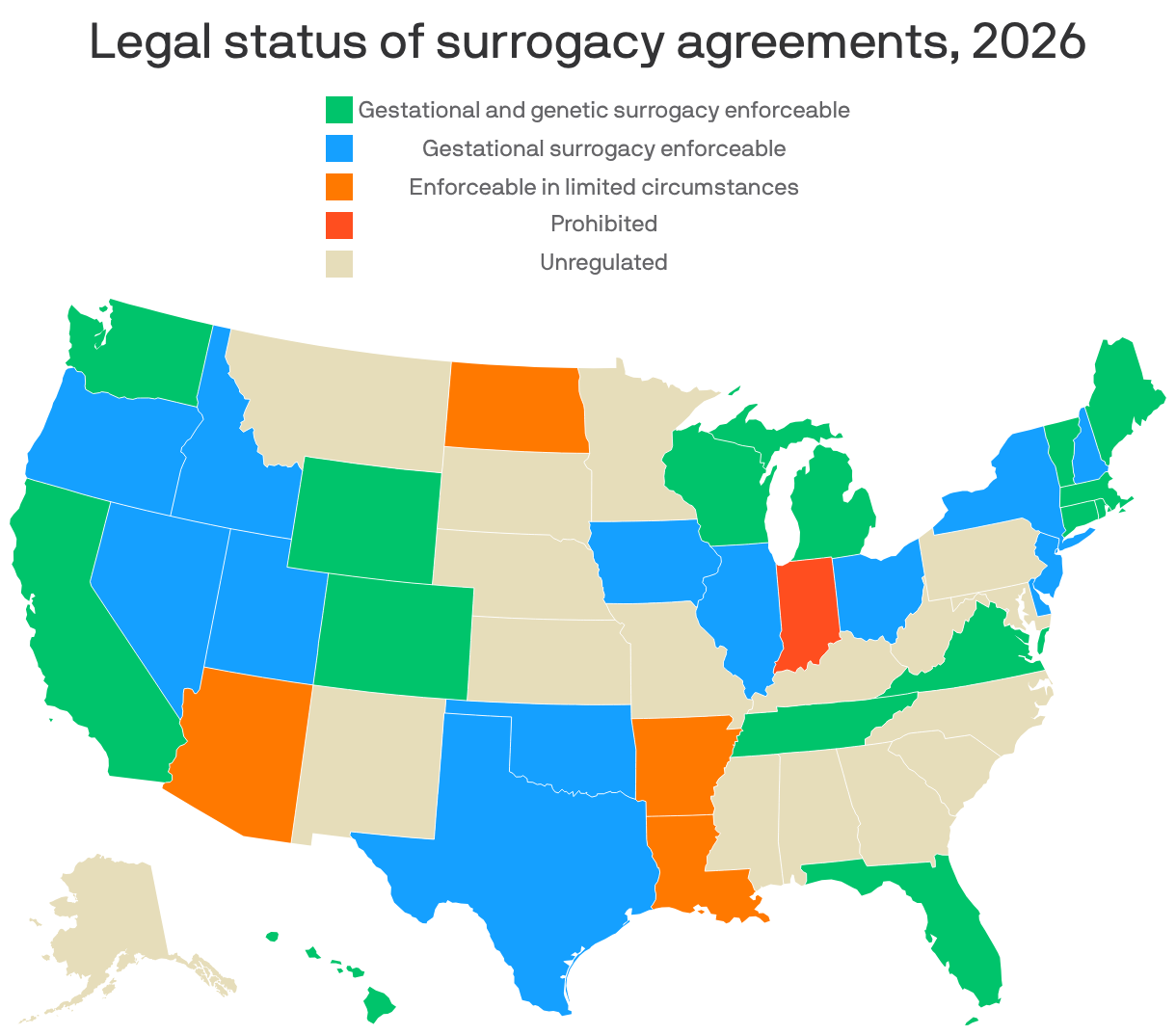
Pennsylvania's murky surrogacy laws highlight a broader reality: Without federal rules, the practice is governed by a patchwork of state regulations.
Why it matters: Confusing, varied local rules can determine everything from whether agreements are legally binding to who is recognized as a parent at birth.
By the numbers: As of 2026, surrogacy agreements are enforceable in 31 states (with some limitations), void in one, and unregulated in 17, Surrogacy360 tells Axios.
Major differences between state laws include:
- How a surrogate must be compensated (if not considered "altruistic").
- Who becomes the legal parents of a child born via surrogate.
- And whether genetic surrogacy (when the surrogate uses her own egg) is even allowed.
Zoom in: Surrogacy is relatively common in Pennsylvania, though it's difficult to determine exactly how many arrangements occur each year.
- The state does not have clear laws governing the practice, including whether surrogacy agreements are enforceable or whether a surrogate can be paid beyond basic expenses.
- After a child is born, intended parents often need to complete an adoption to be legally recognized as the child's parents.
Friction point: That legal gray area has led some to call for a clearer state framework after a case in which a Pennsylvania man who was a registered sex offender became a parent through surrogacy.
Between the lines: Some state regulations have barriers for intended parents who are single, unmarried, not a heterosexual couple and/or not genetically related to the child.
- And, often, surrogacy agreements happen across state lines, so multiple state laws might need to be considered.
What they're saying: A growing number of lawyers "have begun to specialize in advising either intended parents or being the separate counsel for a surrogate," says Ming Wong, an attorney and the director of community justice and access at the National Center for LGBTQ Rights.
- Because contracts involve so many potential risks, like one party changing their mind midway through the process, "we always encourage people to at least talk to an attorney … even in a state where it's not criminalized," Wong says.
3. News Market: Wawa's recall

đź«– Put that Wawa ice tea down. The popular convenience store and gas station has recalled some store-brand drinks, including iced tea lemon and diet lemonade, from Philly-area stores after the USDA said some of the 16 oz drinks may include a milk allergen. (Inquirer)
âšľ He's completely outta here! Former Phillies outfielder Nick Castellanos, now with the Padres, has sold his Moorestown mansion for $4.9 million.
- The luxe home was once owned by Ben Simmons, who, like Castellanos, also had an unceremonious exit from Philly. (Biz Journal)
4. Fly, Flyers, Fly
Porter Martone kept the Flyers' playoff hopes alive, scoring the winning goal in overtime of Sunday's 2-1 win over the Bruins.
Why it matters: The Flyers, long Philly's forgotten sports team, are on the cusp of making the NHL playoffs for the first time since 2020.
Driving the news: Martone's first career goal boosted the Flyers into third place in the Metropolitan Division with five games to go.
Catch up quick: The Flyers have been a down-and-out franchise since losing the Stanley Cup to Chicago in 2010, winning only three playoff series since then, per the AP.
The bottom line: If the Flyers can hold on down the final stretch of the season, Gritty-loving Philly's going to be collectively hitting the Griddy dance.
What's next: The Flyers are back in action Tuesday at 7pm against the New Jersey Devils.
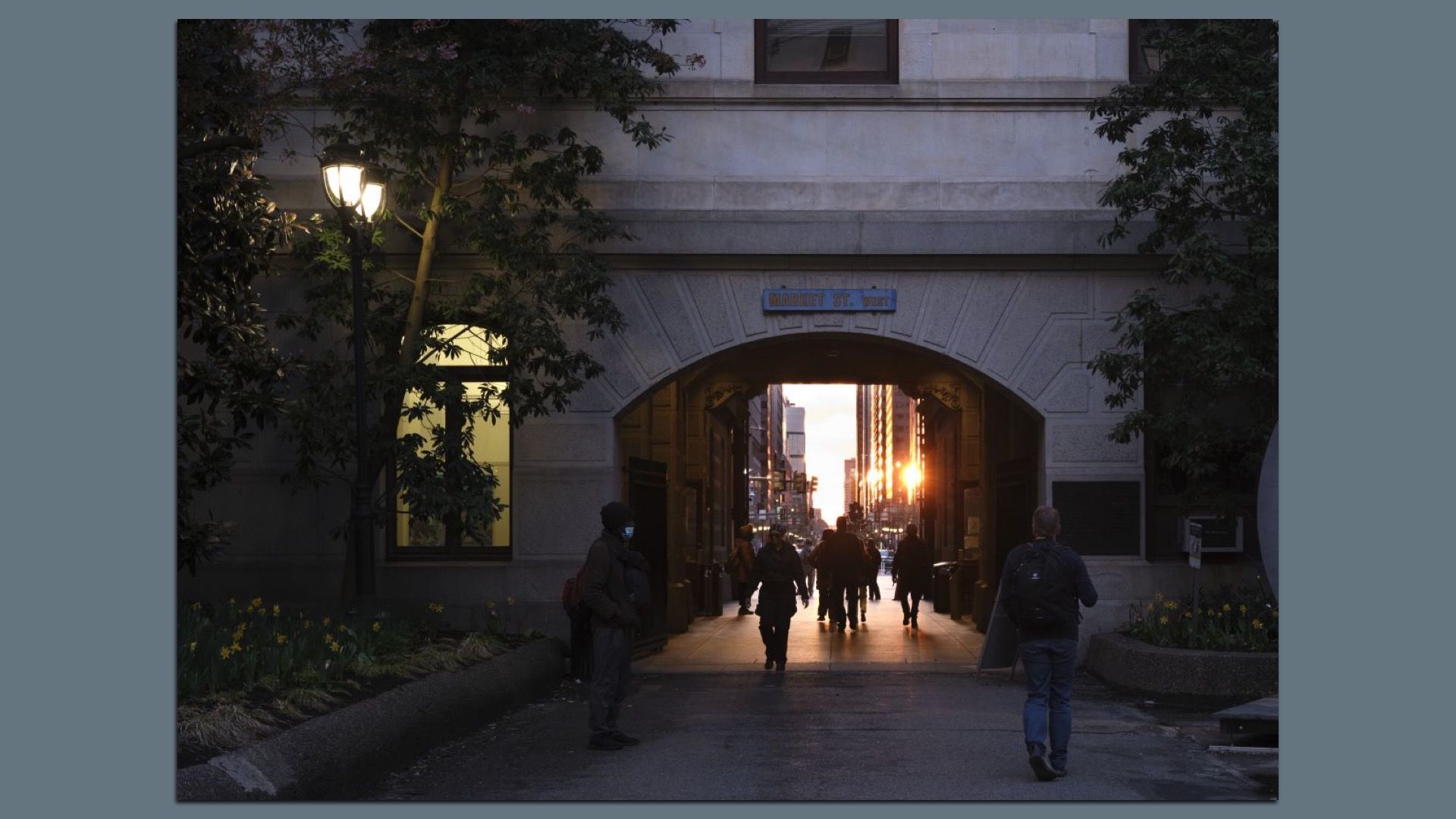
5. 🌄 1 Phillyhenge pic to go
Axios reader Bill P. was one of the few photogs staked out at City Hall for yesterday's Phillyhenge.
- Mother Nature didn't look like she was going to cooperate — until the clouds parted for this gorgeous shot.
🫡 Isaac hopes his co-pilot had a welcome respite.
Today's newsletter was edited by Katie Peralta Soloff.
Sign up for Axios Philadelphia