Axios Northwest Arkansas

October 26, 2022
Good morning. It's Wednesday.
โ โ We're bringing you a special newsletter today to take a look at Issue 4, the amendment on the Nov. 8 ballot that would legalize recreational marijuana. Early voting has begun. Check out our complete voter guide.
โ๏ธ It's finally sunny again. Plan on highs in the mid-60s.
โก๏ธ Situational awareness: The Medical Marijuana Commission approved the transfer of Osage Creek Dispensary from Fayetteville to Eureka Springs, and the Alcohol Beverage Control Administration has issued a letter authorizing the company to formally open the dispensary at 101 E. Van Buren St.
Today's newsletter is 979 words โ a 4-minute read.
1 big thing: What's in the amendment
Illustration: Shoshana Gordon/Axios
If Issue 4 on Arkansas' 2022 midterm election ballot is passed, people ages 21 and older could buy marijuana from licensed dispensaries for any reason. A medical marijuana card would not be required.
State of play: Voters legalized medical marijuana in Arkansas in 2016, and dispensaries began opening in 2019.
- The state has 38 operating licensed dispensaries and allows up to 40 โ as many as five in each of the eight zones. Eight cultivators do business in Arkansas, the maximum allowed by the state, Scott Hardin, spokesperson at Arkansas' Department of Finance and Administration, tells Axios.
- Additionally, 18 dispensaries, including The Source in Rogers, ReLeaf Center in Bentonville and Acanza in Fayetteville, grow some of their own product.
By the numbers: Medical marijuana is taxed at 10.5%, including a 6.5% sales tax and a 4% privilege tax that goes toward establishing a cancer research institute at the University of Arkansas for Medical Sciences.
Details: In addition to allowing people to legally purchase marijuana, the amendment would:
- Make it legal for people ages 21 and up to possess up to 1 ounce of marijuana.
- Eliminate all taxes on medical marijuana and tax recreational marijuana at 16.5%, including the standard 6.5% sales tax plus 10% for UAMS, law enforcement and the state's drug court programs, which are voluntary drug recovery programs intended to keep people facing drug charges out of jail.
- Increase the allowed number of dispensaries and cultivators.
- Allow dispensaries to sell items such as pipes and bongs.
Learn more from the University of Arkansas Division of Agriculture.
Between the lines: The amendment does not decriminalize growing marijuana for personal use or private sales of marijuana.
Look whoโs hiring
๐ Find a job thatโs out of this world with our Local Job Board.ย
- Campus Security Coordinator at Thaden School.
- Senior Manager, Cost Accounting at Pernod Richard.
- Account Executive at NW Arkansas Naturals.
Want more opportunities? Check out our Job Board.
Hiring? Post a job.
2. Issue 4 is a nail-biter
Illustration: Lindsey Bailey/Axios
The issue needs just over 50% of votes to pass.
State of play: A recent poll by Talk Business & Politics and Hendrix College indicated that about 53% of Arkansans support legalizing recreational marijuana, while about 32% say it should be allowed for medical reasons only. About 10% said marijuana should not be legalized.
- Yes, and: A separate survey by the same organizations found that just over 50% of likely voters are definitely or probably in favor of Issue 4.
What they're saying: Responsible Growth Arkansas, the group that gathered signatures to get Issue 4 on the ballot, has highlighted the sales tax revenue the state would receive as well as the funding for law enforcement, drug court programs and UAMS. The group also cites new jobs and the ability for adults to safely purchase marijuana as reasons to vote for the amendment.
The big picture: Legalizing pot is part of a national trend. Advocates argue that regulated marijuana is safer than buying off the streets and that arresting or jailing people for marijuana use or possession is a waste of law enforcement's time and money.
- Issue 4 can prevent some future convictions, as it will be legal to possess up to 1 ounce.
- Recreational marijuana is legal in 19 states and D.C.
- President Biden announced this month he will pardon all federal offenses of simple marijuana possession.
The other side: Reasons for opposing the amendment vary from those who oppose legalizing recreational marijuana to those who say they support legalization but have problems with this amendment. They say it gives money and power to the marijuana industry but doesn't do enough to help those traditionally hurt by anti-marijuana laws.
- Gov. Asa Hutchinson says he will vote no on the amendment, arguing recreational marijuana leads to increased drug use among minors and more dangerous roadways. Hutchinson is a former administrator at the Drug Enforcement Administration.
- Melissa Fults, a longtime advocate for marijuana legalization and executive director of the nonprofit Arkansans for Cannabis Reform, says she does not support this amendment because it doesn't expunge records for those previously convicted of marijuana possession and doesn't decriminalize growing marijuana at home, a cheaper option. She notes that poor people have historically been targeted for marijuana possession arrests.
- State Sen. Greg Leding (D-Fayetteville) tweeted he supports legalizing recreational marijuana but will vote no on Issue 4 because it "hands a small number of companies full control of the industry, guaranteeing they'll never face competition."
3. Charted: Card carryin' MMJ members


The number of active medical marijuana patients in Arkansas increased steadily through 2022 from about 83,000 at the end of 2021 to about 92,000 at the end of September.
The big picture: The figures come from the state's Department of Health via the Department of Finance and Administration's monthly report.
- DFA's reporting system changed in 2021, and ADH's reports are annual, so comparisons back to the first sale in June 2019 weren't readily available.
By the numbers: Since 2019, Arkansas has collected about $81 million in taxes, and $62 million of that has been directed to the University of Arkansas for Medical Sciences for its work to obtain a National Cancer Institute designation.
4. Employers are in the weeds with medical marijuana
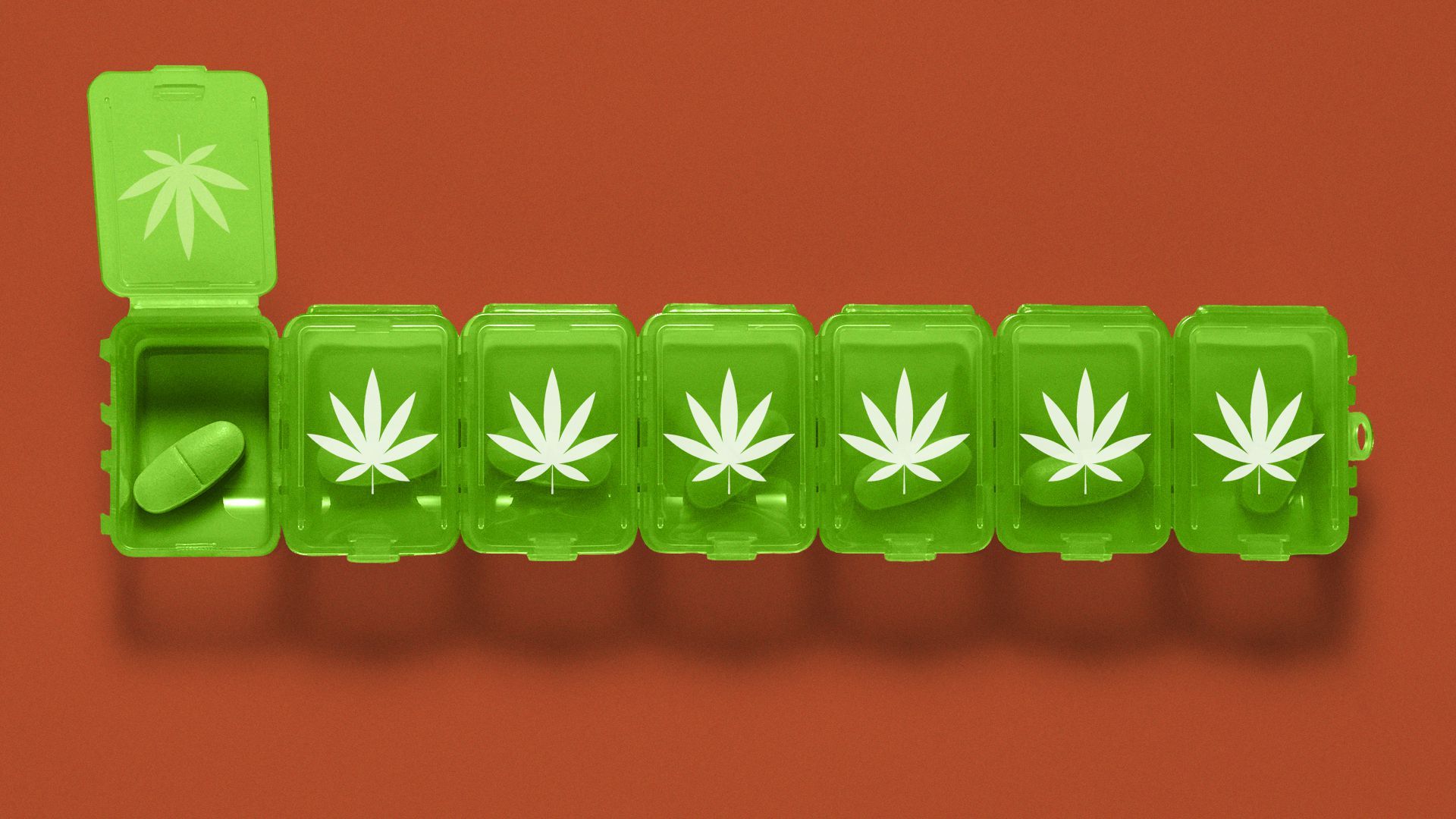
Illustration: Allie Carl/Axios
If the recreational marijuana issue is passed, how it will impact Arkansas' employers and employees is as hazy as the rafters at an Eagles concert.
State of play: The state's current law prohibits an employer from discriminating against an employee or applicant if they're a medical marijuana patient or caregiver.
Yes, but: An employer can have drug-testing policies and discipline an employee for possession, use or being under the influence at work or during work hours.
- Employers can choose to keep an employee from working in a safety-sensitive position โ like forklift driver or school bus driver โ if there's a good faith belief they're a user of medical marijuana.
Between the lines: The use of marijuana is still illegal on a federal level, so contractors and businesses working with the federal government may require drug testing of employees.
The big picture: There's no agreed metric to determine marijuana intoxication, so testing will reveal only that someone has used the drug, but may not reveal if they're currently impaired.
๐ Thanks to Carolyn DiPaolo for editing and Carlin Becker for copy editing this newsletter.
๐ฎ Alex is excited to watch Fortune Feimster's new Netflix special, "Good Fortune."
๐ฌ Worth is reading about Ye in Axios.
Sign up for Axios Northwest Arkansas

Get smarter, faster on what matters in Northwest Arkansas with Alex Golden and Worth Sparkman.