Axios Nashville

January 17, 2025
It is Friday. Our Axios colleague Alex Fitzpatrick is taking the helm today for a special edition focused on 2025 travel trends.
- Today's weather: Cloudy with a high of 56.
🎂 Happy early birthday to our Axios Nashville member Ellen Levitt!
📆 Programming note: We won't have a newsletter Monday as we commemorate Martin Luther King Jr. Day, but we'll be back in your inboxes on Tuesday.
- Several Nashville events marking MLK Day are set to take place, including an annual march, panel discussions and speeches. NewsChannel 5 published an online guide with more details.
Today's newsletter is 849 words — a 3.5-minute read.
1 big thing: Air travel is busier than ever — in Nashville and beyond
What initially seemed like a release of pent-up demand for air travel immediately following the worst of COVID-19 now looks like a never-ending climb.
Driving the news: Record numbers of travelers are taking to the skies, according to the latest data.
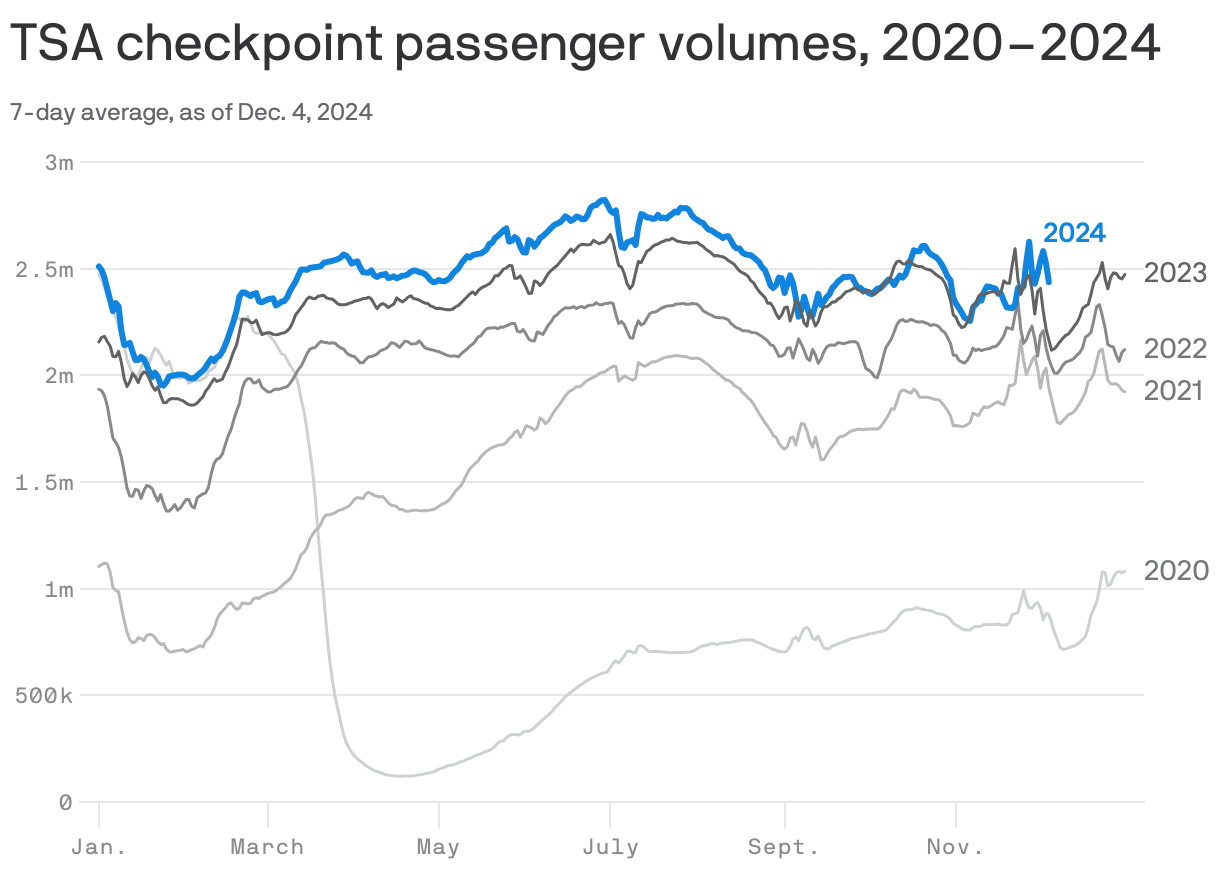
- TSA reported nearly 3.1 million people passed through U.S. airport security checkpoints on Dec. 1 (the Sunday after Thanksgiving) — an all-time agency high.
- 2024's numbers were consistently above those of 2023, just as 2023's figures were above those of 2022, and so on.
Zoom in: Nashville International Airport has been on a record-breaking streak as well.
- BNA hit a high-water mark last year, with 23.7 million passengers moving through the airport during the 2024 fiscal year, which ran from July 1, 2023 – June 30, 2024.
- Airport officials expect to soar past that total this year.
State of play: The Nashville airport is continuing to expand. Construction underway in the D concourse will add five extra gates to handle the increasing number of flights.
Between the lines: This huge demand is partly why aviation leaders like United Airlines CEO Scott Kirby have been calling for more air traffic controllers and other improvements.
The bottom line: If your flights seem particularly jam-packed lately, well, you're not wrong.
2. Detour to your destination
Trying to save on travel this year? Consider "detour destinations" — oft-overshadowed places near perennial hotspots worth a closer look for the budget-conscious or crowd-weary.
Why it matters: Travel prices rose 10% from September 2019 to September 2024, per a recent NerdWallet analysis, leaving many searching for cheaper ways to get away.
Driving the news: "Detour destinations" will be a big 2025 travel trend, predicts Expedia's annual year-ahead outlook.
- "63% of consumers say they are likely to visit a detour destination on their next trip."
- Among Expedia's trending "detour destinations:" Reims, France (detour from Paris); Brescia, Italy (detour from Milan); Cozumel, Mexico (detour from Cancun); Santa Barbara, California (detour from Los Angeles) and Waikato, New Zealand (detour from Auckland).
Zoom in: Some travelers are embracing what Expedia calls "goods getaways," or traveling in search of a viral item they can't find back home — that chocolate bar from Dubai, for instance.
- "When going on vacation, 39% of travelers visit grocery stores or supermarkets and 44% shop for local goods they can't get at home."
The intrigue: "Noctourism," or traveling to bask in the glory of a stunning night sky, is another 2025 travel trend to watch, per Booking.com's 2025 travel predictions.
- More on that in a moment.
What they found: Booking.com's own list of trending destinations includes Sanya, China; Trieste, Italy; João Pessoa, Brazil; Tromsø, Norway and Willemstad, Curaçao.
Reality check: As much as travelers gripe about rising prices, they aren't stopping people from booking trips.
- 24.3 million people flew in August, "reflecting a 4% increase in U.S. domestic trips and a 3% increase in international trips compared to August 2023," per ticketing infrastructure firm Airlines Reporting Corp.
What's next: Having trouble putting an itinerary together for next year? Let AI take the wheel — 2025's version of closing your eyes and throwing a dart at a map.
3. Dark sky escapes
Night-sky tourism, or "noctourism," is set to be a major travel driver this coming year, Booking.com predicts.
Why it matters: The trend could bring travelers — and their dollars — to more remote locales with better night skies.
How it works: You don't have to leave the country to get a great view of the cosmos, but you typically want to get away from big cities and their light pollution.
- The U.S. is home to over 100 dark sky sanctuaries, parks and more, according to DarkSky, which calls itself "the globally recognized authority on light pollution issues and night sky conservancy."
- You can use Dark Site Finder's online map to help you plan some noctourism of your own.
Zoom in: Many of the country's best dark sky sites are out West, like Arches National Park in Utah, Big Bend National Park in Texas, and Joshua Tree National Park in California.
- But the East has its night-sky gems, too, like Pennsylvania's Cherry Springs State Park and the AMC Maine Woods International Dark Sky Park — which bills itself as "the first and only International Dark Sky Park in New England."
If you go: Try downloading apps like Sky Guide, which uses your GPS coordinates to help you ID what planets and stars you're seeing in the evening sky — just keep the brightness low to avoid ruining your night vision.
- Also consider grabbing a flashlight or headlamp with red LEDs, for the same reason.
The intrigue: With the sun now in "solar maximum," it's also prime time for aurora-hunting in northern-latitude locales like Alaska, Iceland and the Nordic countries.
Yes, but: Some astronomers and stargazers are worried that the ever-increasing amount of satellites and space junk in low Earth orbit could mar our views of the night sky — perhaps forever.
The bottom line: Get your noctourism in now while the view remains spectacular.
This newsletter was edited by Ashley May.
✈️ Alex is planning his next big trip — and eyeing the Pacific Northwest
Have a wonderful weekend, everyone. Nate and Adam will be back to wake you up on Tuesday.
Sign up for Axios Nashville