Axios Media Trends

November 18, 2025

Good afternoon. Today's Media Trends, edited by Christine Wang and copy edited by Katie Lewis, is 2,281 words, an 8Β½-minute read. Sign up.
Situational awareness: Meta won a landmark antitrust case against the U.S. government today, ensuring it won't have to divest Instagram and/or WhatsApp.
Tune in today: RedBird Capital founder and Paramount board member Gerry Cardinale told Axios' Dan Primack the firm isn't the "right owner" for the Telegraph Media Group and the process got "too politicized." Watch more from Axios BFD here.
1 big thing: Exclusive ... Fox's Palantir deal
Fox News Media has been working with Palantir for the past year to build a suite of custom AI newsroom tools alongside its journalists, Fox News Digital president and editor-in-chief Porter Berry tells Axios.
π€ Why it matters: The Palantir relationship is strictly commercial, granting broad access to Fox News Media's workflow to facilitate the AI transformation, without giving up its proprietary intellectual property.
- Fox News has also struck other enterprise software licensing deals with firms, like OpenAI.
- "It's a business arrangement," Berry said of Palantir. "We hired them."
πΈ Of note: For many newsrooms, strictly commercial deals with AI companies are too expensive. Fox News, which is the most profitable arm of Fox Corp., can afford to pay for enterprise AI tools without giving up its IP.
How it works: About a year ago, Fox News hired Palantir to essentially "build a digital twin" of its business, mirroring the workflows, data, tools and systems the company uses to produce and publish its digital journalism, per Berry.
- The companies then enhanced those processes by building new tools and processes, embedding Palantir engineers into the digital newsroom's daily workflow.
- They initially focused on addressing the repeatable, mundane tasks that AI could help journalists improve β "things like SEO keywords and tagging," Berry said.
- Now, the companies have progressed to building proprietary tools that help journalists discover, produce and distribute stories across Fox News' platforms and social media.
Zoom out: While dozens of text-based newsrooms have struck licensing and training deals with AI firms, those with a large broadcast or video business have typically been more reluctant, mostly due to legal complications surrounding AI copyright and news video.
2. π° Dow Jones starts paying publishers for content used for AI summaries
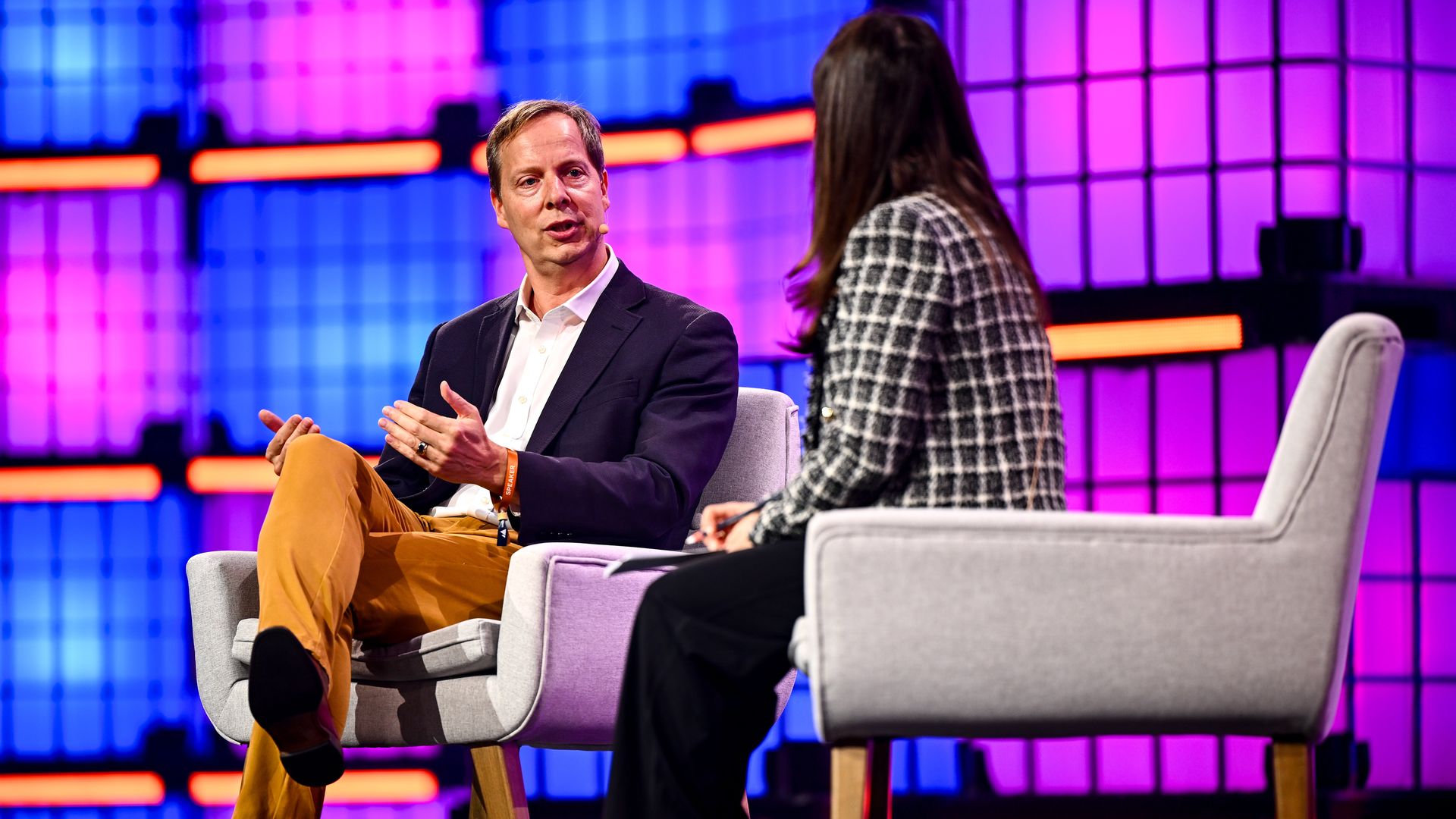
Dow Jones, the parent company to the Wall Street Journal, has started to pay publishers for their content when it's used by companies within its Factiva content marketplace for generative AI summaries, CEO Almar Latour told Axios on stage at Web Summit in Lisbon, Portugal last week.
π¦Ύ Why it matters: With more than 7,500 publishing partners, Factiva has become one of the largest generative AI content marketplaces in the world.
How it works: Factiva has for years brokered content deals between enterprise companies and thousands of news, data and information sources globally.
- Last year, it launched a generative AI product called Smart Summary that allows corporations to create short, informative summaries from a pool of Factiva's trusted content partners.
- It recently began cutting checks to those publishing partners for the AI generated summaries.
π€ The big picture: Dow Jones is one of several companies working to build marketplaces that can help publishers get compensated for their work in the AI era. But many of those firms lack scale.
- ProRata, for example, has built its own search engine that utilizes only high-quality, licensed content to service user queries. It has hundreds, not thousands, of publishing partners.
3. ποΈ Bidders circle WBD

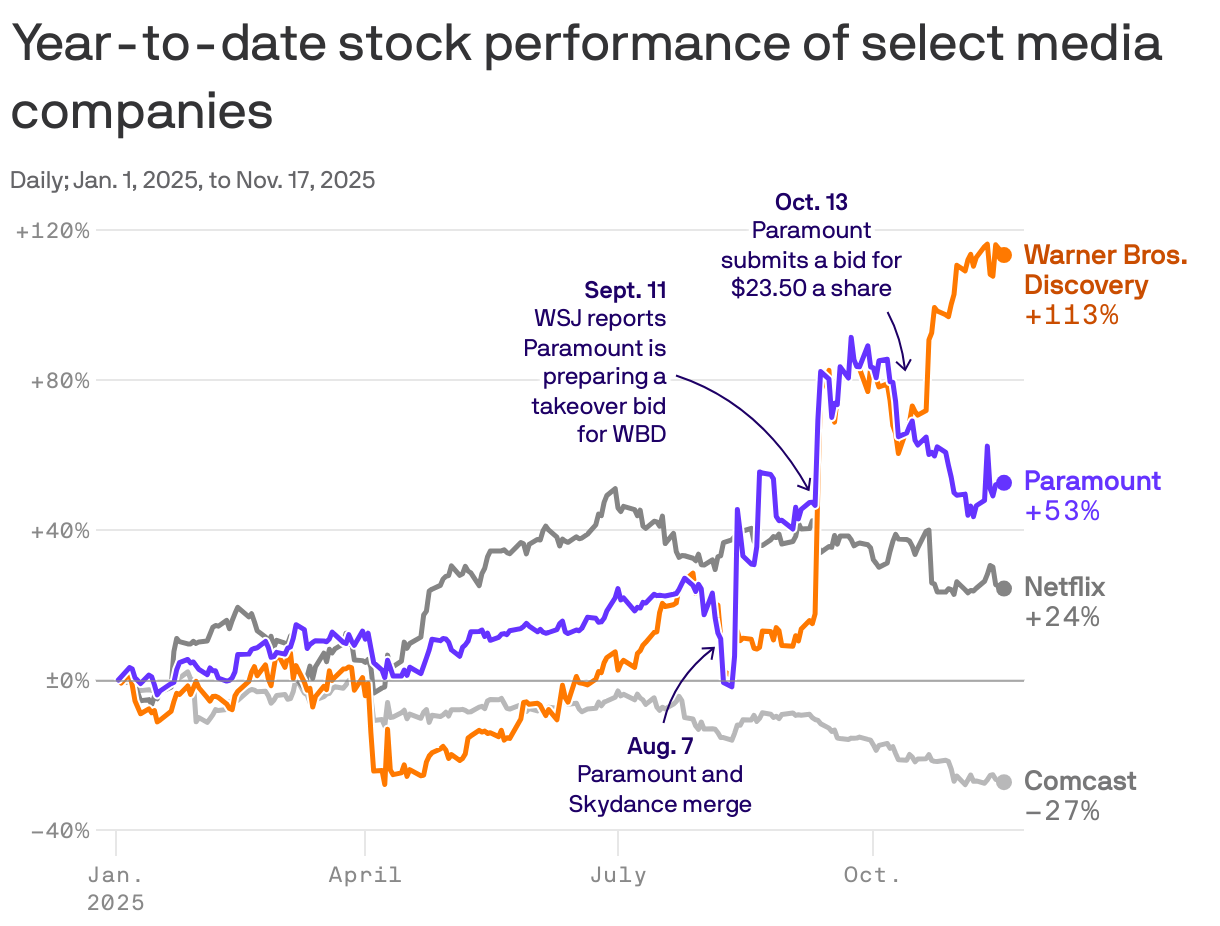
Paramount, Comcast and Netflix are all expected to make formal bids for Warner Bros. Discovery ahead of the Nov. 20 deadline this week, sources tell Axios.
Why it matters: Paramount is currently the only company pursuing a full buyout of WBD, which it believes gives it an advantage over other bidders.
Yes, but: WBD's board wants Paramount to up its latest offer of $23.50 per share to around $30, the source said. Its last offer was an 80-20 cash-stock split.
- The concern with Paramount's previous bids, the source said, is that they devalued the assets more than separating them.
π Context: WBD's stock price closed at $12.54 on Sept. 10, the day before the Wall Street Journal first reported Paramount's takeover interest. Its share price has since ballooned to $24.
- Paramount's bid is an 87% premium to WBD's pre-deal talk stock price.
- Comcast and Netflix are only interested in WBD's studio and streaming assets, sources said.
State of play: A big concern for all parties involved is how regulators would evaluate a deal that combined major streamers, studios and possibly cable behemoths.
π§ββοΈ Reality check: Even if the Trump administration tried to pressure the DOJ to sue to block any WBD deal, a judge would need to independently rule on the case. History shows politics tend not to influence those decisions in federal court.
- The DOJ sued to block AT&T's merger with Time Warner in 2018, and a judge ultimately ruled in favor of AT&T.
π Between the lines: If the DOJ were to evaluate a WBD merger based on streaming subscribers, Comcast and Paramount would have stronger arguments than Netflix because Peacock and Paramount+ have far fewer streaming subscribers.
- If the DOJ were to evaluate the deal based on box office ticket sales, Netflix would have a clearer advantage over Comcast and Paramount because it doesn't own a movie studio.
- However, regulators blessed a deal between Fox Corp. and Disney in 2019 that brought together two dominant movie studios at the time.
π° By the numbers: Paramount and Netflix's clear advantage over Comcast is access to cash, although Comcast likely wouldn't face many hurdles trying to raise debt.
- Paramount chair David Ellison not only has access to the coffers from his father, Oracle co-founder and chairman Larry Ellison, but he's also been in talks with Apollo Global Management to secure some debt financing for a potential offer, Axios has confirmed.
π The intrigue: A Variety report out today suggested Paramount was prepping a $71 billion bid for WBD with backing from three Arab sovereign wealth funds. Paramount immediately pushed back on the report, calling it "categorically inaccurate."
4. πΊ Sinclair mounts takeover bid for Scripps


Sinclair, the third-largest local broadcast company in the country, has taken an 8.2% stake in E.W. Scripps' Class A shares as it pushes to combine with the smaller broadcaster, according to a new regulatory filing.
Why it matters: The Trump-era Federal Communications Commission has signaled a willingness to roll back decades-old ownership cap rules that prevent large broadcasters from merging.
- Those efforts are expected to usher in a new wave of consolidation among local broadcasters, which have for years argued that regulation makes it difficult to compete with Big Tech.
The big picture: Bigger local broadcast companies are trying to scoop up smaller rivals while the regulatory environment seems more favorable for big deals.
- Nexstar, the largest local broadcast group in America, has agreed to acquire Tegna, the fourth-largest local broadcaster, in an all-cash deal valued at $6.2 billion.
- Apollo Global Management, which is looking to sell its majority stake in Cox Media Group, has eyed bids from multiple suitors, Axios has reported.
What to watch: The fate of many of these deals rests on whether the FCC can lift the current limit on television station ownership.
- FCC chair Brendan Carr has long advocated for repealing decades-old consolidation rules and removing the cap, arguing the FCC doesn't need Congress' approval to do so.
5. π Streaming goes "back to the future"
Disney's new multiyear distribution agreement with YouTube represents a new streaming future in which programmers finally let their sports content be ingested by larger digital pay-TV providers, instead of trying to force consumers to their own apps, LightShed Partners' Rich Greenfield tells Axios.
π Why it matters: "It's back to the future," he says. "We've gone in a circle."
- Greenfield believes this deal, as well as the recent Peacock-YouTube TV deal, could represent the beginning of exclusive sports rights moving back into the pay-TV bundle.
How it works: The deal gives YouTube TV customers access to Disney's full suite of networks and stations, and makes the unlimited version of ESPN's new direct-to-consumer service available at no additional cost to subscribers.
- They also get access to a selection of live and on-demand programming from ESPN Unlimited within YouTube TV's app.
- Some Disney networks will be included in various genre-specific packages.
- One of Disney's streaming bundles, which includes Disney+ and Hulu, will be available to customers as part of a select offering within YouTube TV.
ποΈ The intrigue: For Disney, which is still awaiting regulatory approval of its acquisition of digital pay-TV rival Fubo TV, the YouTube TV deal may look like a major concession from the outside, but that might not be the case.
- Greenfield hypothesizes that Disney might have assumed it would ultimately need to let YouTube TV ingest its ESPN content and used its DTC ambitions as negotiating leverage to get a better financial deal.
- Either way, he notes, more programmers making their sports content available on bigger pay-TV platforms is a better consumer experience.
6. π€ WPP shares jump on takeover rumors


Ad giant WPP saw its U.S.-listed shares soar as much as 13% yesterday after reports of takeover interest from smaller French agency Havas and private equity firms.
π Why it matters: The rally underscores investors' eagerness for a shake-up after WPP's shares have declined 60% this year amid weak client spending and rising competition.
- The merger of IPG and Omnicom has put more pressure on WPP and its rivals to scale their offerings with data and AI-driven solutions.
Zoom in: The Times of London reported over the weekend that Havas has held talks about a potential deal with WPP, possibly buying its media arm or acquiring a stake in the overall company.
- Adweek reported the two sides were in "very serious" discussion and that Havas was interested in a minority stake.
- The Times also cited Apollo Global Management and KKR as potential suitors.
β The other side: Havas CEO Yannick BollorΓ© denied any talks, saying in a staff memo that the company is "not in discussions with WPP," per Bloomberg.
- Apollo pointed Axios to a comment it provided to the Sunday Times in that it is "neither in discussions with nor considering a bid for WPP." KKR said "the reports on KKR are untrue."
Between the lines: Havas has pursued other partnerships amid the consolidation of rival agencies. In September, it formed a joint venture with Horizon, combining media operations to manage $20 billion in billings.
π΅βπ« The big picture: WPP has struggled as traditional agency economics have become unreliable.
- Its woes are mostly attributable to its own execution challenges, not necessarily broader market trends, according to a note from top ad industry analyst Brian Wieser.
- While Publicis and Omnicom posted positive organic growth rates in the third quarter, WPP fell 5.9%. IPG saw a slight decline in organic revenue growth, but improved over the last two quarters.
7. π€ Exclusive: Digital vets raise $2M+ for new startup
A group of digital media veterans has raised a roughly $2.5 million seed round to launch a new media brand that targets food business operators, chefs, influencers and restaurant lovers, CEO and co-founder Max Tcheyan, formerly of Puck and The Athletic, tells Axios.
π½οΈ Why it matters: The company aims to apply The Athletic's city-based sports model to the world of food, serving both industry insiders and food enthusiasts.
Zoom in: Tcheyan is co-founding the company alongside COO Dan Tsinis, formerly of Roku, Puck and Disney, and editor-in-chief Dana Brown, former deputy editor of Vanity Fair.
- The group has closed a $2 million seed round on a SAFE note with venture investors including Human Ventures, which led the round, Wheelhouse, Powerhouse Capital, Precursor Ventures and 32 Ventures.
- Human Ventures' Joe Marchese will join the company's board alongside Tcheyan and Tsinis.
- The company plans to raise additional funds from a few strategic angel investors.
Of note: The startup's cap table consists of longtime backers of successful new media startups.
- Brent Montgomery founded and sold Leftfield Entertainment, best known for its hit series "Pawn Stars," before founding Wheelhouse.
- Patrick Keane, another investor, was CEO, board director and an early investor in Action Network, a sports betting media startup, which sold for $240 million in 2021.
- Powerhouse Capital's Ian Doody and Precursor Ventures' Charles Hudson were investors in The Athletic, which sold to The New York Times for $550 million in 2022.
Zoom in: The new company, which has not yet disclosed its name, will focus on producing personality-driven content across an array of channels, including newsletters, podcasts, events and video, per Tcheyan.
- It aims to launch in early 2026 with a focus on major food scenes across U.S. cities before expanding internationally.
- The company plans to compensate content creators with a base salary, a bonus linked to subscription-driven products and company goals, and equity in the company.
8. ποΈ 1 fun thing: Media's true crime dominance
True crime, which was the third-most-listened-to podcast genre last year, continues to grow in popularity in the U.S., according to Apple's new ranking of top podcasts.
Why it matters: Traditional media is behind many of the hit true crime shows.
π§ By the numbers: Out of the 10 top series, nine are in the true crime genre and five are from traditional media, including NBC's "Deadly Mirage" and ABC's "Devil in the Desert."
- Out of the 10 top new shows on Apple, seven are in the true crime genre and five of those are from traditional media.
Yes, but: Ashley Flowers' independent media company Audiochuk remains a true crime powerhouse and is behind some of the most popular shows and podcasts."THREE" and "CounterClock" rank in this year's top series, and "Crime Junkie" remains one of the top shows.
πββοΈ The big picture: Several shows on Apple's top charts are hosted by women, including "Not Gonna Lie with Kylie Kelce," "Call Her Daddy" hosted by Alex Cooper and "Good Hang with Amy Poehler."
Thanks for reading our free tier. π Join Media Trends Executive for exclusive reporting, data, reports and briefings.
Sign up for Axios Media Trends