Axios Media Trends

September 30, 2026

Hello! Today's Media Trends, edited by Christine Wang and copy edited by Sheryl Miller is 2,117 words, an 8-minute read. Sign up.
📣 This just in: Writer, producer, actor Lena Waithe joins this year's Media Trends Live lineup in Oct. 20 in New York City. Get your tickets here.
Situational awareness: CNN, MS NOW and Politico formally filed for a preliminary injunction that would block the White House's ban until the litigation is resolved.
- President Trump blocked CNN from Air Force One over the weekend, but his administration said the network is back in the pool rotation this week.
1 big thing: 🐍 AI eats itself
Publishers suing OpenAI and Microsoft are accusing the Trump administration of playing politics in siding with AI companies in a lawsuit alleging widespread copyright infringement.
Why it matters: The Justice Department's statement of interest in the case, as Axios has reported, surprised critical agencies that are typically consulted in these types of filings — like the U.S. Patent and Trademark Office and the Copyright Office.
- That deviation is notable considering how different it is from the Copyright Office's official position on the issue.
- The Trump administration attempted to fire the head of the office last year, the day after it published a paper explaining its position. Shira Perlmutter sued to stop her firing, and the case is still being litigated while she remains the office's director.
Zoom in: In a court filing Monday, the New York Times, alongside other publishers, argued the Justice Department's statement of interest in the case shouldn't hold any weight, in part because it could've been politically motivated.
- The filing "may have been influenced by extraneous considerations — up to and including the Administration's political and financial interests," the plaintiffs allege, pointing to donations AI executives have made to the Trump administration.
State of play: As part of its defense of AI firms, the Justice Department argues that requiring AI firms to license copyrighted works for training would be too cumbersome, impeding them from being able to adequately compete with China. That, the DOJ said, is a national security risk.
- Publishers argue the real national security concern would be if lax copyright enforcement allows AI firms to swallow U.S. news companies whole.
The intrigue: The plaintiffs point to a recent admission made public in an unsealed document during discovery that shows Microsoft's director of applied science warned that its AI content strategy had created a "doom loop" that would hurt both the long-term performance of the company's large-language models and the entire web.
The bottom line: The admission suggests AI firms know that long term, without copyright protections, there will be mutually assured destruction for the web's content owners and distributors alike.
2. 📉 Rubber stamp regime

The Monday filing underscores that changes at the Justice Department reportedly made to elevate the administration's policies over independent oversight.
- Axios previously reported the Justice Department's statement of interest did not include the signatures of any career antitrust attorneys alongside senior DOJ officials.
Between the lines: A new report from Law360 details the impact of the "brain drain" at the DOJ and Federal Trade Commission, particularly in the antitrust department.
- Staff focused on competition at the FTC has sunk from 744 in 2024 to 600 people now. At the DOJ it's fallen from 910 in 2024 to 776 now.
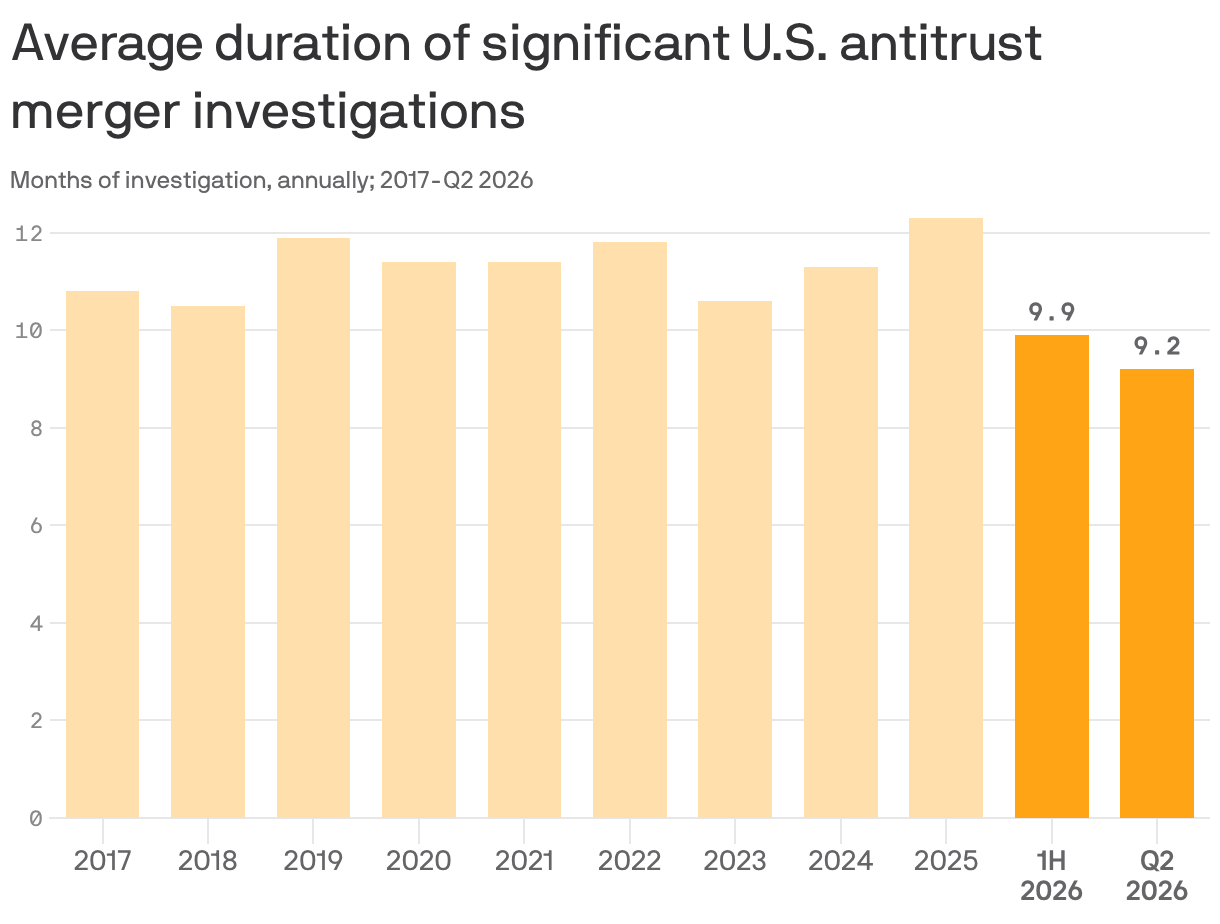
The big picture: Data from Dechert shows deals are facing less scrutiny, with fewer investigations being conducted and time spent investigating cases falling to 10-year lows.
- Efforts to settle cases or approve major deals underscore that position.
- Last year, the DOJ settled an antitrust lawsuit brought by the Biden administration that sought to break up Live Nation and Ticketmaster, despite bipartisan backing for the case.
- Shortly after that decision, made by a small group of DOJ lawyers, the Wall Street Journal reported that career attorneys working on the case learned about the settlement when the court did.
Reality check: The Trump administration has a history of supporting AI firms, media allies and parties targeting certain outlets in key lawsuits.
- Earlier this month, it filed a statement of interest in favor of Paramount Skydance's request for a bond from state attorneys general seeking to block its acquisition of Warner Bros. Discovery via an antitrust suit.
- It filed an SOI supporting an antitrust claim brought by the Children's Health Defense against several news outlets in 2025.
3. 📰 News lobby makes "critical infrastructure" case in AI fight

The News/Media Alliance flew in hundreds of top news executives to Washington this week in an effort to frame its members' work to lawmakers as "critical infrastructure" that needs to be protected amid the U.S. AI race against China.
Why it matters: The positioning shifts the industry's lobbying case from copyright protections to the argument that a strong news industry is essential to U.S. dominance in the global AI race.
Zoom in: More than 300 executives participated in NMA's annual "fly in" day today with around 140 that headed to Capitol Hill, according to CEO Danielle Coffey.
- That delegation includes Condé Nast CEO Roger Lynch, Minnesota Star Tribune CEO Steve Grove, USA Today Inc. CEO Mike Reed and many others.
By the numbers: This year's lobbying force is roughly double last year's, Coffey said.
Zoom out: Like energy and semiconductors, Coffey argues American journalism is a valuable asset and one that should be protected, especially as it faces copyright threats from AI giants.
- NMA, alongside more than a dozen of its members, sued Cohere for copyright and trademark infringement last year.
State of play: A focus of the group's lobbying push this week will be around its "Bad Bots" bill proposal, which aims to establish protections around unauthorized scraping of publishers' content.
- The bill, formerly called the Stealth Bot Prohibition Act, was introduced in the House earlier this year. According to Coffey, it also has Senate support.
The big picture: The lobby's frame shift comes as several high-stakes legal battles between publishers and AI firms ramp up.
- As the NMA's focus centered more on AI protections, Coffey says the industry's business priorities are also changing. She expects licensing to become a bigger part of the news industry's revenue base, similar to the music business.
4. 📑 AI FOIA boom
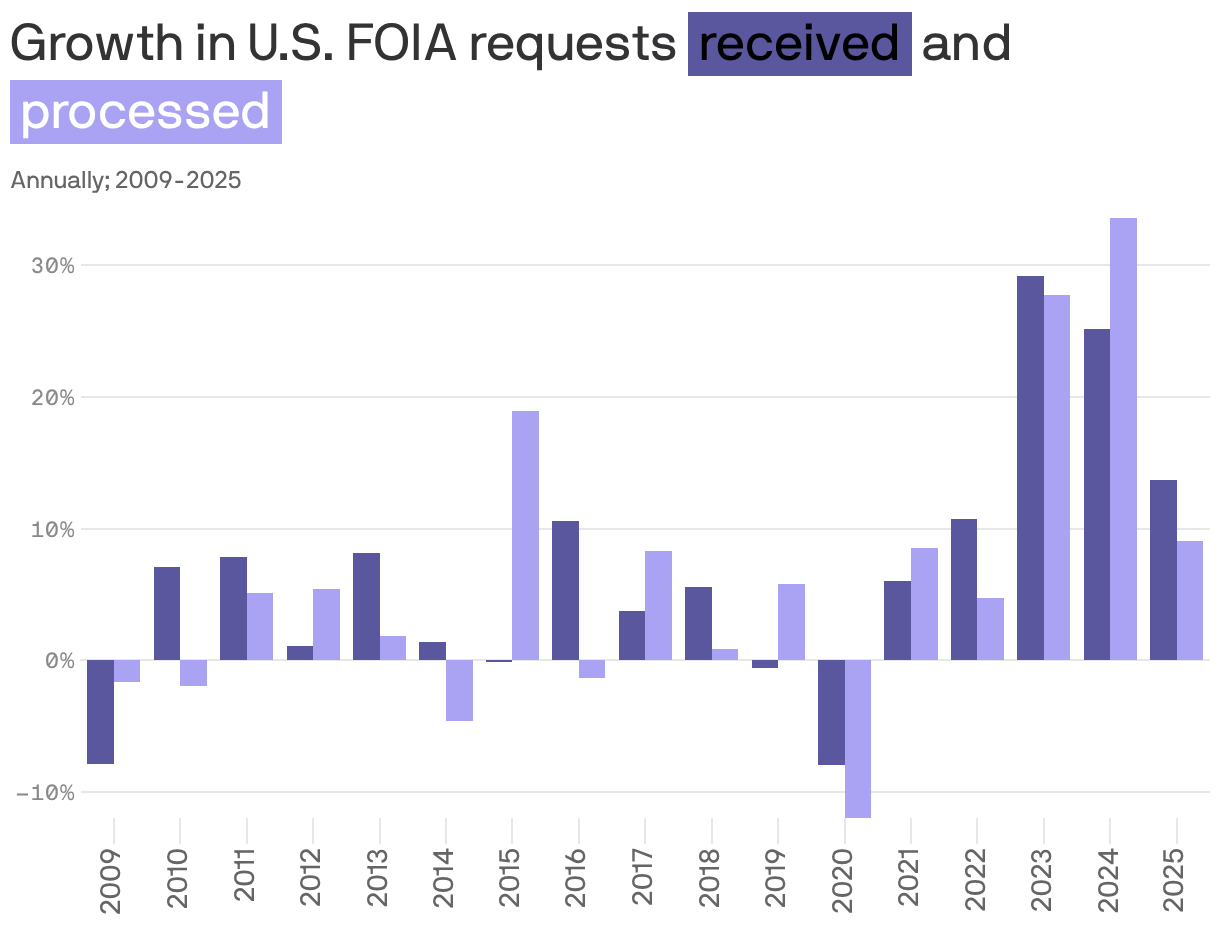
Artificial intelligence is leading to a boom in Freedom of Information Act requests, according to government data, but it's also being used to help the government process those requests more efficiently, according to a new report from the Washington Post's FOIA director Nate Jones.
Why it matters: Agencies are processing more requests than ever, but they're still behind. That reality makes the government's use of AI to help process and redact requests more compelling.
Zoom in: Customs and Border Protection at the Department of Homeland Security plans to use AI to help its staff with redaction recommendations for more than 100,000 FOIA requests, per the Post. Humans will still oversee the redaction recommendations.
- The Interior Department is using AI to help redact FOIA information around potential attorney-client privileged information.
Yes, but: Experts worry AI can make critical mistakes as a redaction tool.
- "I am more concerned about information being incorrectly released than over-withholding (which a requester can challenge), particularly where disclosure could cause real harm and the information generally can't be clawed back," said Allan Blutstein, a FOIA attorney.
- A paper published Monday in the Journal of Civic Information argued AI will be helpful as the rate of FOIA requests skyrockets, but cautioned human oversight will be necessary to prevent mistakes.
The bottom line: "AI and machine learning should not be a substitute for a FOIA professional's judgment on exemptions and the foreseeable harm standard," Blutstein said.
5. Scoop: Trump plots more taxpayer-funded ads

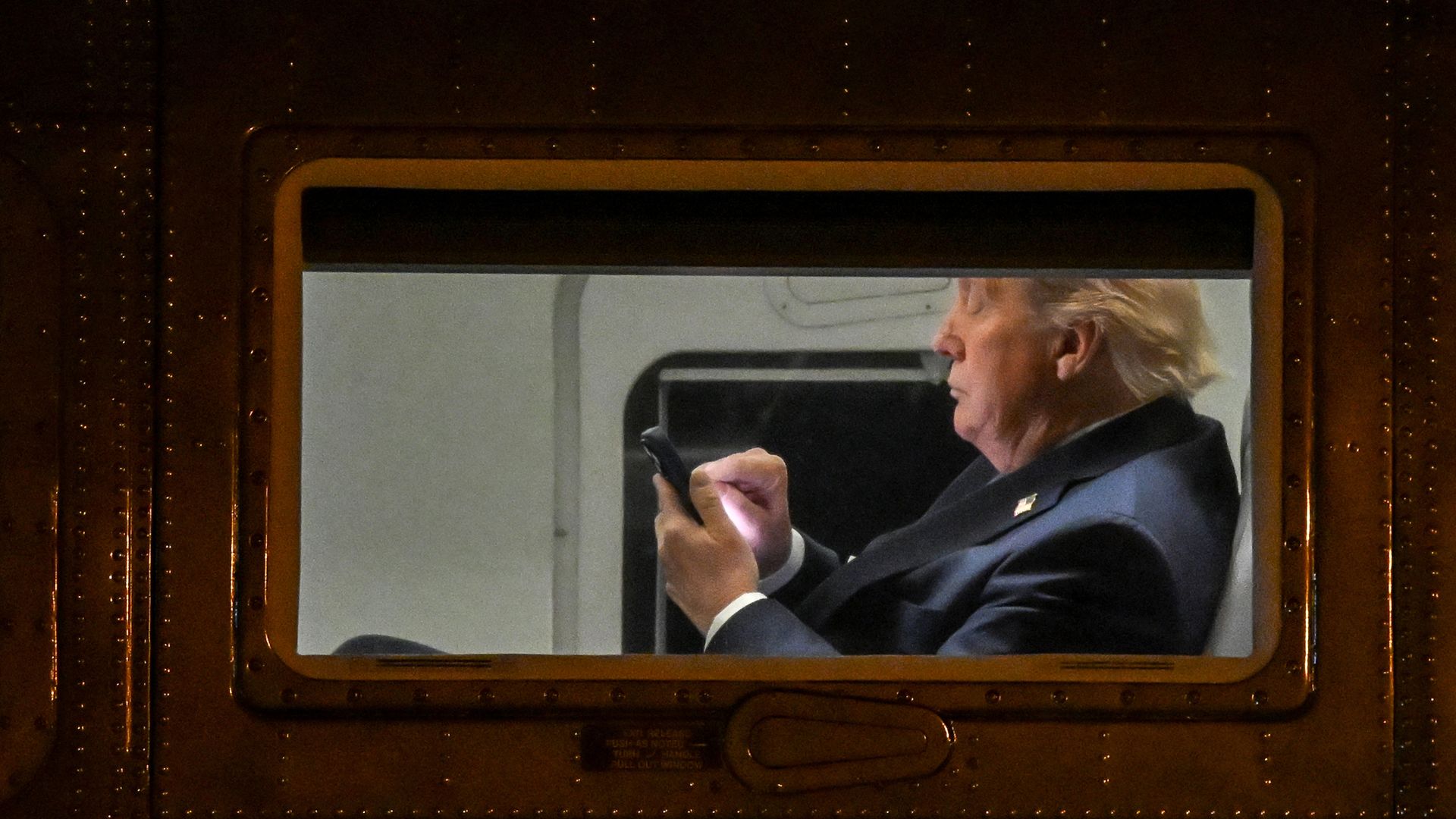
President Trump is personally selecting which government-funded ads his administration is airing ahead of the midterms — with more to come, Axios has learned.
Why it matters: The seemingly partisan nature of the taxpayer-funded ads — which come a little more than a month before the midterms — has drawn bipartisan pushback.
Yes, but: No official lawsuits aimed at the administration over the ads have been filed.
- Congress could ask the Government Accountability Office, which falls under the legislative branch, to determine whether an agency improperly used funds for personal or political purposes, as opposed to true public service announcements, which are legal.
Between the lines: The Department of Homeland Security is placing the ad buys using money from an existing budget, according to the administration official.
- The government has spent at least $2.5 million to air the ads, according to an estimate by the ad-tracking firm AdImpact.
- The ads have aired more than 2,000 times on broadcast networks and more than 50 times on cable.
- The single biggest program outlay was on Fox's NFL coverage over the weekend, with 340 airings.
6. 🤝 Paramount scrambles to get deal across the finish line
Paramount Skydance began holding investor calls to shore up around $44 billion in bond sales to pay for its acquisition of Warner Bros. Discovery, per Bloomberg.
Why it matters: Securing the financing is a necessary step toward closing the deal, which executives hope to complete in early October.
Yes, but: Its historical settlement with 12 state attorneys general still needs a judge's approval.
- Last week, U.S. District Judge Araceli Martínez-Olguín refrained from approving the deal at a hearing and asked for more details from the parties about how the behavioral remedies outlined in the deal would be enforced.
- It's unclear when she plans to rule on the settlement. Sen. Cory Booker (D-N.J.) has urged the court to scrutinize the deal, a request that has drawn pushback from the state attorneys general who settled.
Between the lines: As part of the settlement, Paramount agreed to a number of concessions, mostly over a five-year period, including a theatrical distribution minimum, a promise to keep its cable companies separate from WBD's in fee negotiations, and the creation of an editorial oversight board for CBS and CNN.
Follow the money: The acquisition, which values WBD at around $81 billion plus an additional $29 billion in debt, is one of the most expensive and highly leveraged mergers in U.S. history.
- Paramount's bond sale will go toward financing the deal and refinancing its associated debt. The company is also raising $7.5 billion in additional loans.
The big picture: The settlement clears the path for the creation of one of the biggest TV and movie behemoths in the world and ends what has been one of the most expensive, drawn-out and dramatic merger fights in U.S. history.
7. 📊 Republican's media trust makes sharp comeback
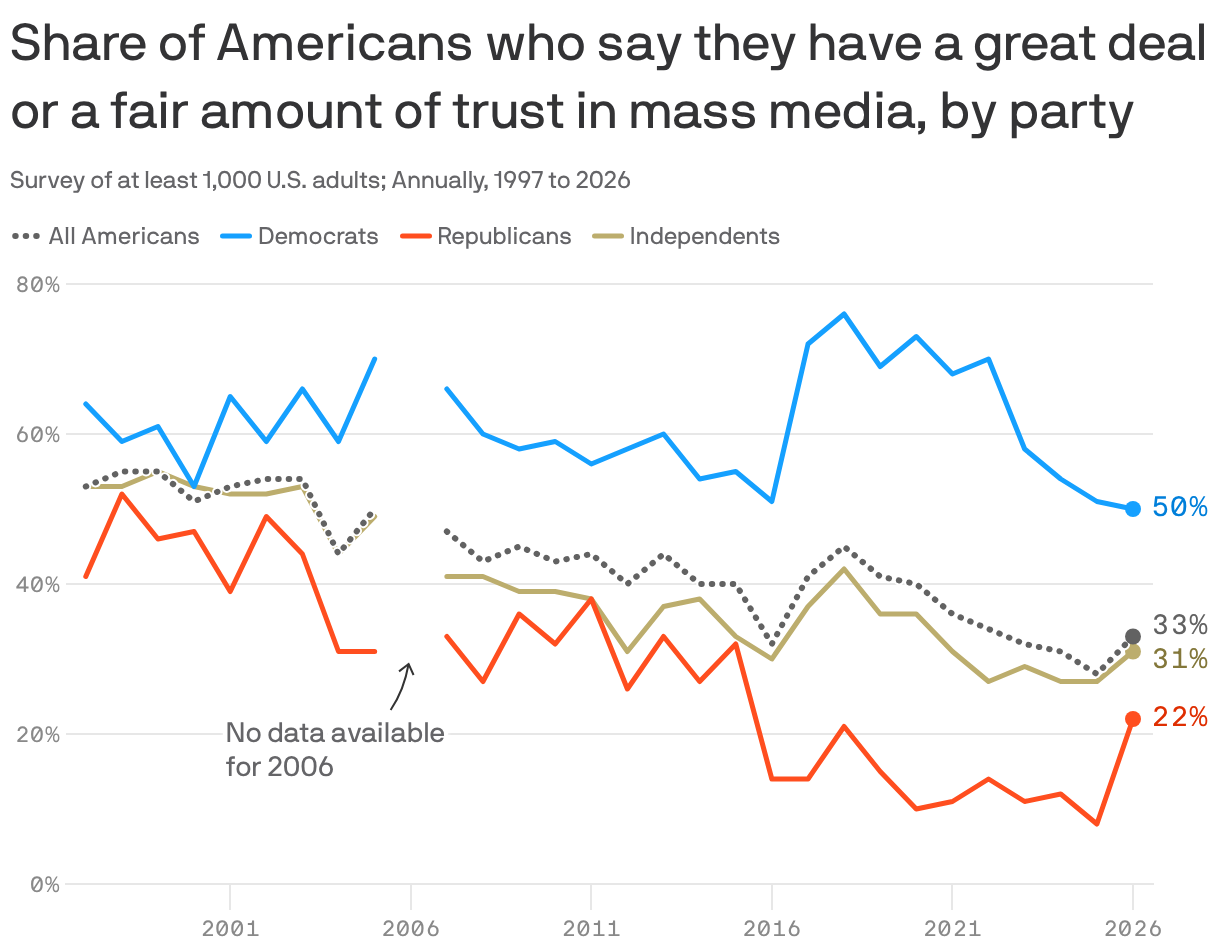
Trust in media is rebounding among Americans for the first time in years, a sign of optimism as the country faces record levels of polarization and distrust in traditional institutions.
Why it matters: Driving that trend has been a sharp increase in trust among Republicans.
By the numbers: Around one-third of Americans (33%) say they have a great deal or a fair amount of trust in mass media, according to a new Gallup survey, up from 28% last year — a record low.
- Republicans' trust sharply rebounded from 8% last year to 22% today, while Democrats fell slightly from 51% to 50%.
Context: The survey was conducted Sept. 1–17, before outlets were banned from the White House.
Zoom out: Trump's election in 2016 drove a historically high gap between Democrats' and Republicans' trust in mass media.
- Today, that gap has narrowed, as Americans across the political spectrum report historically low trust levels.
What to watch: The access battle between the White House and select outlets has escalated, as the press grows concerned that the administration will try to find other ways to restrict access.
- On Monday, CNN, MS NOW and Politico asked the judge overseeing their lawsuit against the administration to stop President Trump from reviving the ban.
8. 🎓 Student paper was first on Cornell story

The Cornell Daily Sun's coverage of the fraternity rape scandal, long before it became a national story, shows how critical student newspapers have become in providing transparency to local communities and holding university executives accountable.
Why it matters: The paper has been doggedly pursuing the story for years, helping to establish the groundwork for national reporters, who would only later look into the case.
- "[A]s student journalists, our responsibility to the campus community is shining light on the opaque parts, on the dark corners of Cornell," Cornell Daily Sun editor-in-chief Sophia Dasser told The Cut.
- "This is a perfect example of that, so we wanted to focus specifically on the lack of transparency. The outrage was really sourced in the fact that no one knew what was going on for 23 months," she said.
Zoom out: Student journalists are increasingly serving as community watchdogs while traditional news outlets shrink.
- But their independence is under threat as they become more reliant on university funding amid the decline in advertising revenue.
- At least 56.1% of college newspapers at schools with more than 5,000 students receive funding from their institutions, per a 2024 University of Florida study.
Sign up for Axios Media Trends