Axios Markets

June 11, 2025

☀️ Good morning! Today we're taking a special look at power, climate and the markets, with surging bets on clean energy, a collapse in the residential solar industry, and the effect of rising weather risks on minority homeowners.
👀 Situational awareness: The Trump administration got two key trade wins last night. An appeals court blocked a lower court ruling that invalidated most of the president's tariffs, while negotiators in London reached a "framework" deal with China to implement the trade truce from May.
All in 980 words, a 4-minute read.
1 big thing: Clean energy investment rises
Record capital is flowing into energy despite plenty of geopolitical tension and economic uncertainty, but the picture varies among technologies, a new global analysis finds.
Why it matters: The International Energy Agency's investment report tallies regional and source-specific trends at a time when the world is badly off pace for reaching Paris Agreement goals.
Takeaways from the annual report:
New is outpacing old and it's not even close.
- Investment in "clean" tech — a catch-all term for renewables, grid tech, storage, nuclear and more — is slated to hit $2.2 trillion this year. That's twice the $1.1 trillion for coal, gas and oil, the report finds.
Electrons are outpacing molecules in new spending.
- Electricity sector investment is slated to reach $1.5 trillion in 2025, "some 50% higher than the total amount being spent on bringing oil, natural gas and coal to market."
Don't forget the whole energy supply pie is growing.
- Global demand for coal, gas and oil — the dominant sources — is rising. Coal supply investments are estimated to grow 4% this year, driven by China and India. Spending on new liquid natural gas facilities is on a "strong upward trajectory," and approvals of new gas-fired power are increasing.
The oil picture looks a little bit different.
- Lower prices and modest demand growth outlooks have upstream oil and gas investment projected to fall this year, driven by a sharp decline among independent producers. The projected 6% decline would be the first year-over-year decline since the pandemic slump and the largest since 2016.
The numbers out of China are remarkable.
- Its share of global clean investment grew from a fourth to a third over the last decade alone. But everything is bigger in China. It greenlit almost 100 gigawatts of new coal-fired power plants last year.
Data centers are driving investments in clean tech and fossil fuels.
- The International Energy Agency sees $18 billion in cumulative investment in gas-fired generation specifically to meet data center demand by 2030.
What we're watching: An exceptionally fluid energy landscape.
- Some investors "are adopting a wait-and-see approach to new project approvals" amid cloudy trade and economic outlooks, it says. But still, "we have yet to see significant implications for spending on existing projects."
2. Residential solar power in crisis mode

Despite all that growth in renewables, the U.S. residential solar market is in crisis mode, as President Trump threatens to cut tax credits.
Why it matters: The rooftop solar sector has long faced a "solar coaster" driven by policy and trade fluctuations, leaving lenders vulnerable and contractors highly exposed.
Driving the news: Solar Mosaic, a home solar lending business backed by Warburg Pincus and Affinity Partners, filed for bankruptcy on Friday, citing elevated interest rates and potential legislation.
Zoom in: Tax uncertainties prevented Solar Mosaic — which had layoffs in 2023 — from securing its latest round of funding, Bloomberg reports.
- It paused much of its lending tied to the solar credits two weeks ago, leaving its contractors in the lurch. It says it has about $8 billion in active loans.
- Phoenix-based residential installer PEP Solar says it has not been paid on roughly half a million dollars in completed projects, which could lead to its own bankruptcy. "We're trying to hang on the best we can, but there's a point where we have to cry uncle," PEP CEO Bonnie Katz says.
Zoom out: Solar Mosaic is far from alone.
- Residential solar firm Sunnova filed for Chapter 11 bankruptcy last Sunday after troubled months. Sunpower, Sunworks and Titan Solar Power all filed for bankruptcy last year.
The big picture: The residential solar market was hit hard by a combination of high interest rates and cuts to solar subsidies for California, with home rooftop installations cratering between 2023 and 2024.
What to watch: If Trump succeeds in slashing tax incentives for rooftop solar, we can expect even more turmoil.
For a steady diet of scoops and smart analysis on supply chain deals, talk to our sales team about Axios Pro Deals.
3. Minority homeowners face more risks

Minority homeowners are particularly vulnerable to certain climate risks, according to a Zillow analysis.
Why it matters: The findings reflect history and a legacy of redlining and economic disparities that shape where people live, as well as how they are affected by climate change.
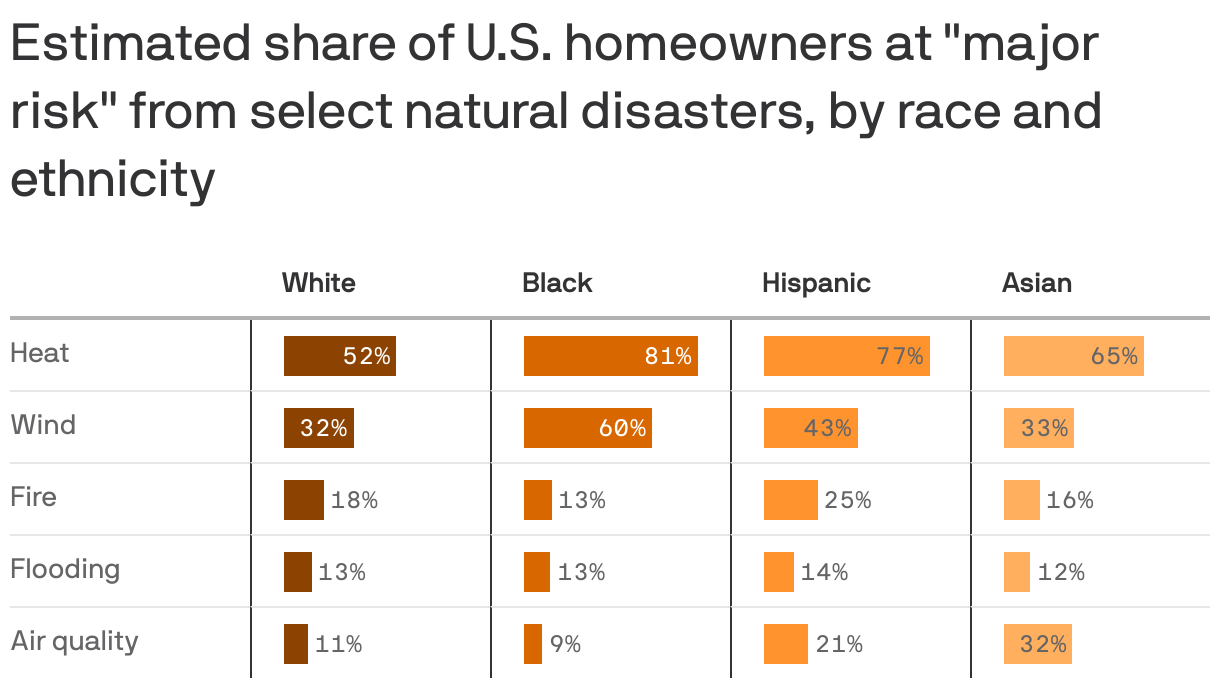
By the numbers: Nationally, 81% of Black homeowners, 77% of Hispanic homeowners and 65% of Asian homeowners are at risk of extreme heat, compared to 52% of white homeowners, per the analysis.
- Meanwhile, 60% of Black homeowners, 43% of Hispanic homeowners and 33% of Asian homeowners are vulnerable to extreme wind, compared with 32% of white homeowners.
- Some 32% of Asian homeowners and 21% of Hispanic homeowners are vulnerable to poor air quality, compared with 11% of white homeowners and 9% of Black homeowners.
How it works: Zillow based its analysis in part on climate risk data for homes listed for sale on the platform using risk modeling techniques from First Street.
- It does not include renters, who also face various climate risks. This is the full methodology.
Between the lines: Some of the nationwide figures are a result of history and geography, according to Zillow senior economist Kara Ng.
- For example, Black homeownership rates are higher in the South, where extreme heat is more common compared with other regions.
Zoom in: Some cities have especially stark differences between demographic groups for certain climate risks.
- In New Orleans, for example, about 95% of Asian homeowners, 92% of Black homeowners and 86% of Hispanic homeowners are vulnerable to flooding, compared with 76% of white homeowners.
The bottom line: Climate risks are making homeownership more expensive due to increasing insurance, energy and repair costs, Ng notes in her analysis, adding that vulnerable homes often take longer to sell and go for less money.
- "These impacts have the potential to widen the racial wealth gap and further set back minority groups that historically have been financially disadvantaged," she writes.
Thanks to Ben Berkowitz for editing and Anjelica Tan for copy editing. See you tomorrow!
Sign up for Axios Markets