Axios Markets

March 11, 2026

🌅 Good morning! Markets remain volatile, with stock futures falling and the price of benchmark Brent crude oil rising. A new report that the International Energy Agency plans a record release of emergency oil reserves appeared to have little impact.
🛢️ Today is all about the oil shock, who benefits from the increase in oil prices, and what it means for the politics of economic sanctions.
- Plus, could the Iran war eventually lead more people to drive electric cars? Axios energy correspondent Amy Harder examines the question.
Let's do this. All in 1,080 words, a 4 minute read.
1 big thing: Cashing in on higher oil prices
Russia and other oil exporters outside the Mideast — and not ensnared in the conflict — are emerging as the economic winners in the Iran war.
Why it matters: The market mechanisms are perhaps obvious here — higher oil prices are good for nations that sell oil — but are worth underlining, as the energy market shift plays into the geopolitical calculations.
How it works: Oil price changes are "a powerful mechanism of income redistribution across countries," Qian Wang, chief economist for Asia-Pacific and head of capital market research at Vanguard, wrote in a note Tuesday.
- The winners are those with large oil reserves that can export product and are located far from the war, such as Norway, Canada and some emerging market countries like Nigeria and Colombia.
- "They will experience inflation, but exports and GDP growth will stay robust," Wang wrote.
The big picture: While there are positives for countries like Canada or Norway, Russia is emerging as the clearest economic winner.
- The price of Russian crude oil is now trading above the global benchmark. (See chart below.)
Driving the news: "Sanctioned Russian oil is trading at a premium to the most widely traded international benchmark, which is just mad," Nicholas Mulder, an economic historian at Cornell University who studies sanctions, tells Axios.
- "If you're a Russian oil trader or a Russian company, you've never earned as much money selling oil as right now because of supply-chain interruption," says Mulder, author of "The Economic Weapon: The Rise of Sanctions as a Tool of Modern War."
State of play: Russia is one of the world's top oil exporters. Last week, the Trump administration issued a 30-day waiver on sanctions against the country, allowing it to sell oil to India.
- Reuters reported earlier this week that the White House is considering waiving more sanctions on Russia.
The other side: The White House has said that allowing India to accept the oil, already on a ship, was a short-term measure that would not provide significant financial benefit to Russia.
Reality check: This is a volatile situation that is constantly evolving.
- Today's winners could be future losers.
2. Russian oil comes in from the cold


Russian crude oil prices — or Urals, the main Russian export grade — have skyrocketed over the past week.
Why it matters: This oil, subject to sanctions from the G7, has long been priced lower than the global benchmark Brent crude.
- Now it's trading higher. On Monday, Urals closed at $100.67 a barrel, while Brent was priced at $99, according to data from Trading Economics.
- Yesterday, the gap widened to $12 a barrel at one point, says Cornell sanctions expert Mulder.
Between the lines: There appears to be a rejiggering of the economic sanctions landscape since the Iran war, he says.
- The U.S. and its allies are less able to maintain tight sanctions on Russian oil while dealing with the impacts from the war.
- There's a trade-off between opposing economic weapons: Iran is leveraging its own economic weapon by effectively shutting down traffic through the Strait of Hormuz.
- "In order to defend themselves against Iran's economic weapon, the U.S. is now loosening its own economic weapon on Russia," Mulder says.
What they're saying: "Russia's the obvious country that wins because they end up with higher energy prices and more leverage on countries that need their oil and gas," says Ian Bremmer, president and founder of the Eurasia Group.
- Russia also benefits because American military capability is moved to the Middle East. Still it's a winner at the margins, he says, noting that Russia is embroiled in its own war.
The other side: America and its allies will be the winners once "the objectives of Operation Epic Fury are achieved, our country is safe from threats posed by the rogue Iranian regime, and the free flow of oil in the Strait of Hormuz is no longer disrupted by terrorists," White House spokeswoman Taylor Rogers tells Axios.
The bottom line: "So far, there is only one winner in this war: Russia," António Costa, president of the European Council, said in a speech to European Union ambassadors in Brussels on Tuesday.
- Russia "gains new resources to finance its war against Ukraine as energy prices rise. It profits from the diversion of military capabilities that could otherwise have been sent to support Ukraine. And it benefits from reduced attention to the Ukrainian front as the conflict in the Middle East takes center stage."
Bonus chart: Canadian loonie flies high
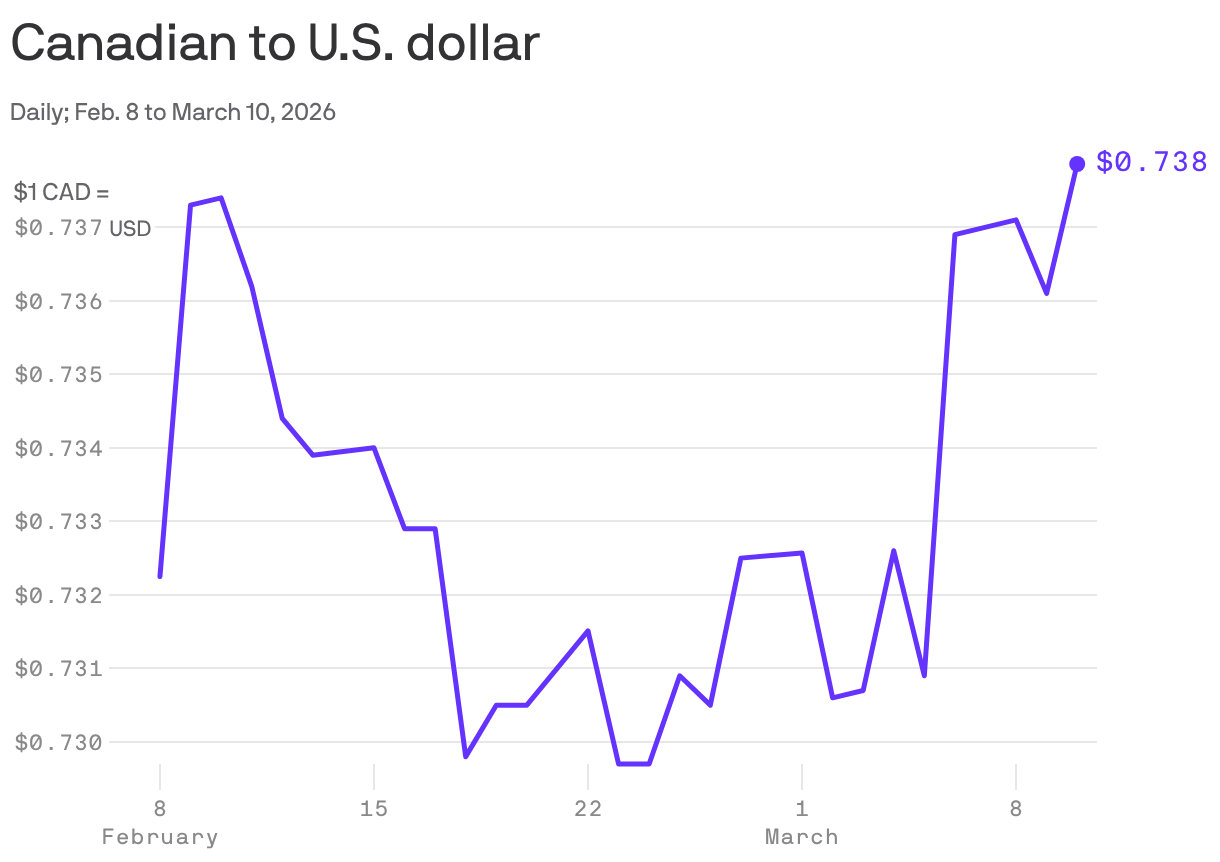
The Canadian dollar, or loonie, has strengthened against the U.S. dollar since the war began, as oil exporters see increased demand for their currency to buy crude.
Between the lines: This is a rare economic win for Canada, which has so often been the target of President Trump's trade war.

3. Will price spikes lead to more EVs?
Every time oil spikes, the same question surfaces: Will this push more people into electric cars or to install rooftop solar panels?
The big picture: Energy transitions hinge on stable policies and market signals that last for decades. Temporary price jolts from unstable geopolitical unrest haven't produced durable change, at least not in the U.S.
What they're saying: "Consumers have been riding an oil price roller coaster for 20 years now," said Bob McNally, who leads consultancy Rapidan Energy Group and advised President George W. Bush on energy security.
Between the lines: Even the most extreme scenarios analysts are modeling would last months, not years.
Reality check: Analysts call this moment the biggest disruption in oil market history, as Axios' Ben Geman reported Monday. If geopolitical turmoil were ever going to force a structural move away from oil, this would be the test.
What to watch: How long this all lasts.
Joann Muller contributed reporting.
Sign up here for the Axios Future of Energy newsletter.
Send comments or thoughts on electric vehicles to [email protected] (who could use a new car some time soon) or simply reply to this email.
Thanks to Jeffrey Cane for editing and Anjelica Tan for copy editing. Tell your friends to sign up.
Sign up for Axios Markets