Axios Markets

February 13, 2026

1 big thing: The AI scare trade accelerates


Just in time for Valentine's Day, the stock market is falling out of love with AI.
Why it matters: Investors are catching up to regular Americans who've been freaked out by AI, and its job-killing potential.
State of play: The tech-concentrated Nasdaq 100 tumbled 2% yesterday. S&P futures are down slightly in early morning trading today.
- "We did see mounting 'AI fatigue,' " but we didn't anticipate that AI would already be harming us humans in the stock market," Ed Yardeni, president of Yardeni Research, said in a note yesterday afternoon.
Zoom in: Stock prices are falling prey to the AI scare trade across industries, from trucking to real estate to software firms.
The big picture: Artificial intelligence is starting to look like the kind of big technology that will reshape the way businesses work, as the internet did at the turn of the century.
- No one quite knows what that disruption will look like. At first, that was exciting, driving up Big Tech stocks — now it's unnerving.
- It's not even clear that the hyperscalers shelling out billions of dollars on AI will make money from it.
The intrigue: Now, it seems like any nibble of AI change in any industry can trigger a reaction. And it's getting a bit weird.
- Yesterday, the Wall Street Journal reported that a press release from a company called Algorhythm Holdings — that until this summer was in the karaoke machine business — started a sell-off in trucking stocks.
- In the release, the company said it boosted freight volume without an increase in headcount.
Reality check: The declines are relatively small percentages — stocks are still trading near all-time highs. And no one really knows exactly why the market moves.
The bottom line: AI was supposed to take jobs and give the stock market a huge boost.
- Alas, there are signs this pact is faltering.
2. Antitrust, RIP?



MAGA's anti-Big Tech position was knocked off its axis yesterday when the Justice Department's antitrust chief Gail Slater resigned, after less than a year on the beat.
Why it matters: So much for the bipartisan coalition devoted to breaking up Big Tech and other monopolies.
- The upshot could be a surge in U.S. dealmaking — a bat signal to Big Tech that it can consolidate.
State of play: Slater, a well-respected antitrust attorney with bipartisan support, had talked up an America First Antitrust philosophy.
The big picture: She was a star in the populist wing of the Republican party — a movement meant to fight for the little guy against big business and globalization.
- Her departure may mark the movement's "defeat," writes Tim Wu, a Columbia law professor, who was former President Biden's chief antitrust official.
Catch up quick: Slater's troubles reportedly started last summer after the DOJ settled its lawsuit seeking to block a $14 billion merger between Hewlett Packard Enterprise and Juniper Networks, a cloud-computing and software company.
- The department had filed the case just days after President Trump took office, alleging the merger would reduce competition in the wireless networking market.
- Both Slater's deputy and merger enforcement chief — Trump appointees — were ousted in the aftermath.
Friction point: There's another big case pending now, filed in 2024 against Ticketmaster parent company Live Nation, over allegations that it operates an illegal monopoly that keeps concert prices inflated.
- Live Nation has added notable Trump allies to its board and advisory rolls. In recent days, Semafor reported that settlement talks over the case had deepened the tensions at DOJ.
- Then, two days ago, the lead attorney on the case stepped down.
The company's stock price surged on the Slater news:
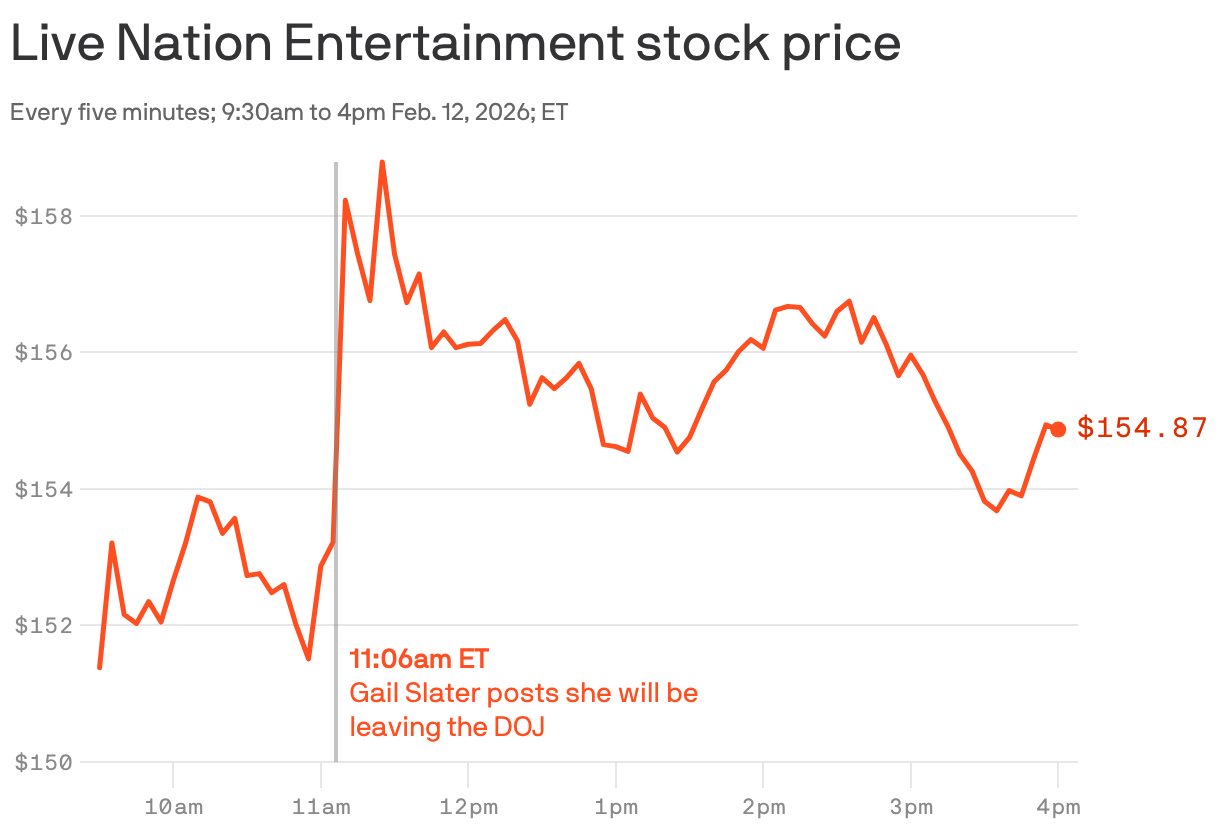
Between the lines: The Live Nation case generated more attention than the HP lawsuit when it was filed under Biden.
- Americans know Live Nation — Taylor Swift made it an enemy — and at least one poll found a majority supported a break-up.
- "People may not have strong feelings about large area networks, but they have very strong feelings about ticket prices," says Douglas Farrar, who was former FTC chair Lina Khan's senior advisor.
What they're saying: "President Trump remains committed to restoring America as the most dynamic economy in the world for big and small businesses alike," White House spokesman Kush Desai tells Axios.
What to watch: Whether there's a settlement with Live Nation before its trial begins on March 2.
3. Why your Valentine's chocolates are so expensive


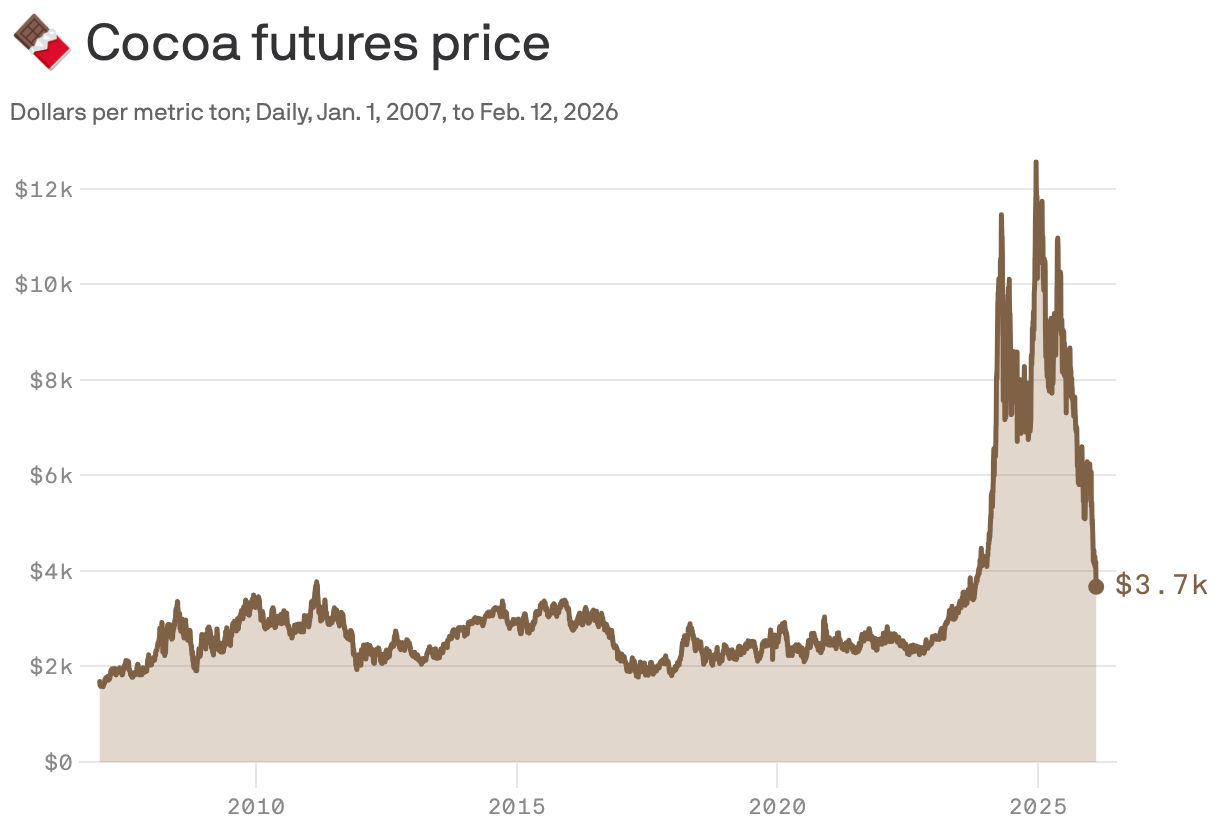
Here is a love note from the global commodities market: Roses are red, violets are blue; cocoa prices are still crashing, but no chocolate bargains for you.
Why it matters: Few commodities have plummeted in price more than cocoa this year. The plunge extends a months-long drop from record high prices, a fall that is wreaking havoc on big cocoa exporters in West Africa.
- But don't expect to see any of that reflected in lower prices at the checkout line this year.
The big picture: Tight cocoa supply drove prices to record highs in recent years. Now, supply is loosening up, pushing prices lower.
- But the chocolate you'll find on the shelves now was manufactured with cocoa that was purchased at near record-high prices. Companies like Mondelez, the maker of Cadbury and Toblerone, increased prices multiple times to offset the higher cocoa costs.
By the numbers: Cocoa prices are down almost 30% over the past month alone.
Between the lines: Big food manufacturers hedge their exposure to price swings by locking in prices for delivery months ahead of time. Large chocolate makers are still getting cocoa above spot-market prices.
- That limits how much companies can benefit from the drop — and, in turn, how much relief they can pass on to consumers.
What they're saying: "The cocoa price has declined more than anybody would have expected," Mondelez CEO Dirk Van de Put told investors this week.
- "There's not a lot we can do anymore, but 2027 certainly will benefit from this."
What to watch: Chocolate sales on Feb. 15 usually hit the sweet spot.
We'll be back on Tuesday after the long weekend. Until then, send me tips, feedback and fancy chocolate recommendations (I love Lake Champlain) at [email protected].
Thanks to Jeffrey Cane for editing and to Carolyn DiPaolo for copy editing.
Axios Markets