Axios Markets

May 21, 2024

Welcome back. Today we're going deep into the mess that is the housing market, in 958 words, 4 minutes.
🚨Late yesterday afternoon, FDIC chair Martin Gruenberg, under fire over the agency's toxic workplace culture and his past behavior, said he'd resign.
- There's a catch: He'll step down only once the Senate confirms his replacement. That could take quite some time, though the White House says it will move quickly.
1 big thing: The latest attempt to thaw the housing market

Homebuyers typically covet amenities like walk-in closets or cold-plunge pools — but the latest hot thing in the housing market is the old-school sub-4% mortgage.
Why it matters: The new idea to revive the housing market is called an "assumable mortgage," where a homebuyer not only acquires a house but also the seller's mortgage.
The big picture: Sounds cool in theory — homebuyers and sellers surely miss the ultra-low mortgage rates of a bygone era — but the problem is these assumable mortgages are rare, hard-to-obtain specimens.
- Despite the difficulties, assumables are getting attention in the form of new startups that help you find one as well as media spots (like this one!).
- It demonstrates how desperate the real estate world is to solve its biggest problem: "rate lock."
Catch up fast: Also known as the "golden handcuffs," rate lock is the phenomenon in which homeowners feel they can't sell their house because they'd have to give up the low mortgage rate they nabbed before rates rose (the average rate on the 30-year mortgage is now hovering at 7%).
How it works: Any government-backed loan, including FHA, VA and USDA mortgages, could be assumed by a purchaser.
- 23% of outstanding mortgages, about 12.2 million, fall into this category, but only 13%, or 6.8 million, have rates below 4%, according to data from Intercontinental Exchange.
- The universe might be even smaller than these numbers suggest. About two-thirds of assumable mortgages were taken out within the past 3.5 years, says Andy Walden, vice president of enterprise research strategy at ICE.
- "Meaning borrowers may not be ready to sell just yet," he says.
How it works: Some real estate listings now note if a home comes with an assumable mortgage, and there are new startups where buyers can peruse only these kinds of homes — including Roam, AssumeList and Assumable.
- If you find a house to buy, there are high hurdles to closing the deal.
- The down payment is the big one. You don't simply lay out 10% of the purchase price. The required down payment for an assumable is the difference between the purchase price and the seller's loan balance, as Roam explains in its FAQ.
- For example, if you bought a $400,000 home in the usual way, maybe you'd have to come up with $40,000. If you're assuming the mortgage on that house, you might be assuming a loan with a remaining balance of $200,000 — and you'd need to come up with the rest in cash or via a second mortgage.
Reality check: Mortgage servicers may not want to do these deals because they can charge only a few hundred dollars on assumptions, less than they'd get for new loans and "often less than the cost of processing the assumption," the WSJ reported recently.
- There were only 6,000 assumptions completed in 2023, per the New York Times, which outlines a bunch of other reasons why this process is so hard. So far this year, there have been 3,896.
- That's not a lot.
2. You can't take it with you — yet
There's another idea floating out there, even more far-fetched than the assumable rate mortgage: the portable mortgage.
- A recent paper, highlighted by New York Times columnist Peter Coy, proposes that mortgage holders pay a fee to tote their low-rate mortgage along to their next home.
The bottom line: Don't hold your breath on this one. The Mortgage Bankers Association and the Federal Housing Finance Agency both told Coy this isn't happening.
3. Charted: Rate lock

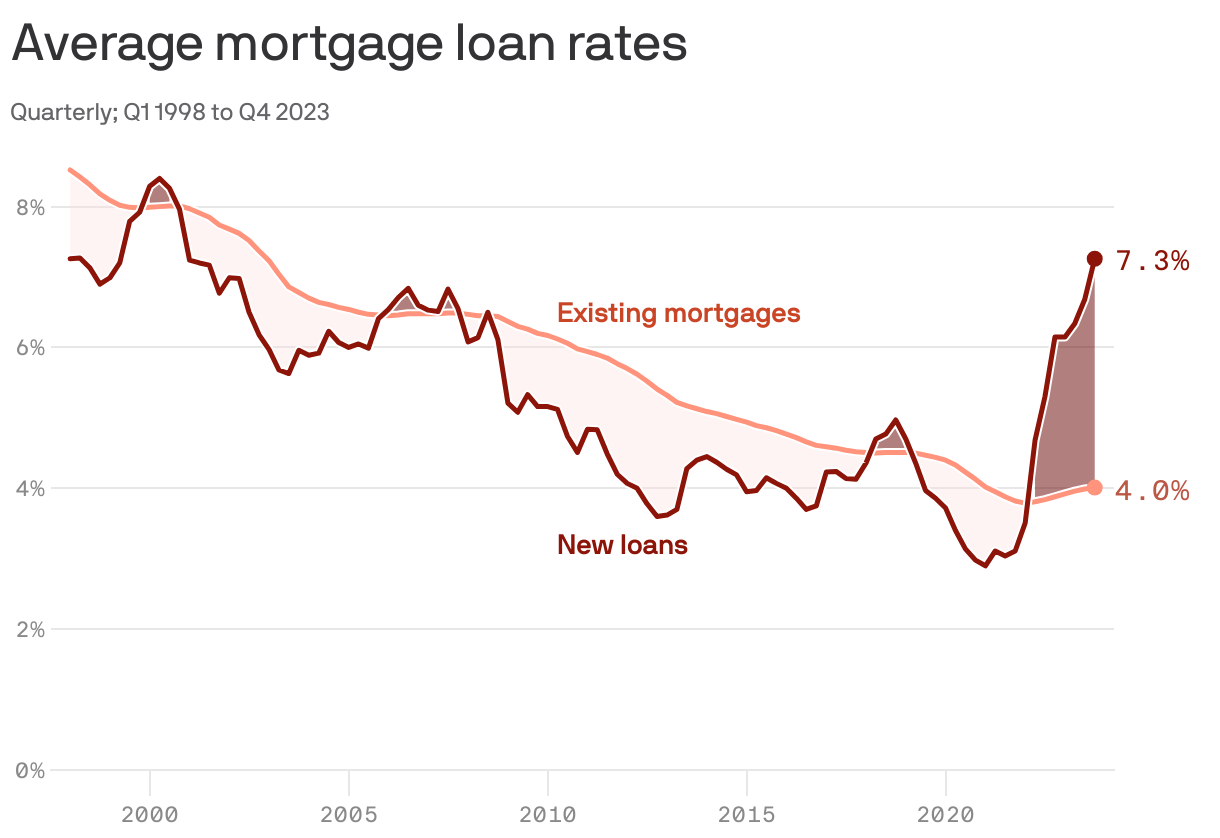
The gap between the mortgage rate you can get on a new loan and the rates most mortgage holders are holding hasn't been this wide in more than 25 years.
- This mortgage rate lock prevented 1.3 million home sales between the second quarter of 2022 and the fourth quarter of 2023, per a working paper from the Federal Housing Finance Agency out earlier this spring.
- The unusual situation is keeping first-time buyers out of the market, and reducing home inventory, which keeps house prices elevated.
The bottom line: "The "stuckness" in the housing market may also be feeding broader frustration with the economy," write Emily Badger and Francesca Paris in the NYT (read their full story).
4. Ivan Boesky, 1937—2024

Ivan Boesky, arguably the most iconic antihero Wall Street has ever produced, died Monday at the age of 87.
They don't make 'em like they used to. This is probably a good thing, given Boesky's conviction for insider trading.
The big picture: Boesky was the kind of criminal who craved the limelight.
- The day before he surrendered to federal authorities, he descended via helicopter to a friend's son's cruise ship bar mitzvah, wearing a tuxedo and "looking like a latter-day James Bond," per the NYT's obit.
- He embossed the carpets in his Westchester County, New York, mansion with his initials, IFB; was driven around town in a pink Rolls-Royce; and had a habit of ordering every dish on the menu at fancy restaurants, leaving most of the plates untouched. (He consumed much more coffee than food.)
The backstory: Boesky grew up in working-class Detroit and dropped out of Wayne State University in Detroit, the University of Michigan, and Eastern Michigan University before turning the last of his father's chain of bars into Le Club a-Go-Go. Two years later, it went bankrupt.
- Boesky first became rich by marrying real estate heiress Seema Silberstein, whose parents bought him a Park Avenue apartment and seeded his investment fund with $700,000.
- Boesky took 40% of all the fund's gains, but only 10% of any losses.
The bottom line: Boesky's insider trading landed him a three-year prison sentence; he ended up serving 18 months.
- Upon his release, his wife filed for divorce; in the settlement, he received $20 million from her, plus a $2.5 million home in California and an annual income of $180,000.
Thanks to Kate Marino for editing this newsletter and to Mickey Meece for copy editing it.
Sign up for Axios Markets