Axios Markets

March 18, 2026

1 big thing: Homeownership split


New U.S. homebuyers spend a far higher share of their income on housing than existing homeowners — and that gap is growing, an analysis out this week finds.
Why it matters: There's a huge bipartisan push to make homeownership more affordable — but policy ideas often target existing homeowners, the ones least in need of help.
- Worse, some efforts to increase affordability — particularly the push to lower mortgage rates — can exacerbate the problem.
How it works: New homeowners almost always spend more of their income on housing. They're typically younger, earn less money and face higher home prices.
- But the share of income they're devoting to housing has spiked over the past four years, as the pandemic drove up home prices and then mortgage rates surged.
By the numbers: In 2024, the most recent year with available federal data, new homeowners — defined as those who bought a house within the past year — spent nearly 27% of their income on housing, according to the new analysis from the centrist Economic Innovation Group.
- That's close to the level last seen in the years before the housing bubble began to burst in 2007, when buyers with bad credit were taking out mortgages they couldn't afford.
- Existing homeowners, meanwhile, spent just 20% of their income on housing, near record lows.
- The gap between the two groups is the widest in at least 40 years.
Friction point: President Donald Trump and many lawmakers like to focus on mortgage rates as a way to make homes more affordable for new homeowners.
- "We got to get interest rates down even lower," Trump said at a Cabinet meeting in January. "To me, the biggest factor is interest rates for housing."
- The White House has touted the decline in rates over the past year — though they've come back up over the past two weeks, as the war has raised borrowing costs.
Between the lines: Mortgage rates are big and splashy, but they don't actually do much to make homes more affordable, EIG finds.
- Instead, when rates are low, more new buyers enter the market — and bid up prices.
- Low rates do benefit existing homeowners, who can refinance.
- "Rate cuts likely would help recent homeowners to refinance at lower rates, but it's unlikely that they would do much to lower the barrier to entry for new buyers," writes Jess Remington, a research analyst at EIG who links to similar research from the Dallas Fed.
Zoom in: When interest rates fell from 2019 to 2021, new homeowners' real monthly mortgage payments actually increased, the analysis notes.
- That's been the pattern since 1980, other research finds.
The big picture: Buying a house — once the American dream — has increasingly become a fantasy for many.
- There's remarkable bipartisan agreement that something needs to be done to bring down housing costs. Big housing affordability bills have now passed both the House and Senate — though have since stalled out, as Trump is focused on election legislation and the Iran war.
- Still, Trump has floated ideas outside of Congress — introducing 50-year mortgages, preventing investors from buying single-family homes and directing the purchase of $200 billion in mortgage bonds.
- Last week, he issued executive orders that would make it easier to build and finance homes.
The bottom line: Some of the policies that focus on building new supply could ultimately make homes less expensive — by addressing a housing shortage.
- But those policies will succeed on fairly long-time horizons.
- Mortgage rates move much faster than home builders ever could — don't expect anyone to stop talking about their benefits anytime soon.
2. How much more can air travelers take?


Even for those accustomed to the indignities of air travel, it's clear that right now is a particularly terrible time to fly.
The big picture: The Iran war is creating major travel headaches on top of an already chaotic situation at airports in the U.S., raising the prospect of a downturn in the travel industry.
The latest: More than 52,000 flights to and from the Middle East have been canceled since the war began on Feb. 28, according to data cited by the New York Times.
- The conflict is spiking fuel prices — the average price of a gallon of jet fuel is up about 60% this month, much of that as a result of an increase in refining costs because the war is disrupting key infrastructure, per the Argus Jet Fuel Index.
- Some airlines are already raising prices, per NBC News, and the industry warns that a sustained conflict could have long-lasting impacts on prices across the industry.
- At the same time, airport security lines in the U.S. have grown comically long in the wake of the partial government shutdown.
How much more can travelers take?
- "The cynical might assert that air travelers have gotten used to taking abuse, so they'll begrudgingly put up with even more," Kent Fung, vice president at Fundstrat Global Advisors, wrote in a note Tuesday.
- "But the proverbial camel's back gets broken with a single straw, and what's happening in the Persian Gulf is quite a heavy straw indeed."
Zoom out: The moment could grow so sufficiently bad that it marks a travel breaking point — akin to what happened in the oil crisis of the 1970s, Fung writes.
- Back then, high gas prices and long lines at the pump drove a real shift for Americans in terms of fuel consumption — they started buying smaller, fuel efficient Japanese cars and took steps to conserve energy.
- Companies also redesigned how they worked to become more fuel efficient.
- If the current travel woes deepen, Fung said, perhaps the travel sector will see a similar kind of shift.
Zoom in: Airline stocks are having a rough year — Delta is down 6% from January. United Airlines is down 17.5%, and American Airlines is off nearly 30%.
- Yesterday, however they caught a bit of a bounce after both Delta and American raised their revenue outlooks for the first quarter.
Reality check: It's only been a few weeks. Air travelers are used to punishment.
The bottom line: Americans' appetite to spend on going places has been a driver of economic growth in recent years. Even after our zeal for revenge travel subsided, spending continued to grow.
- Now that could change.
3. Charted: Dire straits
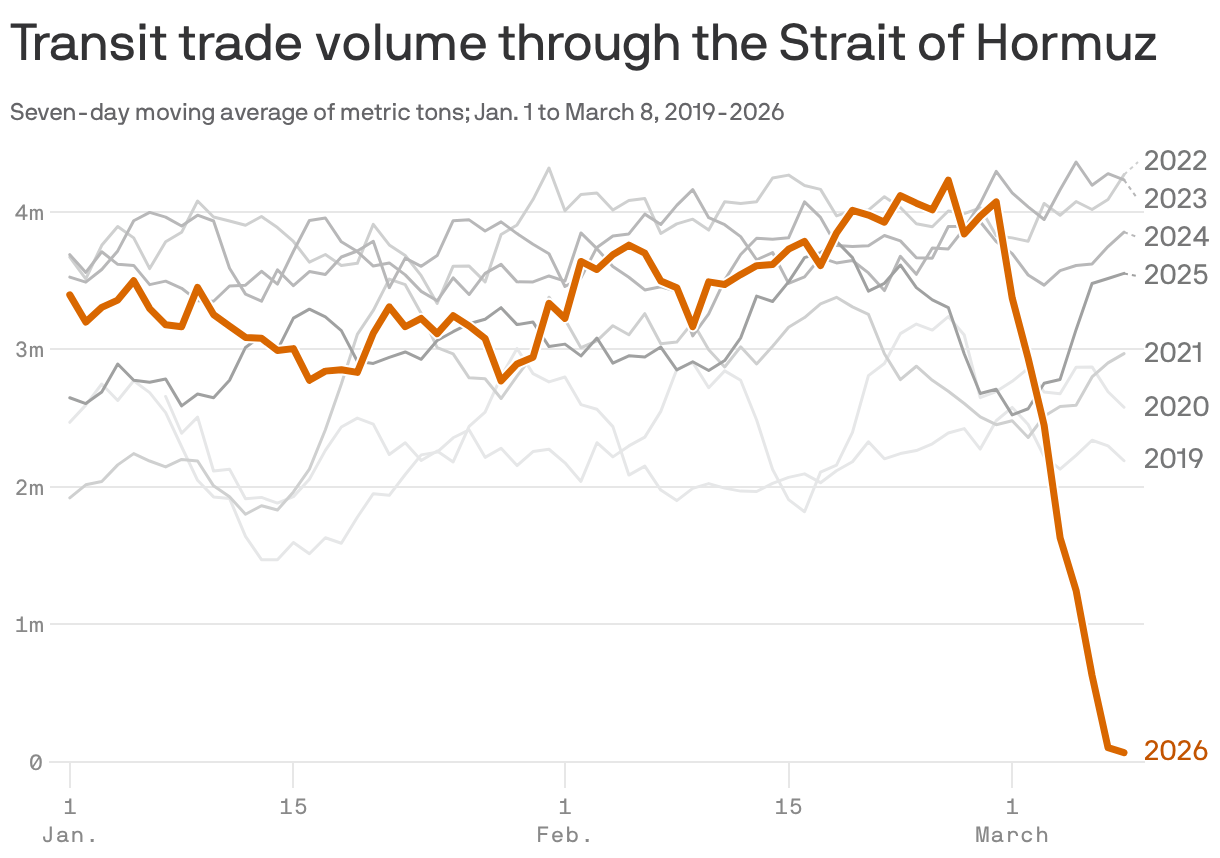
The shutdown of the Strait of Hormuz isn't merely affecting fuel prices.
- The Financial Times reports today that the war has turned container shipping into a "wild west," with the largest shipping companies invoking some 19th-century rule that lets them leave containers wherever works best.
Axios Markets