Axios Markets

March 18, 2025


1 big thing: Is this the end of cheap clothes?


The real price of clothes has been on a steady downward trend for 25 years. Across-the-board tariffs could be the one force powerful enough to reverse it.
Why it matters: "Access to cheap goods is not the essence of the American dream," per Treasury Secretary Scott Bessent.
The big picture: Should the era of cheap and fast fashion start coming to an end, MAGA won't mourn its passing.
- Interestingly, neither will much of the left, which has spent decades bemoaning the social and environmental toll of cheap fashion.
Zoom out: "The infrastructure for domestic manufacturing at every level of the supply chain, from fiber through to fabric through to garments, has been methodically dismantled over the last 30 years to maintain low prices for North American customers," garment industry veteran Karuna Scheinfeld says.
- "We do not have the infrastructure anymore to vertically manufacture in North America, and we're not going to rebuild that infrastructure in the next four years."
Zoom in: While there is some apparel employment in the U.S., it tends to be found in relatively small-scale operations like Mel Gambert shirtmakers in New Jersey, or Waterbury Button Company in Connecticut.
- "I import everything except for my corrugated boxes," says Mitch Gambert, who runs the shirt company, explaining that there's no reliable domestic production of thread, sewing machines, high-quality fabrics, or anything else he needs to buy.
- Since apparel margins are so thin, any tariff-driven percentage increase in input prices will force Gambert to raise his own prices by a similar amount, he says.
- The only way for tariffs to help U.S. manufacturers would be if they were inconsistent, for instance, if the tariffs on fabrics were lower than tariffs on finished shirts. Across-the-board tariffs, like those proposed by the Trump administration, wouldn't help.
How it works: As inflation-adjusted garment prices have dropped by roughly 50% over the past 20 years, unit consumption has roughly doubled, per Kristy Caylor, CEO and founder of textile companies For Days and Trashie.
- That's the legacy of fast fashion, as originally invented by H&M and Zara, then turbocharged by Shein and Temu.
- By raising prices, tariffs might force the U.S. consumer to buy less and discard less. "Everybody could be more thoughtful and mindful," Caylor says.
The intrigue: Some items can be created by 3D printers, like the Adidas Climamog "Off White" shoe.
- Those kind of items could easily be produced in the U.S., says Phil DeSimone, chief product officer at Carbon, a 3D-printing company. But don't expect the new technology to create much in the way of jobs.
- "The days of having 80 people touch a pair of shoes before it hits the end of the manufacturing line are over," he says.
- "The factories that come back won't look like what we all think a factory looks like, won't have thousands of jobs."
The bottom line: Higher tariffs mean more expensive clothes. Not everyone is convinced that would be a bad thing.
2. Where wine tariffs would hit the hardest
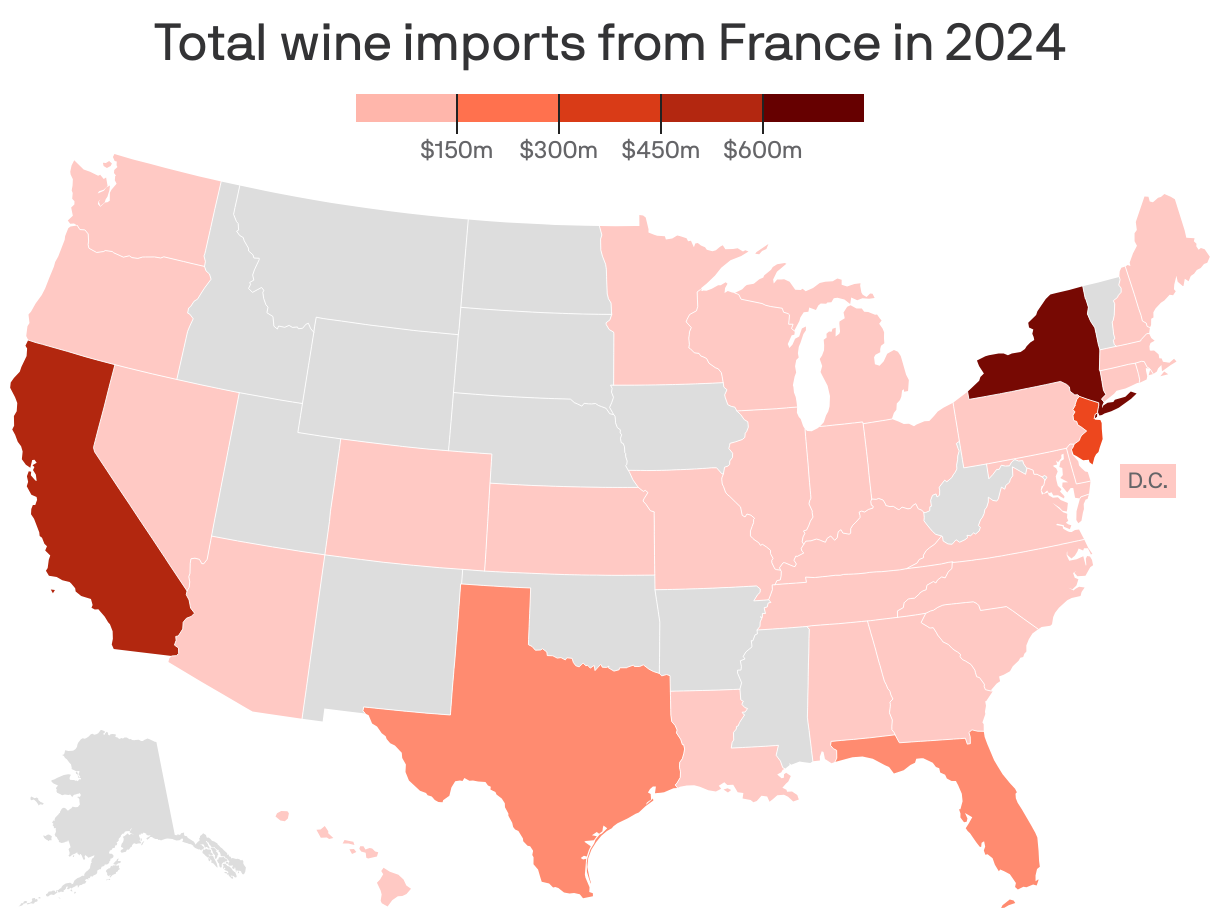
U.S. wine importers spent $6.8 billion to bring wine into the country in 2024, 80% of which went to producers in the European Union, per the American Association of Wine Economists.
Why it matters: If tariffs were to bring that number to near zero, there would be devastating consequences down the chain, not only for the importers, but also for distributors, retailers, and anywhere that sells meaningful quantities of imported wine.
What they're saying: "It's a financial death sentence," says wine importer Lyle Fass, who explains that millions of dollars' worth of wine is already paid for, on ships headed for the U.S., and that if those imports are suddenly hit with 200% tariffs upon arrival, most importers simply won't have the money to pay what they owe.
- "This is obliteration," Fass says of that scenario.
Zoom out: If President Trump were to follow through on his threat of imposing 200% tariffs on E.U. wine imports, those tariffs would generate almost no revenue, since no one can raise their prices that much.
- By the same token, wine importers would also see their revenue fall to near zero, because after stripping out European imports they would have almost nothing to sell.
- While most of those importers are in California, New York and New Jersey, there are also plenty in Florida and Texas.
Flashback: Much smaller 25% tariffs imposed in 2019 resulted in French wine imports falling by 54% and German imports by 42%.
The big picture: The threat of these wine tariffs are almost certainly part of what a White House official characterized to Axios as "the art of the deal" — a negotiating position rather than an attempt to kill a whole industry.
- French politicians are already suggesting walking back the proposed E.U. tariff on U.S. whiskey, which triggered Trump's initial response.
The bottom line: 200% tariffs probably won't ever get imposed.
- If they do, however, they would be so large that the wine industry would probably opt to wait them out rather than pay them, only to look foolish when they're lifted a day or week or month later.
3. Charted: Global economic effect of tariffs


The trade war is already expected to increase inflation and dampen growth, and it could get even worse if tariffs rise further.
The big picture: Additional trade levies could compound the risks to the world's biggest economies, the Organisation for Economic Cooperation and Development warned yesterday.
By the numbers: The OECD modeled a scenario where the U.S. raises tariffs another 10% on all noncommodity imports, and all other countries respond with a similar countertariff on U.S. exports.
- Three years out, all major economies and economic areas would experience lower growth than they would have otherwise, with the biggest impacts to Mexico and the United States.
Axios Markets