Axios Markets

May 05, 2026

Good morning! Stock futures are higher, and oil prices have retreated on apparent hopes that tensions in the Persian Gulf have eased after the U.S. and Iran exchanged fire yesterday.
🗓️ Today, Axios' Madison Mills returns to Markets to discuss the risks in all that AI spending we learned about last week. And there's a new cohort of stocks that are both AI and Halo.
All in 1,051 words, a 4-minute read.
1 big thing: AI's $1 trillion risk keeps growing
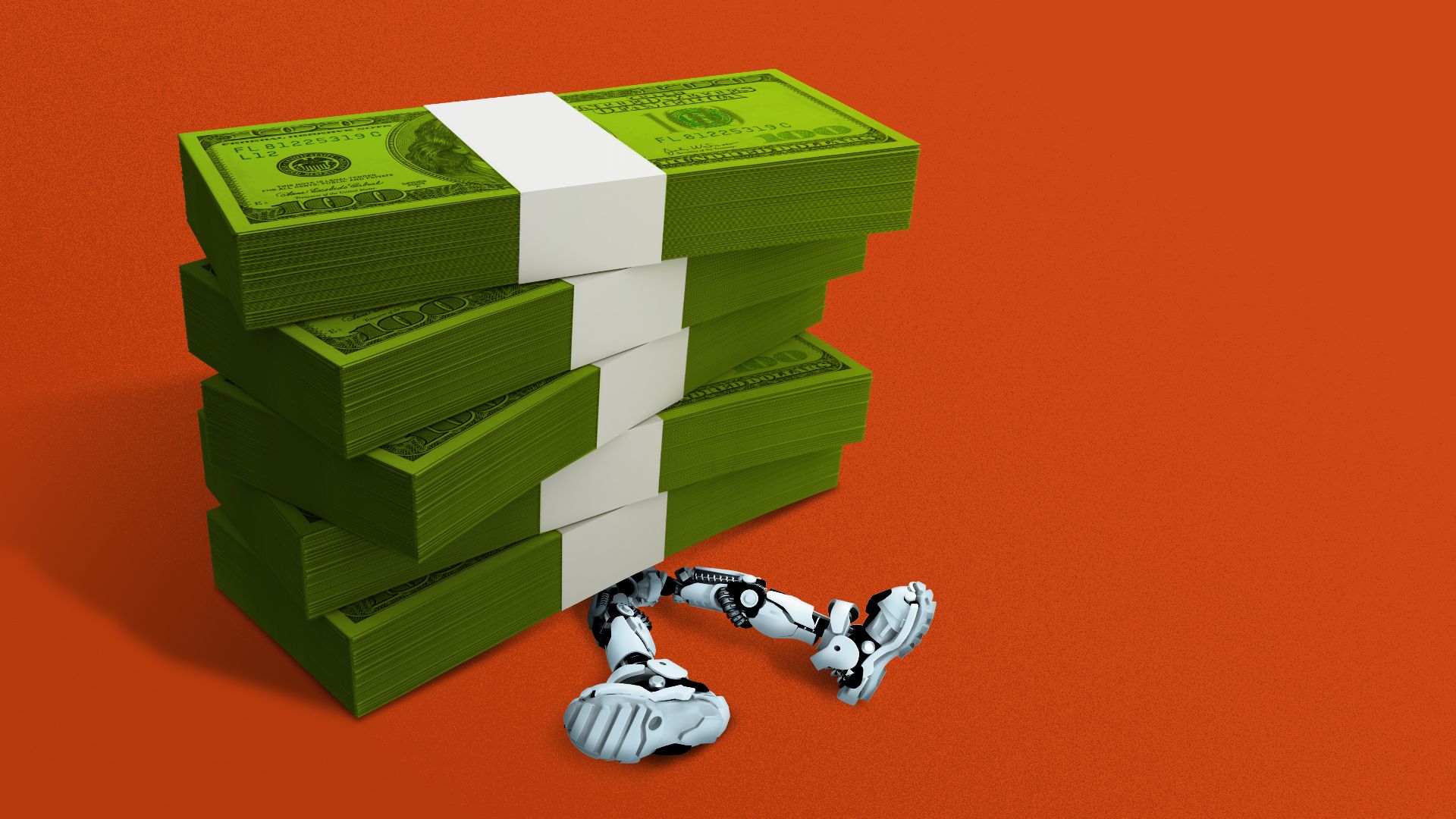
The biggest tech companies are set to spend $1 trillion on AI by next year, according to multiple banks, a bill so big that it's propping up both the stock market and economy.
Why it matters: Our financial system is now load-bearing on AI spending that may never pay off, and most investors can't even see what the full tab is.
State of play: The biggest tech firms are on track to spend $700 billion on their AI ambitions this year, double their 2025 spending, according to Goldman Sachs. That could swell to over $1 trillion next year, according to multiple estimates.
- AI costs went up, not down, for four of the Big Tech companies that reported earnings last week, according to Bank of America.
- As their cash flows erode, these companies argue they have to keep spending to stay ahead in the AI race.
What they're saying: "The question I want answered is not whether any of these four companies beat the Street by 2 cents. I genuinely do not care about that," Mark Malek, chief investment officer at Siebert Financial, wrote in a note to clients.
- "What I want to know is whether the monetization engine is actually firing."
- That's a very difficult question to answer because there's no end in sight for AI spending: Computing processing power, or "compute," is constrained, and demand is at an all-time high, meaning the cost of servicing AI keeps rising.
Zoom out: While the spending spree ramps up, it's increasingly propping up the stock market and economy.
- AI spending from businesses is a larger contributor to economic growth than consumer spending.
- AI's big spenders, meanwhile, make up nearly half of the stock market, the outperformance of which has minted more millionaires than ever, who in turn are spending more while lower-income consumers struggle under the weight of inflation.
What we're watching: With both the market and the economy relying so much on continued AI spending, the danger is if it doesn't start to pay off and the Big Tech companies start to turn the spigot off.
- "The moment one of those hyperscalers doesn't succeed ... you break a link in the chain," PitchBook's Harrison Rolfes tells Axios.
- That could cause a market correction with "ripple effects to everyone else," he added, saying that 2028 through 2030 will be revealing as more compute capacity is expected to come online then.
Threat level: And there's more spending we don't even know about.
- The biggest tech companies are spending over half a trillion additional dollars on data center leases that aren't on their balance sheets, according to a report from Moody's.
- According to Michael Burry, made famous by "The Big Short" for betting against the housing market heading into 2008, Big Tech's earnings are overstated by as much as 42% due to these unknown risks.
The bottom line: The true cost of the AI buildout is larger than what's showing up on balance sheets, and investors are pricing risk they can't fully see, just as the broader market and economy grow more dependent on the spending spree continuing.
2. Meet the "Data Center 7"
Speaking of the AI buildout, Caterpillar is not the only equipment maker benefiting from the boom in data centers.
The big picture: Two of the biggest bullish trends in the market have been the AI boom and stocks that are "heavy assets, low obsolescence," or the Halo trade.
- In the middle of the Venn diagram of those two trends sits a number of industrial companies.
What they're saying: Robert Armstrong, the Financial Times markets columnist who coined the term TACO, has identified seven of them that he calls the Data Center Seven.
- They are: Vertiv Holdings (up 104% year to date), Comfort Systems USA (up 103%), Generac Holdings (up 89%), Quanta Services (79%), Cummins (up 29%), Emcor Group (up 49%) and, of course, Caterpillar (up 53%).
- In contrast, the company at the epicenter of the AI boom, Nvidia, is up only a bit more than 6% so far this year.
What to watch: Still, there's reason to be wary, Armstrong notes, given that the industrial stocks' performance shows that AI boom is not just the hyperscalers and the chipmakers.
- "If the boom should fizzle, the damage will not be contained to one or two segments," he writes.
3. Amazon takes aim at the supply chain


Three decades old but still a disruptor, Amazon is offering its distribution, parcel shipping and fulfillment services to outside businesses, not just to those on its marketplace.
Why it matters: The $2.9 trillion company is now aiming to be a dominant force in the global supply chain, going head to head against delivery companies like FedEx and UPS, as well as air freight and logistics firms.
By the numbers: Shares of those companies tumbled after Amazon's announcement yesterday.
- Amazon shares rose 1.4%.
Zoom out: Amazon has already built out a distribution network, with its own logistics technology.
- It was just behind UPS in the number of parcels handled in the U.S. in 2024, per Pitney Bowes, and is projected to be No. 1 by 2028.
- Creating Amazon Supply Chain Services as a service for other businesses is somewhat like how it started Amazon Web Services, now the cloud provider for countless businesses, a point the company made in its announcement.
What they're saying: "For UPS and FedEx, this is not immediate disruption, but it is a structural warning shot, especially in e-commerce-heavy lanes where Amazon already has density, data and delivery-speed advantages," Parth Talsania, CEO of Equisights Research, told Reuters.
- The news is "a shot across the bow to the entire transport market," said Joe Gilbert, portfolio manager at Integrity Asset Management, per Bloomberg.
Send me tips and story ideas: [email protected] or reply to this email.
Thanks to Jeffrey Cane for editing and Carlin Becker for copy editing this edition.
Tell your friends to sign up here. You can also hit me up on X.com or Bluesky at EmilyRPeck.
Sign up for Axios Markets