Axios Markets

April 23, 2025

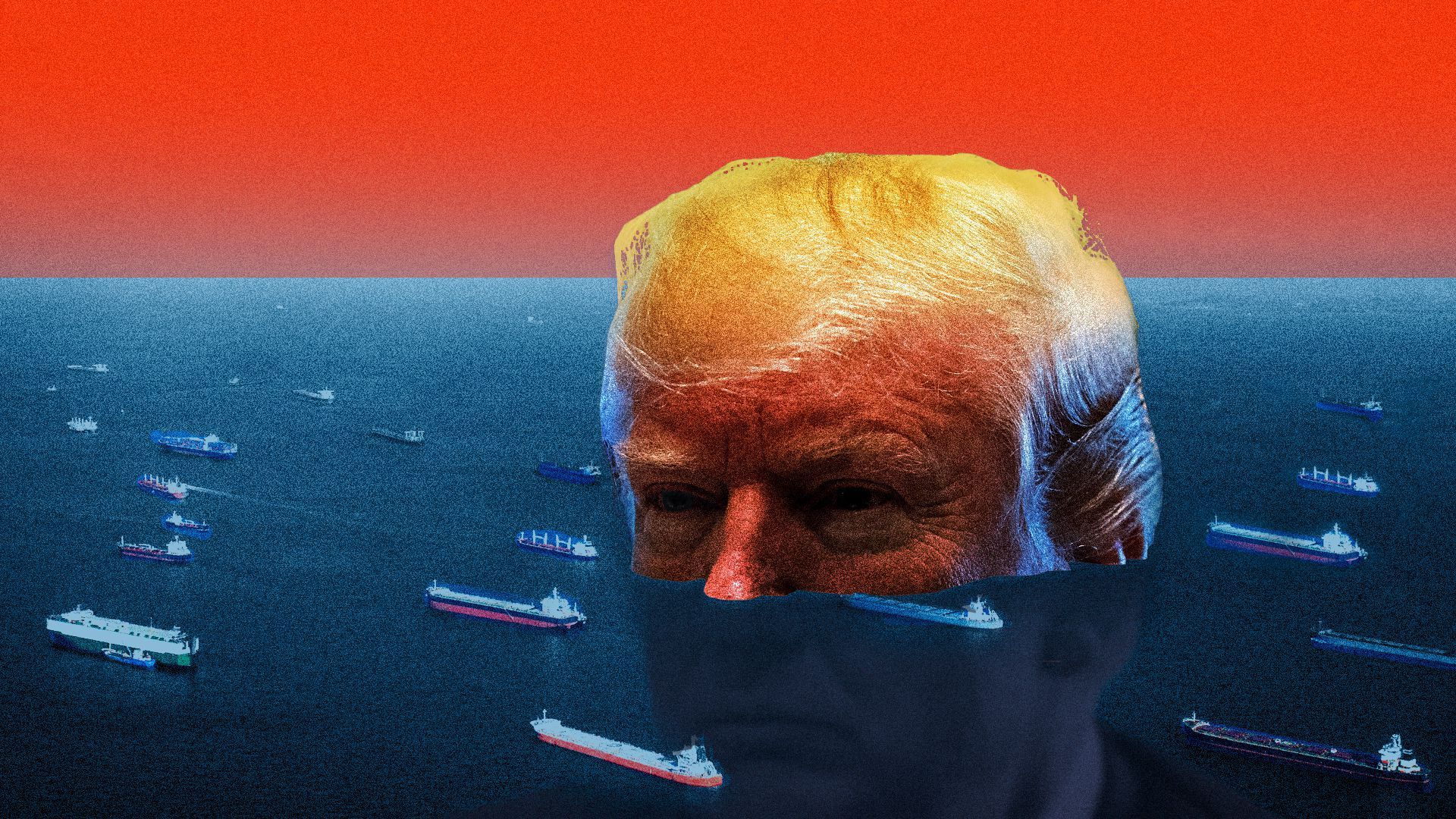
🌊 If you're looking for warning signs about the effect of tariffs, check out the ports and the highways, as freight's under pressure.
- We're looking at the details of what's happening, and how much damage has been done, even if the trade war eases.
👀 Situational awareness: Global markets rallied overnight after President Trump signaled a somewhat softened tone toward China and eased off his threats to fire Fed chair Jerome Powell.
- U.S. stock futures were up about 2% this morning, following similar gains in Asia and Europe. Bond yields fell, the dollar strengthened slightly, and gold eased off its recent record highs.
All in 940 words, a 4-minute read.
1 big thing: U.S. trade is already falling
Merchandise trade between China and the U.S. is likely to collapse if the current tariffs on both sides remain in place.
- How much of that collapse has already started, however, is unclear.
The big picture: While some transpacific container-shipping routes have been canceled or changed to avoid U.S. ports, many ships are still headed for Long Beach, Oakland, and other U.S. destinations.
- They can still decide not to dock in the U.S. if the tariffs remain in place.
Driving the news: The U.S. and China have effectively put trade embargoes on each other, Treasury Secretary Scott Bessent said yesterday, echoing a recent forecast from the World Trade Organization that merchandise trade between the two countries "could decrease by as much as 80%."
- President Trump said late yesterday he won't play hardball with China and a deal will be made, but when and with what impact remains to be seen.
Where it stands: While activity at U.S. ports is declining, it's still broadly within a normal range.
- There are 22 vessels scheduled to enter the Port of Los Angeles this week, with 18 set to enter next week and 12 the week after, per the port's Signal database.
- In terms of the number of containers, the forecast for the week of May 4 comes to 62,568, down from an unusually high level of 120,608 this week.
- That's low but far from unprecedented. The week of March 4 in 2024 saw 61,131 container-equivalents imported, for instance.
What they're saying: "These are the most sweeping tariffs we've witnessed in our lifetime," Gene Seroka, executive director of the Port of Los Angeles, tells Axios.
- "I'm hearing directly from large retailers and manufacturers here in the United States that many have ceased all shipments from China," he says. "You're probably going to see two-thirds of normal cargo or less coming through the Port of Los Angeles in the weeks to come."
- On the other side, Seroka says U.S. export volume was down 8% to 10% over the past couple of months, and that "we'll probably see a more precipitous drop with the advanced retaliatory tariffs put in place by China."
Between the lines: In normal times, trade volumes tend to mean-revert. A high number implies firms are stocking up on inventories. A low number means they're going to have to import more in the future.
- These are not normal times, however, so analysts are trying to work out whether the current downtick might be the start of a long-term secular downtrend.
- "We are at a tipping point on the West Coast," Ken Adamo, chief of analytics at DAT Freight & Analytics, told CNBC.
The bottom line: Trump has demonstrated his ability to make tariff decisions in far less time than the two weeks it takes a container ship to cross the Pacific at 18 knots.
2. What shipping charts look like


A closely watched leading indicator of container arrivals in the U.S. is the number calculated daily by Marine Exchange of Southern California, which adds up how many ships are on their way to the Port of Long Beach.
Why it matters: That number has fallen significantly over the past week, from 55 on April 16 to 45 on April 21.
- The data is very noisy, however, and falls of that magnitude happen quite frequently. Moreover, the number is almost exactly the same as it was this time last year.
Context: Shipments are coming down from the record highs set in September when the port handled more containers than ever before in its history.
- That almost certainly contributed to a significant rise in U.S. inventories.
Where it stands: There's reason to believe that manufacturers have begun to put shipments from China to the U.S. on hold.
- Data from Vizion and Dun & Bradstreet, for instance, shows that in the first week of April there was a 64% plunge in new bookings for shipments to the U.S. from China.
- The "widespread booking freeze" came "as shippers paused to reassess costs, timelines, and broader trade strategy," Vizion analysts write.
The bottom line: "The whole thing is so fluid," says Capt. Kip Louttit, who runs the Marine Exchange and oversees its dataset.
- "Here's what my stats are, you figure out what the reason is."

3. Tariffs worsen trucking bloodbath
A knock-on effect of fewer ships arriving is that trucking companies will face plummeting cargo volumes at major U.S. ports in the coming weeks.
Why it matters: The tariff-driven reductions will add to the pain from three years of a freight recession, likely driving some carriers to sell or shutter.
What they're saying: "There are going to be casualties, no doubt," Harbor Trucking Association CEO Matt Schrap, who represents West Coast port truckers, says. "The magnitude remains to be seen."
Zoom out: Many trucking fleets were already constricting or consolidating their operations, as they contended with a prolonged down-cycle after a post-pandemic boom.
- "That includes downsizing, outsourcing, relying more on technology and, frankly, just losing customers because costs are too high," Schrap says.
- The struggle isn't limited to trucking. Some distribution firms are backing out of long-term warehouse leases in Southern California because of the economic uncertainty, Schrap adds.
Between the lines: Even if the U.S. and China agree to a deal on tariffs, the opening salvo of the trade war has done irreversible damage, Pacific Merchant Shipping Association President Mike Jacob wrote in a blog post last week.
- "We are already seeing dramatic drops in intermodal booking data, growth in blank sailings, pauses in trading, and unknown damage in the US-China commercial and financial relationship," Jacob wrote.
For a steady diet of scoops and smart analysis on supply chain deals, talk to our sales team about Axios Pro Deals.
Thanks to Ben Berkowitz for editing and Anjelica Tan for copy editing. See you tomorrow!
Sign up for Axios Markets