Axios Markets

August 27, 2024

The rich are different from you and me: They buy companies much like we buy betting tickets.
- Today's newsletter, edited by Emily Peck and copy edited by Mickey Meece, is 828 words (3.5 minutes).
1 big thing: Why you shouldn't invest like a billionaire
A perennial pitch in the investment industry comes from firms that claim to give the middle class access to investment strategies hitherto available only to people of great wealth.
The catch: Investing like the ultra-rich is a terrible strategy for most people.
- Billionaires don't need to maximize their returns when they make investments — and they almost never need to sell anything. They're therefore terrible role models when it comes to most people's personal investment decisions.
The logic: The financial services companies pitching exotic solutions tend to implicitly or explicitly lean on a powerful argument.
- Ultra-high-net-worth individuals are growing their wealth more quickly than the middle class; they have access to investments unavailable to the middle class; therefore, the middle class would grow their wealth faster if they had access to those rarefied investment opportunities.
- That syllogism is a solecism.
Driving the news: Various billionaires, including Sean Combs, Bill Ackman, Larry Ellison, Jack Dorsey, and Prince Alwaleed bin Talal, were revealed last week to have helped fund Elon Musk's takeover of Twitter at the inflated price of $54.20 per share.
- British hedge fund billionaire Paul Marshall is reportedly bidding $131 million — some $1,400 per subscriber, or 72 times earnings — for a 150-year-old British political magazine.
- One billionaire scion, David Ellison, beat out another billionaire scion, Edgar Bronfman Jr., for the right to buy control of Paramount from a third billionaire scion, Shari Redstone.
Between the lines: In all of these examples, a trophy asset has personal value to the acquirer, on top of any financial value or price-appreciation potential. While it's possible those investments will end up outperforming a stock market index fund, it seems highly unlikely.
- As Luma's Terry Kawaja told DealBook about the war for Paramount, "If you're the billionaire son of a billionaire, it's the ultimate asset."
- Or as Bloomberg Opinion's Matt Levine put it, having "some coherent, or entertainingly incoherent, story of what you're up to with your money" is clearly superior, to someone worth $25 billion, to a passive investment strategy that makes more money.
The big picture: One of the greatest luxuries that being very rich buys is being able to lose a lot of money and still live a billionaire's lifestyle.
- Wealth also confers the ability to blur investment and consumption — to invest money for nonfinancial reasons but to present that investment to the world as being a great investment all the same.
Follow the money: The real secret to billionaires' outperformance, whether the assets they're investing in are liquid or illiquid, is the endless number of wealth-management companies offering cheap liquidity whenever it's needed.
- Being able to borrow any amount you'll ever need means never having to sell at a loss or give up a promising investment because you need the money today.
- In that sense, billionaires can have their cake and eat it too: They can spend the money in their investment portfolios without having to liquidate those investments.
- Normal folks, by contrast, don't have access to a long list of lenders begging to advance capital against illiquid stakes in private companies.
The bottom line: Once you have more money than you'll ever be able to spend, investment is no longer delayed consumption; it is itself a form of consumption.
2. When sports betting replaces the stock market
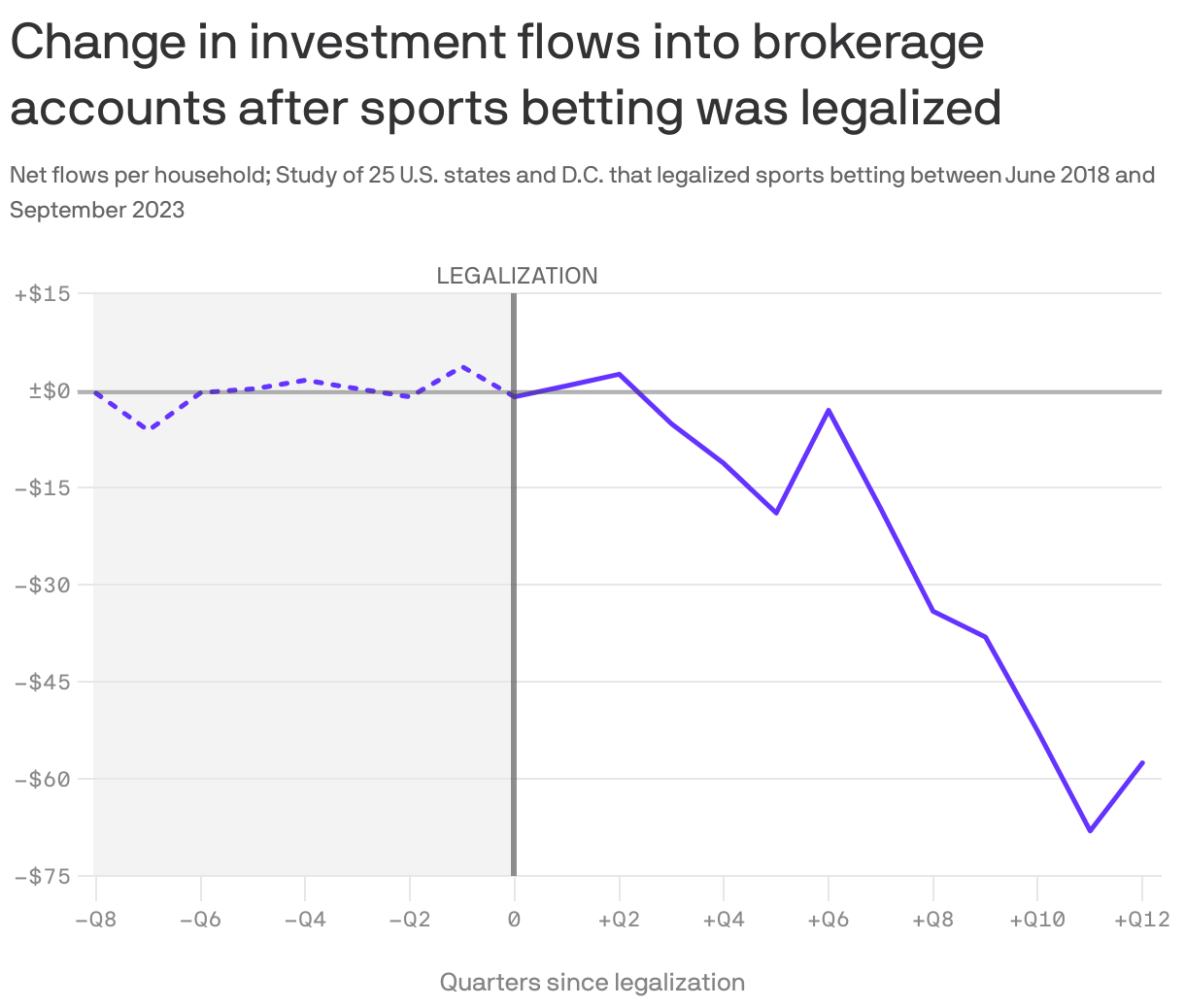
Americans put less money into their brokerage accounts in states where sports gambling has been legalized, per a new paper that has caused something of a stir.
Why it matters: Individuals in a majority of U.S. states now have a relatively new option should they want to tread in the footsteps of billionaires and make a consumption decision that feels kinda like an investment. They can bet on sports.
The big picture: One lesson of the meme-stock winter of 2021 was that get-rich-quick investing, even if it ends up losing money, can be a lot more fun than get-rich-slow investing that involves index funds and decades of doing nothing much at all.
- Compared to meme stocks and NFTs, sports betting doesn't even look like a particularly bad investment — especially if the betting companies are throwing hundreds of dollars of incentives at you.
Between the lines: Sports gambling makes more sense as a pure consumption expenditure than it does as an investment. Sports fans often report they're more engaged with the activity on the field when they have real money on the line.
- Insofar as that consumption expense comes out of monies that would otherwise be invested in the stock market, however, the result is lower wealth and possibly less long-term financial stability.
What they found: On average,* households in states that legalized gambling saw the amount of money they invested in the market fall almost every quarter for the first three years after legalization.
- After three years, the amount invested was about $50 per quarter lower than it was pre-legalization.
The bottom line: When the rich elide consumption and investment, it doesn't affect their standard of living. When working-class folks do so, however, it can.
*Fun fact: "Average" here doesn't mean a simple arithmetical mean. Instead, per Kevin Pisciotta of the University of Kansas, one of the authors, "each point is a complicated weighed conditional mean based on the Boruskyak et al estimator."
- Glad that's cleared up.
Sign up for Axios Markets


/2024/08/23/1724447916526.gif?w=3840)