Axios Markets

April 17, 2025

🌧️ Greetings! Today, we're not all sunshine and rainbows. There's fear over the Federal Reserve's independence, and record-high dread among fund managers over a hard landing.
🏈 But we also bring hope! Axios Closer's amazing Nathan Bomey reports on Kalshi's optimism that sports betting is about to become easier. What could go wrong?
All in 1,240 words, a 5-minute read.
1 big thing: Trump firings raise Fed fears

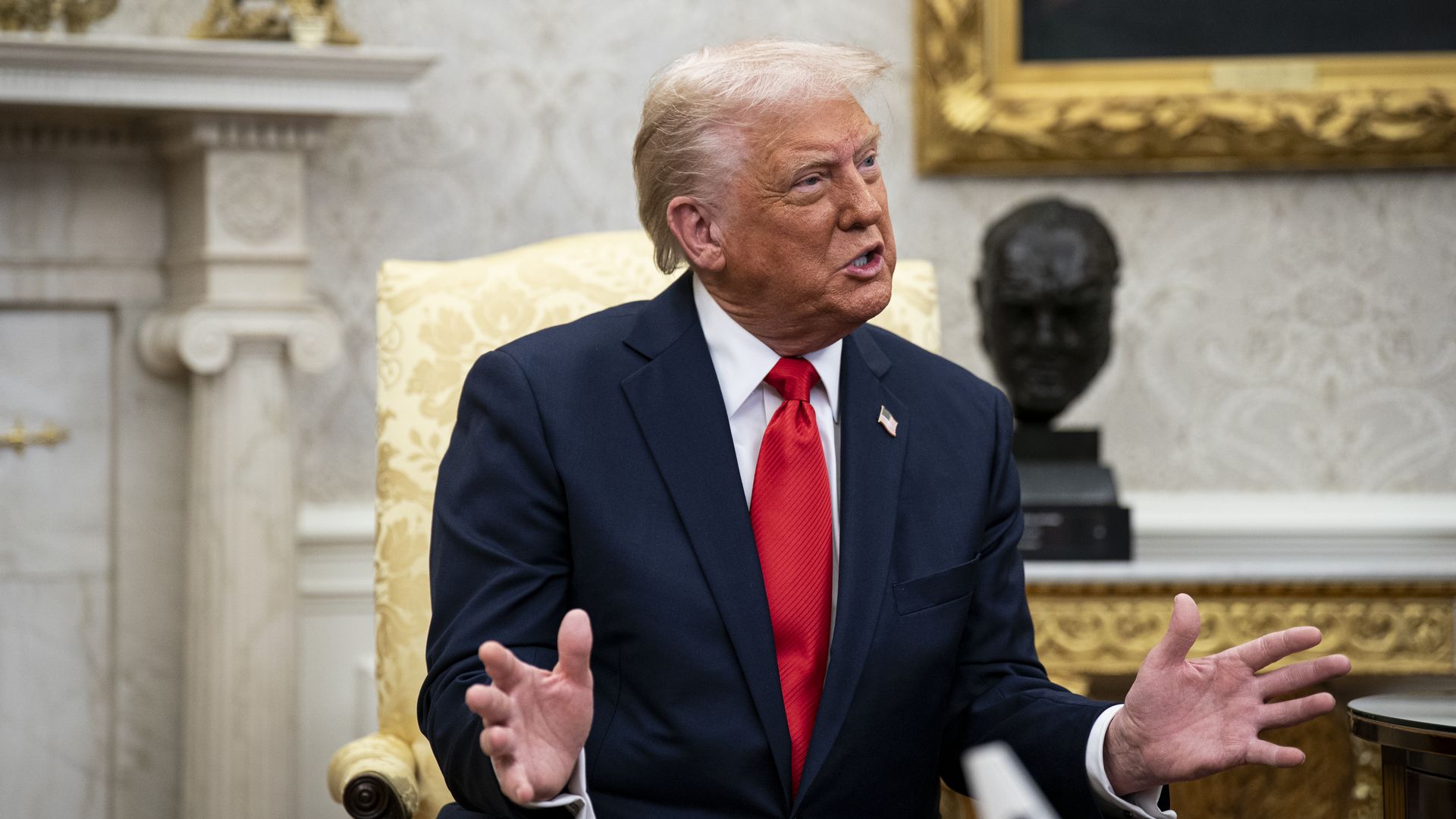
Fears that the Federal Reserve's independence is under threat are rising in the wake of the news that President Trump fired the two Democrats on the three-member board of the National Credit Union Administration, which regulates the country's credit unions.
Why it matters: Almost nothing matters more for the stability of financial markets than faith that the Federal Reserve operates independently from the White House.
Where it stands: These latest firings come on the heels of similar dismissals at other agencies that were formerly believed to be independent.
- "The President appears to be moving closer to justifying removal of Democrats on the Federal Reserve Board," per a note from TD Cowen analyst Jaret Seiberg yesterday afternoon.
- "Trump is knocking down independent financial watchdogs like dominoes and the last one in the line is the Federal Reserve," said Emily Peterson-Cassin, corporate power director at Demand Progress Education Fund, a liberal group.
Current Fed chair Jerome Powell's term expires in May 2026. He was appointed by Trump and is a Republican himself.
- But replacing Powell is something "we think about...all the time," Treasury Secretary Scott Bessent told Bloomberg on Monday, noting that interviews with candidates to replace Powell will begin as soon as this fall.
- "Powell's termination cannot come fast enough!" Trump wrote this morning on Truth Social, complaining about the Fed's reluctance to lower rates.
For the record: Powell played down the threat to the Fed's independence during an interview at the Economic Club of Chicago yesterday.
- "Generally speaking, Fed independence is very widely understood and supported in Washington, in Congress, where it really matters," he said.
The big picture: The NCUA is the latest regulator with oversight of banks and businesses to be stripped of Democrats.
- "After today's firings, there are no Democrats on the boards for NCUA, the FDIC and the FTC even though all three were designed to be bipartisan commissions. At the SEC, Caroline Crenshaw is the only Democrat remaining. Her term ends in December," Seiberg wrote in his note.
Between the lines: Strictly partisan financial regulation is hardly a win for the finance industry.
- "Regulations are better and more likely to be moderate enough to survive elections if they emerge from bipartisan boards," Seiberg pointed out.
Zoom in: NCUA board members Tanya Otsuka, a Biden appointee, and Todd Harper, who was appointed by Trump in 2019, were let go Tuesday night.
What they're saying: "The decision of the White House to fire me before the completion of my term is wrong," Harper wrote in a statement yesterday on LinkedIn.
- His term was set to expire in April 2027.
The other side: "President Trump is the chief executive of the executive branch and reserves the right to fire anyone he wants," White House press secretary Karoline Leavitt said in an emailed statement.
Worthy of your time: Powell referenced (but also poured cold water on) a column yesterday from the Wall Street Journal's Greg Ip that goes into detail on how the Supreme Court could weaken Fed independence.
2. The cratering global economic outlook


Global fund managers have turned startlingly pessimistic when it comes to the chances that the world will be able to withstand the effect of across-the-board U.S. tariffs, and they're particularly bearish when it comes to the U.S. itself.
Why it matters: The most recent fund manager survey from Bank of America underscores the thesis that global investors are selling America.
By the numbers: The survey, which was conducted between April 4 and April 10, includes 164 global fund managers who collectively have $386 billion in assets under management.
- 49% of them said a hard landing is now the most likely outcome for the global economy, up significantly from 6% in February and 11% in March.
- The percentage of investors who intend to cut their allocation to U.S. equities rose to the highest level since the survey began in 2001.
- The Bank of America fund manager sentiment index is now lower than it was even during the depths of the pandemic crash in 2020.
Zoom out: 82% of respondents said the global economy is set to weaken, which is a 30-year high.
- For the first time in over two years, the most crowded trade is no longer being long the "Magnificent 7" tech stocks. Instead, it's being long gold.
The bottom line: Institutional investors have very little risk tolerance right now. In practice, that means they're unlikely to become enthusiastic about companies making big investments, in the U.S. or anywhere else.

3. Is a "sports event contract" gambling?
The future of sports gambling lies in the hands of the Commodity Futures Trading Commission.
Why it matters: If prediction market Kalshi gets its way, bettors in all 50 states will be permanently allowed to gamble on the outcome of games, regardless of state law.
The big picture: Kalshi CEO Tarek Mansour told Axios his prediction markets exchange should not be treated as a gambling operation, in part because it does not make money from losing bets.
What's next: The Commodity Futures Trading Commission, which regulates Kalshi, is expected to hold a roundtable this month as it considers whether to continue allowing sports event contracts.
Catch up quick: Kalshi last year won the right to offer election event contracts and is now quickly expanding its sports event contracts in all 50 states, including the 11 states where sports betting is still illegal.
- That now includes certain single-game event contracts, like games in this week's NBA's play-in tournament, plus "futures" bets like the winner of the 2026 Super Bowl.
What they're saying: Mansour told Axios that the company should not be treated like sportsbooks, which are regulated on a state-by-state basis.
- "I just don't really know what this has to do with gambling," he said at an office in Washington. "If we are gambling, then I think you're basically calling the entire financial market gambling."
- "In our markets, you're trading in an open financial marketplace. You're trading against other people," he added." If you go to a traditional model, you're betting against a sportsbook. They're setting the odds and they make money if you're losing money."
Follow the money: Kalshi reported more than $86 million in trading on the Masters golf tournament last weekend after fielding hundreds of millions on the NCAA men's basketball tournament in the previous weeks.
- "The growth has been astronomical," Mansour said.
The other side: The American Gaming Association, a group that represents traditional gambling interests, has requested permission to attend the CFTC roundtable to discuss how "these sports events contracts are problematic for a variety of public policy reasons," Sportico reported.
- Multiple states, including the gambling haven of Nevada, have also sent cease-and-desist letters to Kalshi over its sports event contracts.
The big question: Where will the CFTC land?
- The CFTC did not respond to a request for comment.
- But acting chair Caroline Pham sent welcoming signals in February when she assailed the agency's "past hostility to innovation" in this area and called prediction markets "an important new frontier."
- Donald Trump Jr. recently became an adviser to Kalshi, and his father has since nominated Kalshi board member Brian Quintenz as permanent chair of the CFTC.
Our thought bubble, from Axios Crypto author Brady Dale: If the argument about not earning fees on losses holds up, that should be great for the giant of prediction markets, the blockchain-based and crypto-powered Polymarket, which charges no fees.
- Polymarket has some legal question marks hanging over it, but it's still doing hundreds of millions of dollars in volume each month.
Thanks to Pete Gannon for editing and Anjelica Tan for copy editing. See you tomorrow!
Sign up for Axios Markets


/2025/04/16/1744822091948.gif?w=3840)