Axios Markets

April 29, 2021
Good morning! I am here to look after you while Dion is away for a couple of days.
Send tips, or feedback, or suggestions for my playlist to [email protected] or find me on Twitter @AjaWMoore.
(Today's Smart Brevity count: 918 words, 3.5 minutes.)
1 big thing: Here comes the reopening boom

Illustration: Sarah Grillo/Axios
Declining COVID cases, rising vaccination rates, trillions of dollars in government spending and an accommodative Federal Reserve are coming together to create a year of U.S. economic growth for the record books, writes Axios' Editor-in-Chief Nicholas Johnston.
Why it matters: A sustained, surging economy is the best way to erase the brutal legacy of business losses and unemployment caused by the pandemic.
Driving the news: This morning's first look at Q1 U.S. economic growth is expected to top 6%.
- Yearlong forecasts for growth are even higher; Goldman Sachs — in a research note literally titled "Anatomy of a Boom" — predicts more than 7% growth in 2021, a sustained pace not seen in more than 30 years.
- The bank writes that post-vaccine hopes of economic rebound are changing from "from forecast to fact."
The Federal Reserve also upgraded its view of the economy yesterday and this week's measure of consumer confidence hit its highest reading since the pandemic began.
What's next: More data is coming to bolster the boom case.
- Retail sales are expected to have surged in March, with Credit Suisse forecasting sales will top the pre-pandemic peak of February 2020, and housing starts should reverse a recent decline.
The bottom line: Get used to lots of economic charts going up and to the right.
Bonus chart: Rebound of the century


2. Catch up quick
Top takeaway from President Biden's address: Big government is back (Axios); and trickle-down economics "has never worked" (Axios).
Biden's plan for tax hikes on the wealthy could apply to 2021, says White House economic adviser Heather Boushey (Axios), and the $400,000 tax cap is for individual earnings, not joint filers (Axios).
The Fed says it is reviewing Archegos' collapse because it highlights risk management failures at several banks that did not understand their exposure to the fund. (Bloomberg)
New SEC enforcement director Alex Oh resigned Wednesday after a few days on the job. The move followed a U.S. district judge questioning her conduct during a deposition in a case involving ExxonMobil. (WSJ)
3. Permanent pandemic debt

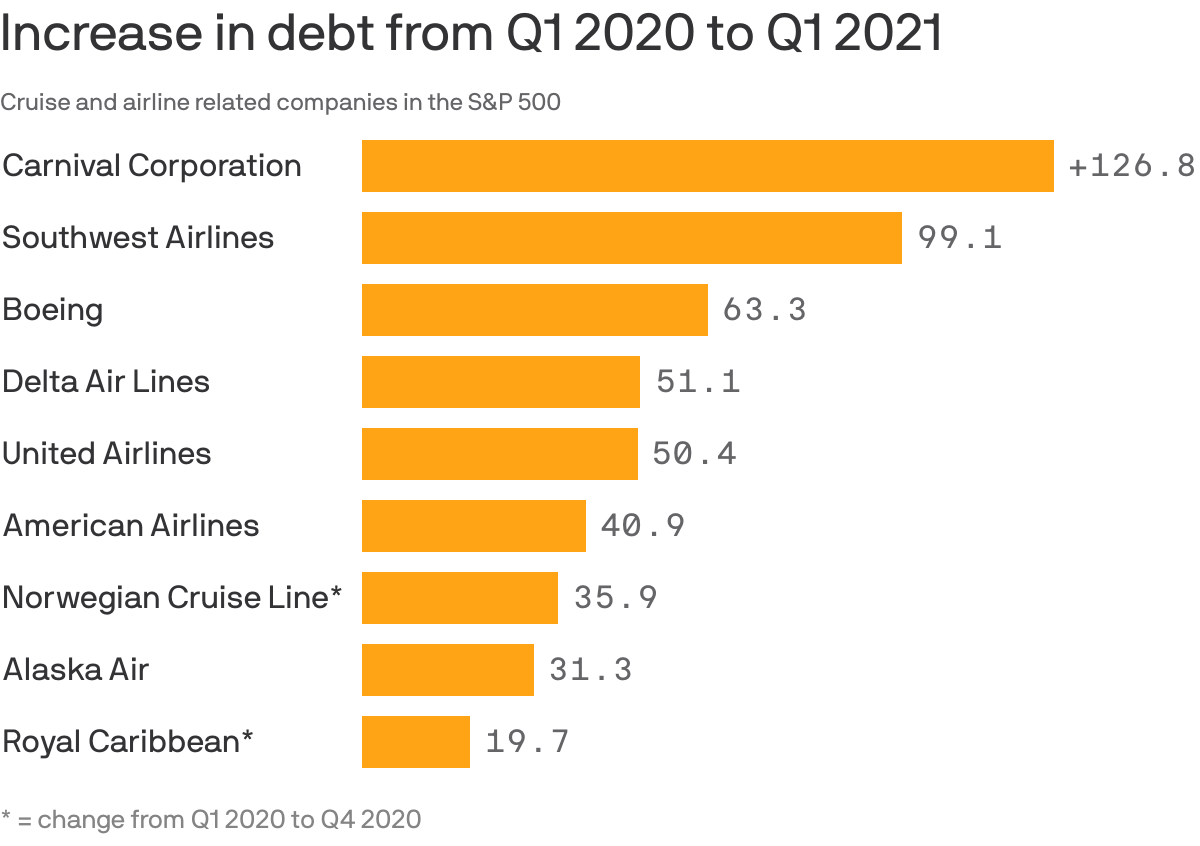
Boeing reported another quarter of negative cash flow Wednesday, to the tune of $3.4 billion, and its sixth consecutive quarterly loss. The plane maker is one of many companies that borrowed from the capital markets heavily last year, even as the pandemic caused its revenue — and ability to pay interest — to shrink, writes Axios' Business Editor Kate Marino.
Why it matters: Piling on new debt helped companies survive the immediate crisis, but borrowing their way through the turmoil now puts some at risk of becoming “zombies" that can operate but can’t pay off their debts or invest in growth.
The big picture: A slew of high yield companies took on billions more in debt during COVID, in some cases increasing their balances by more than half. Many of them — think cruise operators and airlines — may not see earnings fully rebound any time soon.
By the numbers: Boeing sold $25 billion in bonds last May — one of the largest non-M&A bond deals ever — boosting its total debt balance to $64 billion from $39 billion.
- Delta, United Airlines and American Airlines all got financial lifelines as each burned through millions per day.
- Carnival more than doubled its debt load, to $33 billion from $14 billion, as governments issued no-sail orders. Norwegian's debt has increased by 36% to $12 billion, while Royal Caribbean's grew by 20%, to $20 billion.
The bottom line: Positive economic momentum will help pandemic-stricken companies return to normalized levels of profitability. But they still have to address the drastic increases in their debt loads spawned by unprecedented times, while keeping up with investments in their core businesses.
4. Chip crisis worsening for autos

Illustration: Sarah Grillo/Axios
The semiconductor shortage that is roiling the global auto industry will get worse before it gets better, Ford Motor Chief Executive Jim Farley warned Wednesday, writes Axios' Joann Muller.
Why it matters: The chip shortage, which GM President Mark Reuss called the worst supply chain crisis in his career, means car buyers will continue to face fewer choices and higher prices.
Driving the news: Ford said Wednesday it will produce half as many vehicles as planned in the second quarter because it can't get enough chips to power all the electronic components for its cars and trucks.
The big picture: The global chip shortage is hampering supply of all kinds of goods, from cars to smartphones to networking gear. But the auto industry has been hit hardest.
What they're saying: Qualcomm executives told Axios' Ina Fried that they expect the shortage to start easing, at least for them, by the end of the calendar year.
- "We now have line of sight to material improvements for us toward the end of the calendar year," Qualcomm president and incoming CEO Cristiano Amon told Axios.
5. The intensifying battle for Exxon's future


A very public battle is raging over how ExxonMobil should face questions about long-term oil demand and prepare for a carbon-constrained world, Axios energy and climate reporter Ben Geman wrote this week. (Sign up for his newsletter Axios Generate here.)
Driving the news: Investment group Engine No. 1, which is nominating board members it says are equipped to deal with these dynamics, this week gained new support.
- Two huge pension funds — California Public Employees' Retirement System and the New York State Common Retirement Fund — have thrown their weight behind it.
- It adds to prior backing from the California State Teachers' Retirement System, so now, per Pensions & Investments, the country's three largest pension funds back the effort.
Why it matters: The unusually high-profile shareholder battle is something of a microcosm of larger questions about the future of Big Oil.
- But it's also specific to Exxon, one of the world's most powerful companies, which has not sought to diversify as widely as its European peers (though oil-and-gas remains the dominant business for all of them).
What's next: It comes to a head at Exxon's May 26 shareholder meeting. Reuters reports that the hedge fund D.E. Shaw, which has pushed Exxon to change its approach, now intends to vote with the company.
This newsletter is written in Smart Brevity®. Learn how your team can communicate in the same smart, clear style with Axios HQ.
Sign up for Axios Markets

Stay on top of the latest market trends and economic insights