
Axios Markets

January 06, 2024
Happy new year! At least for the next 10 months. After that, who knows?
- In this week's newsletter, I write about 2024's biggest risk, divergent beauty companies, real earnings, and bitcoin ETFs. All in 1,284 words, a 5-minute read.
1 big thing: The 2024 risk that trumps all others
Illustration: Sarah Grillo/Axios
Workers, employers, and investors are facing an uncommonly certain outlook for 2024 — until November. After that, it's uncharted territory.
Why it matters: Donald Trump is the great known unknown of 2024. If — and only if — he is elected president, the domestic and global repercussions will be seismic, will dwarf any other event of this year, and will only grow into 2025 as he actually takes office.
The big picture: Because the November election is such a large and looming date, it's going to be hard for anything to feel — or be — particularly important in comparison.
- Interest rates will tick up or down, a quarter-point at a time. Markets, similarly, will rise and fall. A divided U.S. Congress will pass nothing of importance. The wars in Ukraine and Gaza will continue. Probably there will be an extreme weather event or three. When it comes to non-Trump known unknowns, there's less scope for surprises than normal.
- Against that backdrop, a loud, fractious, and extremely expensive election campaign will increasingly dominate the attention of the general population.
Between the lines: A second Trump term would be far more radical than the first, committed to stretching legal and governance boundaries and to pursuing retribution for the prosecutions he has been fighting since losing office. Domestically, many pillars of American democracy, including an independent judiciary and central bank, would be imperiled.
- Trump's protectionist and isolationist tendencies would also terrify NATO while creating an opening for China. As a global threat, he is unrivaled.
By the numbers: The probability of Trump ultimately winning the Electoral College has been stuck at a steady 40% on PredictIt; that number seems unlikely to budge meaningfully any time soon.
- That 40% number is high enough that it can't be ignored, but also low enough that it can't really be priced in, or a base-case expectation.
- Even if it rises to 50% or higher as Election Day approaches, we'll still be in broadly the same epistemic boat on November 4 that we're in today.
Be smart: The only way for the Trump risk to become manageable would be for him to not be a candidate. That's something which, while possible, is also quite unlikely.
The bottom line: It's reasonable to assume that the first 10 months of 2024 will be relatively — even unusually — calm. If a storm then arrives, there's no doubt whose name will be attached.
2. Beauty is in the eye of the market


L'Oréal and Estée Lauder are the two largest beauty companies in the world, boasting a market share of 16.1% and 13.6%, respectively. (LVMH is a distant third with 8%.)
Why it matters: The two stocks moved in perfect lockstep with each other from pre-pandemic to the beginning of 2023 — but since then, they have sharply diverged.
- L'Oréal is doing so well that Françoise Bettencourt Meyers, the heiress who controls 35% of the company's stock, is now personally worth $100 billion — the first woman ever to achieve that milestone.
- L'Oréal partners with very successful luxury companies like Yves Saint Laurent and Giorgio Armani; it also owns top beauty companies like Maybelline and Garnier (not to mention the namesake L'Oréal).
- Most importantly for me, it didn't ruin Kiehl's after buying the cult beauty brand — which at the time had just a single store in New York's East Village — for a reported $100 million in 2000.
The other side: Estée Lauder, on the other hand, has struggled of late. It overpaid for Tom Ford, which it acquired at the end of 2002 at a valuation of $2.8 billion, increasing its own indebtedness by $2 billion in the process.
- More importantly, the company's business in the Chinese duty-free island of Hainan imploded, and Estée Lauder found itself sitting on large amounts of unsellable inventory.
The bottom line: There wasn't anything particularly predictable about this sudden divergence in fortunes — although any hedge fund manager capable of seeing the relative-value play this time last year surely made a fortune.
- For the rest of us, this chart simply underscores the importance of diversification.
3. Real wage growth returns
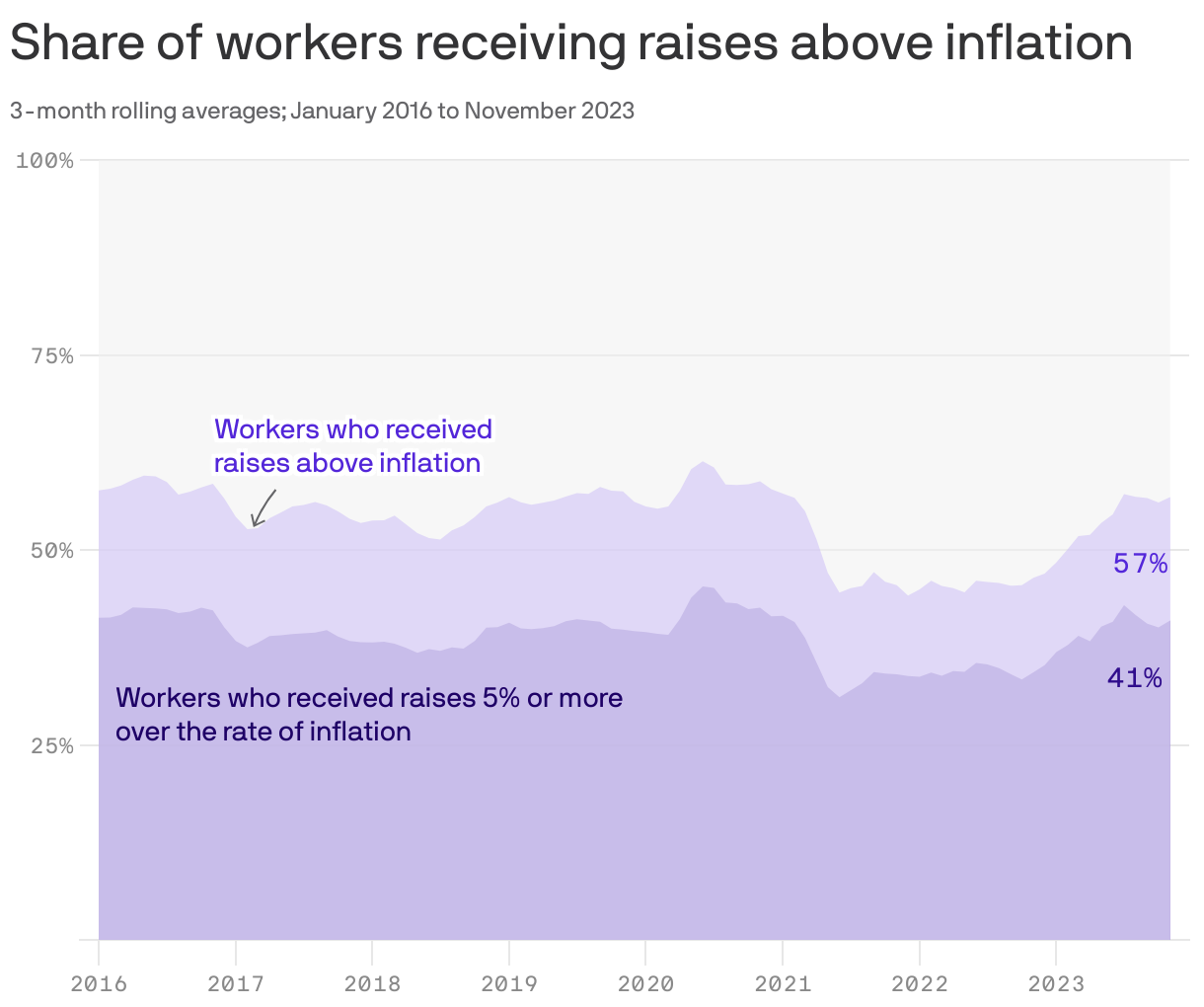
Inflation is hated mostly because it erodes the power of your paycheck. But the good news — and the reason why optimism might return to the U.S. in 2024, as I wrote this week — is that real pay hikes have now returned.
Why it matters: As Brendan Duke of the Center for American Progress writes, 57% of workers are making more money now — after adjusting for inflation — than they were a year ago. 41% of us have seen a real wage increase of more than 5%.
- Be smart: Higher wages don't always psychologically offset higher prices. (A $20 cocktail is still expensive even after you've received a big raise.) That's why unhappiness with inflation can linger long after wages have risen to cover those expenses.
The bottom line: Once inflation falls, as it now has, the remaining discontent does tend to diminish as prices that used to cause shock and resentment become normalized. Meanwhile, higher real wages help everyone.
4. Bitcoin ETF frenzy

Illustration: Sarah Grillo/Axios
The headline from Fortune's Jeff John Roberts says it all: "The crypto world is losing its mind over when bitcoin ETFs will arrive."
Why it matters: Pretty much every major price increase in bitcoin in recent months has been chalked up to anticipation that the long-awaited day will soon arrive when investors will be able to buy funds directly tied to the spot price of the OG cryptocurrency.
By the numbers: Bitcoin is up 162% over the past year, and currently trades at about $45,000 per coin. It was worth less than $30,000 as recently as October.
The big picture: It's not immediately obvious why the arrival of bitcoin ETFs would cause a huge spike in demand for bitcoin.
- There are already lots of ways of getting exposure to bitcoin on the stock market, if you want it, from closed-end funds owning bitcoin (GBTC) to ETFs tracking bitcoin futures (XBTF) to companies that are mostly just piles of bitcoin (MicroStrategy) to companies that are plays on the future of crypto more broadly (Coinbase).
- Institutional and retail investors alike have many ways to buy bitcoin directly if they want to do so, and to hold it with trustworthy custodians.
- Retail investors also don't generally get sent 1099 forms on their crypto trading profits, and as a result often don't report those profits on their tax returns. Any trading profits in a bitcoin ETF, by contrast, will be fully taxed.
The other side: In between institutional and retail sit a huge mass of private bankers, investment advisors, and wealth managers, including roboadvisors.
- Most of these outfits — who in aggregate control trillions of dollars in private wealth — might be perfectly happy allocating a small percentage of a client's portfolio to bitcoin in theory, but don't want to deal with a whole new layer of custodianship and reporting. A simple-to-understand ETF would make buying bitcoin a lot easier, and therefore more common.
- Intriguingly, while the bitcoin world broadly considers bitcoin ETFs to be just around the corner, only 39% of advisors believe such a thing will be approved this year.
- At the moment, only 19% of them are allowed to buy bitcoin for client accounts.
The bottom line: Bitcoin ETFs will have to rapidly accumulate a lot of assets in order to justify the kind of price appreciation we've seen over the past year. Then again, bitcoin is an asset without any real fundamentals, which means its price can — and does — go just about anywhere.
- Sometimes, what goes up just ends up going up further.
Thanks to Kate Marino for editing this newsletter, and to Jay Bennett for copy editing it.
Sign up for Axios Markets

Stay on top of the latest market trends and economic insights