Axios Markets

July 05, 2024


1 big thing: The 401(k) race gap
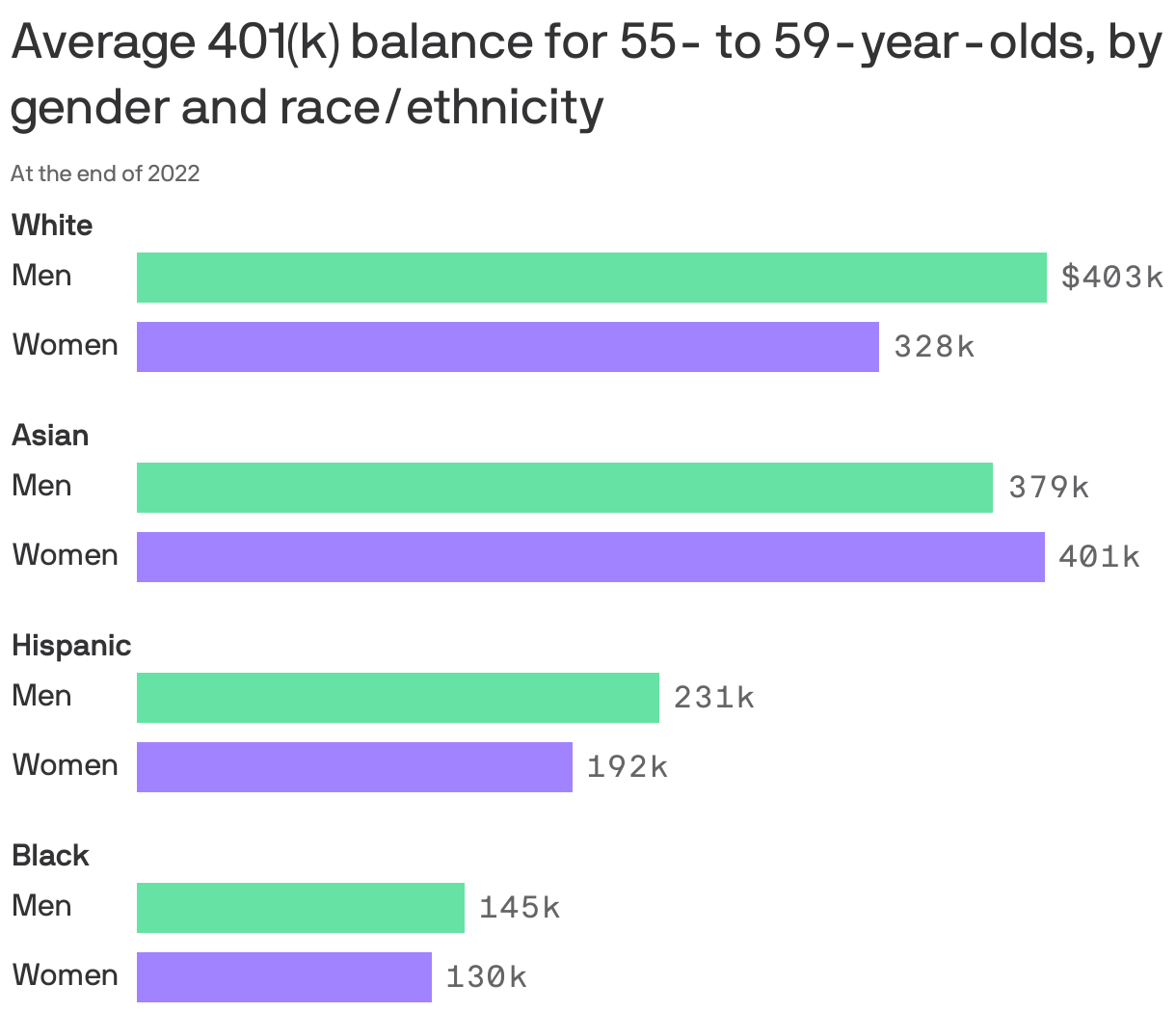
Black Americans, and Black women in particular, tend on average to have lower 401(k) balances than the rest of the population, contribute less to retirement accounts, and be more likely to take out loans against the balance they do have. That's true even after adjusting for any difference in salary.
Why it matters: The Saver's Match, a federal retirement-savings incentive that is due to be introduced in 2027 as part of the Secure 2.0 Act, should help to narrow the gap, although it won't come close to closing it.
The big picture: Lower salaries for Black women, combined with lower levels of intergenerational wealth, mean they tend to have significantly less discretionary income. Spending on necessities eats up whatever is available, and leaves much less for retirement.
By the numbers: The Collaborative for Equitable Retirement Savings (CFERS) examined a huge dataset of 180,684 active plan participants across nine 401(k) plan sponsors, as of the end of 2022. They found:
- For workers between age 55 and 59, white Americans have account balances of about 1.8 times their annual salary, and Asian women have saved up 2.5 times their salary. Black men, by contrast, have a balance of 1.1 times their salary, and Black women have saved only 0.9 times.
- That's partly because contributions are lower. Black women between 55 and 59 save 8% of their salary on average for retirement, compared to 11% for white women and 17% for Asian women.
- Black women in that age group also have a 29% probability of having taken a pre-retirement withdrawal from their retirement account. For white Americans, that number is 8% and for Asian Americans, it's 5%.
Follow the money: Female Black retirement plan participants aged 55 to 59 also earn lower salaries on average, at $85,500 per year, compared to $107,631 for white women.
What's next: The Saver's Match, which will kick in starting in 2027, will offer a 50% match on up to $2,000 of retirement savings contributions for Americans making less than $71,000 per year. It's projected to increase Black women's retirement funds at age 65 by 9% even assuming no increase at all in contributions.
- If contributions rise to maximize the amount of the match, then account balances for Black women would rise by an impressive 21.5%, per CFERS estimates.
- Other groups also benefit, but none by as much. White women, for instance, see their balances rise by 5.7% assuming no contribution increase, and by 12.7% assuming they maximize the match.
The bottom line: More than 50% of Black Americans have no access to a workplace retirement plan at all. Even the ones who do find it much harder to save for a comfortable retirement.
2. Activists' Pyrrhic victory on proxy voting rules



Activist investors were strong supporters of the SEC's changes to the way shareholders elect corporate directors. Then, when they finally got their wish last proxy season, the proportion of seats they won steadily dropped.
Why it matters: The new system, known as the Universal Proxy Card, or UPC, turns out to have been much more management-friendly than anybody expected.
How it works: Up until August 2022, shareholders were given two choices in contested elections: Either vote for management's slate of directors, or vote for the activists' slate instead.
- Now, with the UPC, all nominees appear on a single ballot. Shareholders pick and choose which directors they want.
By the numbers: Most activist campaigns get settled or dropped before they get to a shareholder vote.
- But so far this year, when U.S. fights did go to a vote, activist board nominees won only 11% of the seats targeted. That's a huge fall from 2023 when that figure was 65% — a sign that the UPC system has turned out to hurt activists much more than management.
- Activists won a total of 74 board seats worldwide in the first half of the year when the vast majority of shareholder meetings are held. Nearly all of those seats were in the U.S.
- That's a 31% drop from the same period in 2022, before UPC was introduced.
Between the lines: The one-ballot system has put the focus more on the nominee and less on the campaign. Shareholders are simply picking the nominees they think are the most capable. This proxy season, they sided with management.
- The UPC system still makes directors nervous. The idea that a long-serving director's name appears near a younger, activist-backed nominee is scary even to respected board members.
The bottom line: A single ballot means the end of much of the gamesmanship and clever marketing tricks from the old multi-card method has gone away.
- The change represents the correct way to select a board, even if it gives certain sitting members heartburn — and doesn't seem to have helped activists at all.
Axios Markets
