Axios Markets

February 10, 2026

🌮 Welcome back! Today, we tackle some light subjects like, oh, the decline of the country (in investors' eyes, anyway) and corporate bonds. Read to the end for some news about babysitting costs.
All in 1,017 words, a 4-minute read, but first:
🇨🇦 President Trump threatened to block the opening of a new Canadian-built bridge across the Detroit River last night — the administration's latest infrastructure threat — the Canadian dollar was down slightly against the dollar this morning. (Go deeper)
1 big thing: 4 reasons for a foreign investor exodus
Another day, another sign that foreign investors may be tiptoeing away from the U.S.: This time, it's a report that China is telling its banks to cut back on buying U.S. Treasury securities.
Why it matters: Such a retreat would rhyme with a growing concern that the dollar — and America — is losing its status as the safest place in the world to park your money.
- Longer term, that would make it more costly for everyone in the country to borrow money — from people looking for mortgages, to the federal government trying to fund tax cuts or keep Social Security solvent.
- But for the moment, it's a worry, not a reality. The move away from dollar-denominated assets is a "multi-year trend," RSM chief economist Joe Brusuelas tells Axios.
- And there are reasons to believe China's latest move is being misinterpreted.
Where it stands: Bloomberg, citing people familiar with the matter, reported yesterday that China is telling its banks to limit holdings of U.S. Treasury bonds to diversify their risks.
- The directive does not apply to China's official state holdings — which are huge — and while there was a market reaction, it was relatively small.
By the numbers: China is the third-largest buyer of U.S. Treasuries — the country held $683 billion at the end of last November, down from $769 billion the year before, per federal data.
- Japan is the top buyer, with $1.2 trillion.
- Foreign investors hold 30% of U.S. debt overall.
Follow the money: Already this year, the value of the dollar against other currencies has fallen.
A few critical trends are colliding:
1. President Trump. Tariffs, big policy shifts and concerns that the Federal Reserve is being politicized make investors wary.
2. Rising deficits. There are some signs that investors are also growing antsy over the U.S.' long-term fiscal outlook.
3. Dollar weaponization. Presidents of both parties have used the dollar more aggressively as a tool of statecraft in recent decades—perhaps most vehemently in 2022, when the U.S. and its allies froze Russia's foreign exchange reserves.
4. Japan. For the first time in decades, yields on Japanese bonds are rising, unraveling a backbone of the global markets — the yen carry trade, in which investors borrow in yen and invest in higher-yielding assets— and reducing the demand for dollars and Treasuries.
Between the lines: Even the slightest suggestion that China wants less exposure to Treasuries hits a raw nerve when there's growing debate over the safe-haven status of the dollar.
- But that's not quite what happened here, says Brad Setser, a senior fellow at the Council on Foreign Relations.
- In December and January, Chinese exporters sold their dollars to state-run banks — about $100 billion each month.
- The banks then poured that money into Treasuries, Setser says. (That data doesn't typically show up in the U.S. tracking.)
- What has happened since is the Chinese government is telling these financial institutions to diversify those investments a bit.
The bottom line: "The world cannot move away from the dollar," Setser says. Investors everywhere rely on it. If that were really happening, we'd see much more extreme swings.
2. Bond. Google Bond.
Alphabet is on a borrowing spree — Google's parent company raised $20 billion in a bond sale yesterday.
Why it matters: Tech giants are spending enormous amounts on AI, and, despite their relatively deep coffers, they need help paying for it.
State of play: Meta kicked off its bond binge in October, issuing nearly $30 billion worth.
- The next month, Amazon announced its first bond offering in three years.
Zoom out: In the last three months of 2025, the hyperscalers — the data center behemoths in the vanguard of the AI revolution — issued some $60 billion in bonds, per PitchBook.
- Buckle up. The expectation is there could be a half-trillion dollars more issued this year, says John Atkins, a managing editor for U.S. bonds at the financial data and research firm.
Zoom in: Investors are digging it so far.
- Those who scooped up Alphabet's bonds aren't getting that much more in yield than those buying U.S. Treasuries.
- "They paid very, very skinny spreads," Atkins says. Google's parent is "considered a safe bet."
The intrigue: As part of its debt sale, Alphabet also offered a century bond — one that won't pay off for 100 years — denominated in British pounds, per the Financial Times.
- That's extremely rare.
- IBM, Coca-Cola and Walt Disney have issued century bonds, but did so some three decades ago.
Friction point: Oracle. Its offerings aren't doing as well as those from giants like Meta or Alphabet. Investors are more concerned about the company's prospects.
What to watch: At some point, investors are going to want to see real results from all this spending. They would prefer to be stirred, not shaken.
3. The cost of babysitting

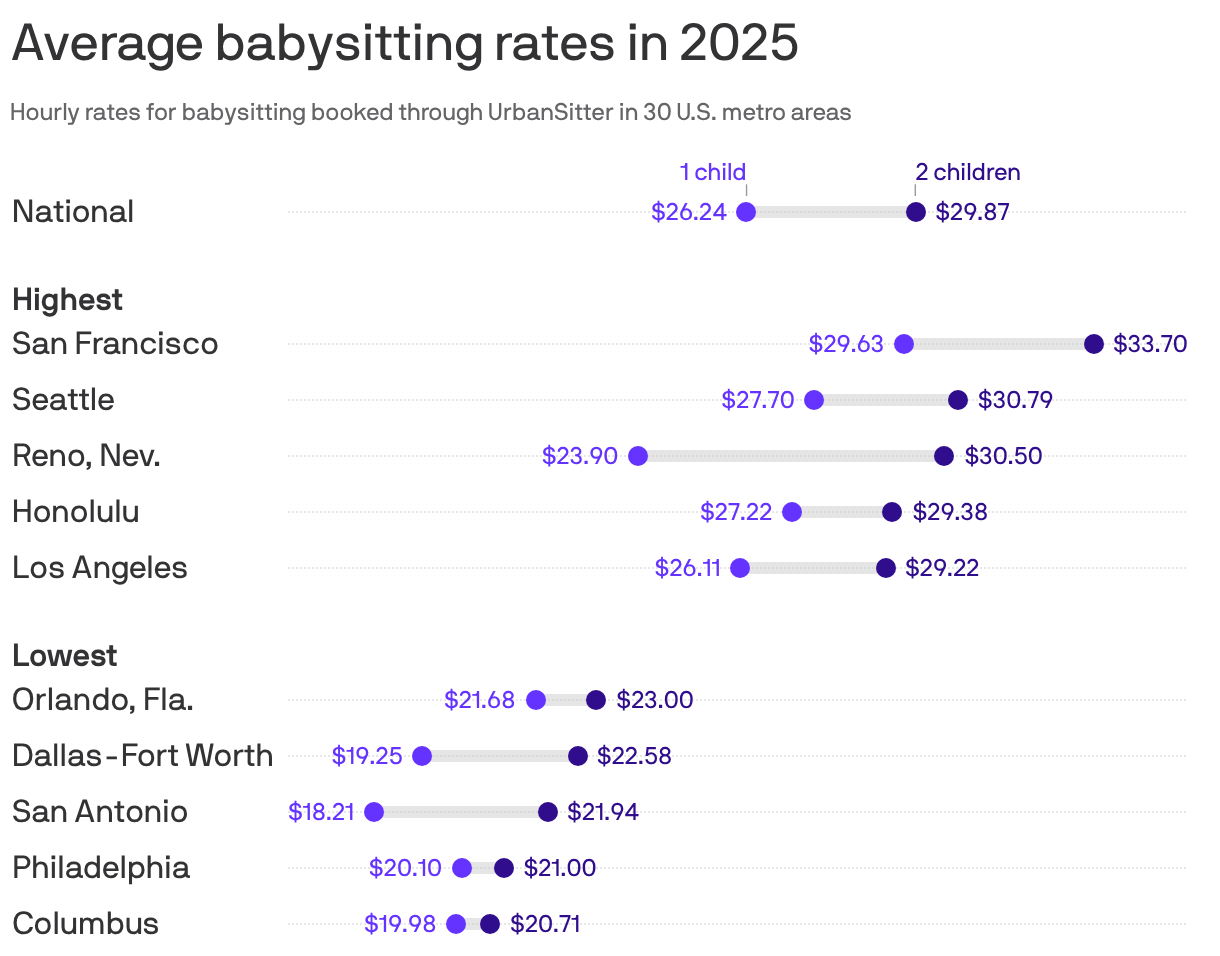
Average babysitting rates rose nearly 5% last year — faster than inflation — hitting $26.24 per hour for one child, per new data from UrbanSitter.
- Parents are paying nearly $30 an hour on average for two kids, the sitter-finding platform says.
Rates tend to be higher in places with steeper costs of living.
💬 Emily's thought bubble: The rising price of child care more broadly is giving parents big affordability headaches — and pushing some, typically mothers, out of the labor market, as I've written previously.
Yesterday, we suggested that the day after the Super Bowl should be a national holiday. Next year, it will be!! The big game is on Sunday, Feb. 14, 2027,— the day before Presidents Day.
- You're welcome.
Any other vacation day suggestions, story ideas or tips to share? [email protected] or reply to this email.
Thanks to Jeffrey Cane for editing and to Carolyn DiPaolo for copy editing. See you back here tomorrow!
Sign up for Axios Markets