Axios Markets

April 03, 2024

Welcome back. Today we're looking at a fast-growing trend in philanthropy. Plus, the end of GE. All in 771 words, 3 minutes.
1 big thing: The rise of collective giving
Illustration: Shoshana Gordon/Axios
The fastest-growing form of philanthropy in America is collective giving — where individuals, usually women, pool their funds and their decision-making, Felix writes.
Why it matters: This kind of structured giving provides a glimpse of what a democratic, egalitarian philanthropy looks like.
The big picture: A detailed new report from Philanthropy Together, based on extensive interviews, focus groups, and surveys, finds that the philanthropy practiced by giving circles is very different from the top-down practices of foundations funded by billionaires.
- The leaders and members of the groups are overwhelmingly women, and often women of color. 60% of groups are entirely women.
- The charities they support tend to be small community organizations. The giving is overwhelmingly local.
- Rather than concentrate on metrics like "bang for the buck," the groups tend to be more concerned with racial equity and inclusion.
- Donations are broadly unrestricted. In the jargon, it's "trust-based philanthropy" that isn't tied to outcomes or specific projects.
Zoom out: One thing the giving groups tend to have in common with old-school philanthropists is a stated commitment to "change not charity."
- That means they see themselves at the philanthropic end of the charity-philanthropy spectrum — not giving to the needy directly, so much as building up the institutions that will create a stronger community.
- The giving groups themselves become part of the civic infrastructure: These are formal institutions, often with paid staff, rather than informal ad-hoc groups of friends
- Members of the groups generally start to self-identify as philanthropists only after joining a giving circle, even though they regularly donated to charity beforehand.
By the numbers: The number of giving circles, and the number of people who are part of one, tripled between 2007 and 2016 — and then tripled again between 2016 and 2023.
- Today, there are roughly 4,000 such groups, with 370,000 members; between them, they gave away more than $3 billion over five years ending in 2023.
- "The movement is now on a trajectory to double again in the next five years," finds the 2024 report.
- Most members donate less than $1,000 per year.
Between the lines: Members of the groups reported significant improvement in their physical, mental, and spiritual health as a result of joining. In an increasingly atomizing world, these groups create real community.
- Members also became more likely to become actively engaged in local civic institutions.
- "Collective giving is inherently a social, long-term, and community-based experience," write the authors.
The bottom line: "Collective giving is democratizing and diversifying philanthropy," concludes the report.
2. The end of the Jack Welch era
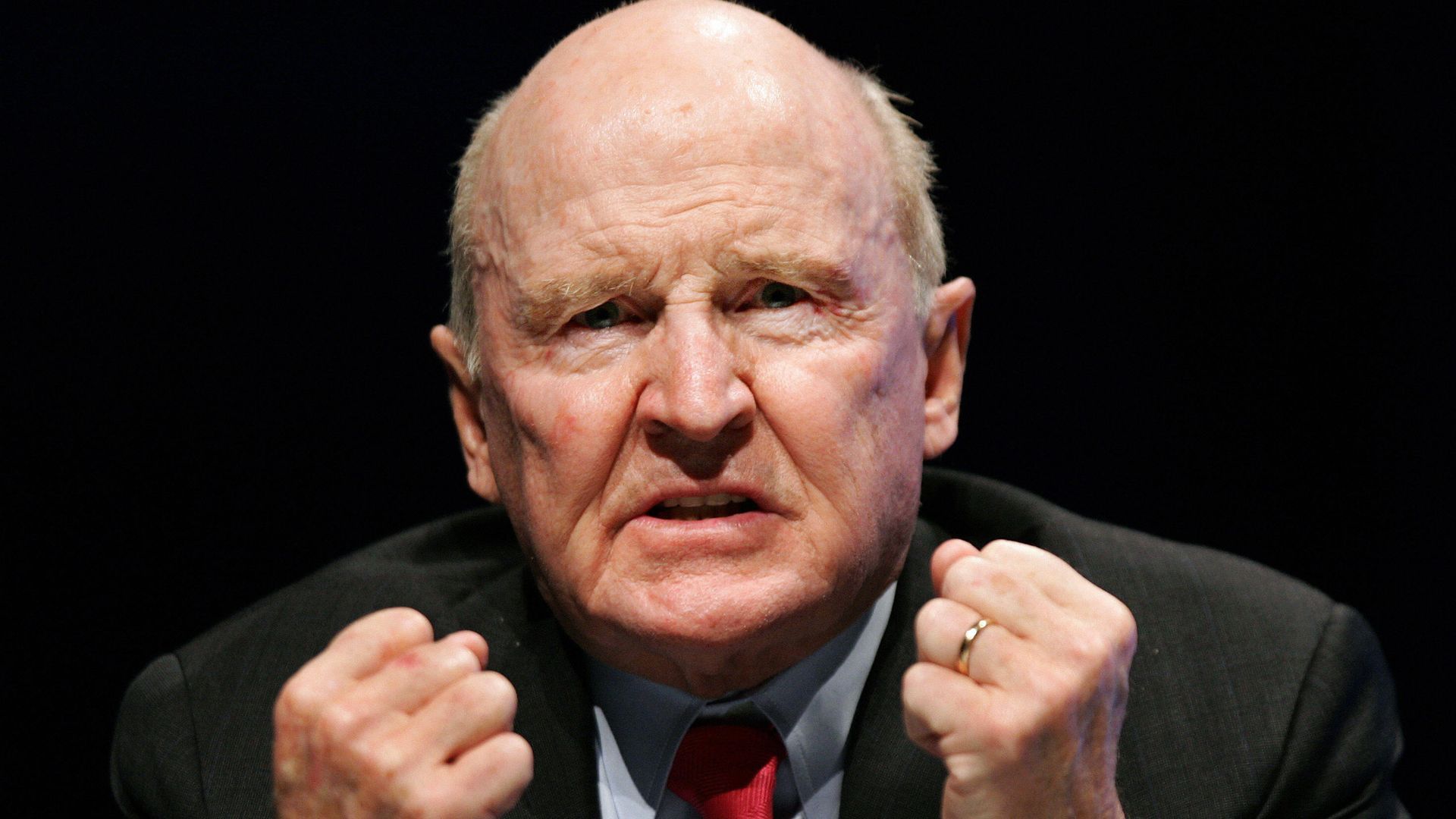
The late Jack Welch, in 2005. Photo: Thomas Lohnes/DDP/AFP via Getty Images
The legacy of former GE CEO Jack Welch lies in tatters. GE no longer exists — its split into three separate parts concluded yesterday — and his school of management has barely fared any better, Felix writes.
Why it matters: Welch was the most important CEO of his generation, a man who was richly rewarded for using financial engineering to goose his company's share price at the expense of its employees' jobs.
By the numbers: On Aug. 28, 2000, with Welch at the end of his tenure as CEO, GE was the most valuable company in the world, worth $594 billion.
- Since then, the S&P 500 — the stock market broadly — has more than tripled. If GE had kept pace with the rest of the market, it would be worth just over $2 trillion today, roughly the same as Nvidia.
- Instead, it has now become three separate companies — GE Aerospace (worth $148 billion as of the close of trade on Tuesday), GE HealthCare ($40 billion), and something called GE Vernova ($38 billion). In aggregate their $226 billion valuation is a little smaller than Netflix.
Zoom out: Welch himself has been the subject of two highly critical recent biographies, by David Gelles ("The Man Who Broke Capitalism") and Bill Cohan ("Power Failure").
- Welch acolyte David Calhoun has announced his resignation as CEO of Boeing in the wake of multiple safety lapses at the company. Wall Street analyst Ron Epstein greeted the news by saying the company needs a "drastic cultural overhaul" after being run by not one but two Welch disciples.
- Other Welch-affiliated leaders to suffer ignominious defenestration include Robert Nardelli at Home Depot, Paulo Fresco at Fiat, and Larry Johnston at Albertsons.
- Welch's own appointed successor at GE, Jeff Immelt, was broadly considered a disaster.
Where it stands: The last remaining Welch disciple helming a major U.S. public company is David Zaslav at Warner Bros Discovery. So far reviews of his tenure have been mixed at best.
The bottom line: Welch was a bona fide corporate hero in the 1990s. Today, he is viewed much more as a villainous creature of corporatist excess.
3. Charted: Zero


Thanks for starting your day with us! If this email was forwarded to you, subscribe here.
Axios Markets is edited by Kate Marino and copy edited by Mickey Meece.
Sign up for Axios Markets

Stay on top of the latest market trends and economic insights