Axios Markets

May 06, 2025

👋 Good morning! What happens when there's no good answer to tariff costs? We have a look at one small business that says no matter what it does, it can't find a solution that doesn't hurt profits.
- Plus: Where gas really is $1.98 a gallon, and the tariff that made Christmas more expensive.
All in 970 words, a 4-minute read.
1 big thing: Small business woes
After Donald Trump was reelected in November, a small business called Lay-n-Go that makes cosmetic bags and drawstring carriers saw the China tariff writing on the wall, and moved production out of the country, but that wasn't enough to keep their profit margins from shrinking.
Why it matters: Many businesses face an existential crisis over tariffs, even the ones that prepared for the onslaught from the Trump administration.
- "It's exponentially worse than what we would've expected," says Adam Fazackerley, who cofounded the company with his wife Amy in 2010. "We're just making less money."
The big picture: After the trade war in Trump's first term, many companies started shifting supply chains away from China.
- Ahead of the president's second term, there was belief that more tariff disruption would be manageable. On earnings calls in November and December, CEOs expressed confidence that they could adjust.
- Then came "Liberation Day" with its global baseline tariffs and a levy that ended up at 145% on China.
Zoom in: Lay-n-Go got started in 2010, making its product in China. It approached several domestic manufacturers, but none were capable of producing their bags for a reasonable price.
- After the first rounds of Trump's tariffs in 2018 and 2019, it moved to Cambodia. That initial interruption really slowed down the company's momentum. It had to stand up a whole new supply chain, Fazackerley says.
- Then in 2020, a federal provision that held Cambodian tariffs at zero lapsed, and costs rose. Suddenly China, which has more sophisticated manufacturing capabilities, looked good again. Lay-n-Go moved back.
By 2022, the increased tariff costs had taken a toll. Lay-n-Go downsized, walking away from its partnerships with retailers Target and QVC and becoming a direct-to-consumer brand that sells only online.
- It was the only way to make their margins work with higher tariffs. "We've had to shrink the business to survive," Fazackerley says.
- Then came the election. When Trump won again in November 2024, Lay-n-Go put a new production order in with its Cambodia manufacturer.
- The company also just re-upped its Cambodian order, even with the additional costs of Trump's latest across-the-board tariffs.
"We are a ping pong ball right now. We are just trying to adjust to survive," Fazackerley says. "Consistency is a huge benefit for running a business. But the lack of consistency has been steady since 2018."
- It's not a good recipe for business growth. Even if the originally proposed reciprocal tax rate of 49% goes through in Cambodia, the company could survive, he says. But if all the China tariffs happen, it could not.
Yes, but: Trump said Sunday he had no plans to give small businesses any carveouts from tariffs, even as the U.S. Chamber of Commerce warns that many may not survive.
- "They're not going to need it," Trump told "Meet the Press."
For the record: "President Trump has been clear: if you're worried about tariffs, the solution is simple. Make your product in America," White House spokesperson Kush Desai said in a statement.
The bottom line: The businesses that rely on overseas manufacturing are seeing a bigger hit than they anticipated from Trump's tariffs.
2. Where gas is really just $1.98

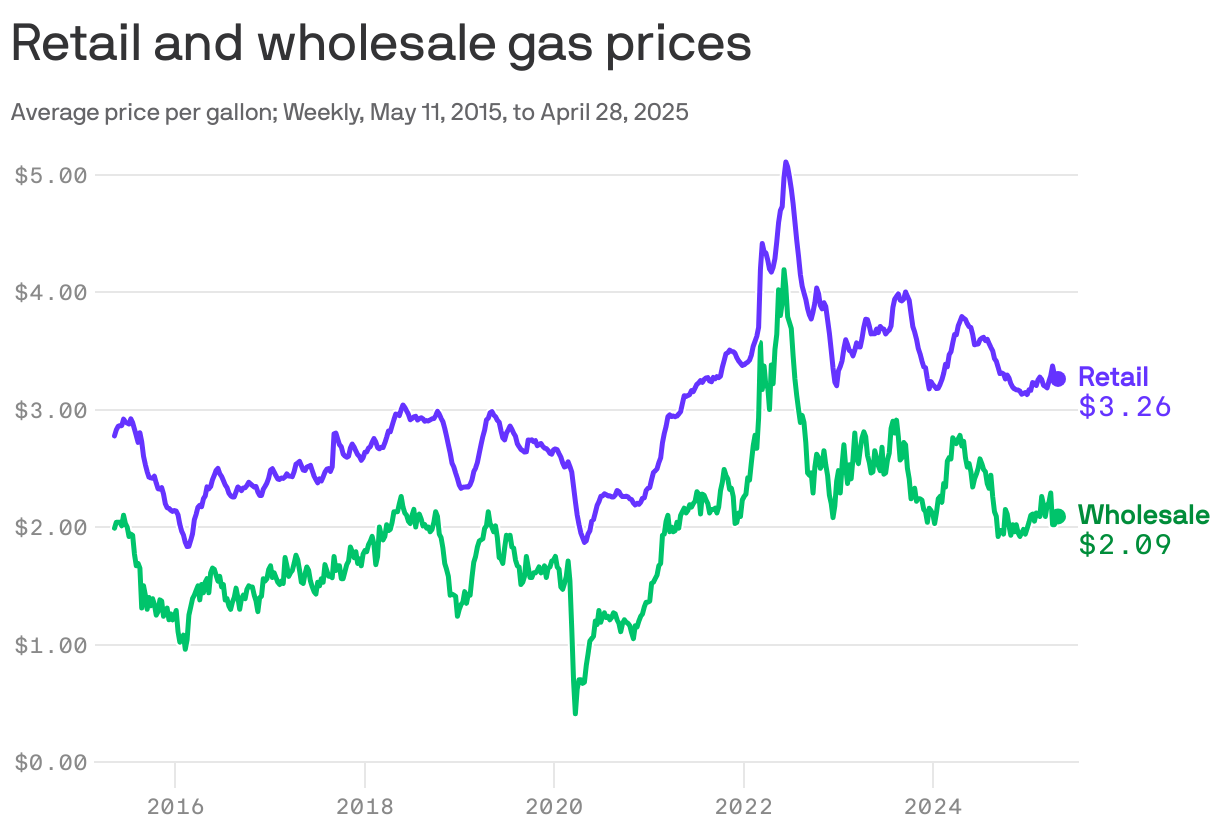
Last week, Trump triumphantly announced that "Gasoline just broke $1.98 a Gallon, lowest in years," even as the average price at the pump was $3.18.
Why it matters: Gasoline did touch $1.98 briefly in April, but not at any pump in the country.
- The wholesale price of gasoline, known as the Reformulated Gasoline Blendstock for Oxygen Blending, or RBOB, is traded on the New York Mercantile Exchange and has occasionally touched that level.
How it works: Once the RBOB lands at New York Harbor, it then needs to be blended with ethanol and transported to gas stations before drivers can pump it into vehicles.
- So the price at the pump is usually over a dollar above the wholesale price.
The bottom line: Gas is the most salient price in the economy, and it is almost impossible to take a car journey in the nation without seeing it multiple times.
- As a result, Americans are fully aware that $1.98 gas is not a thing that exists, at least outside wholesale markets.
3. Toys are having a tough year
As Trump pushes an argument that young American girls don't need so many cheap dolls, Barbie maker Mattel says it's scrambling to move production and raise prices to deal with tariffs.
Why it matters: The administration is trying to convince a goods-consuming culture to settle for less, leaving parents to explain to their kids why Christmas might be a little more modest this year.
Zoom out: Mattel said Monday it would accelerate efforts to manufacture outside China and diversify sourcing but would also look at raising prices where needed.
- CEO Ynon Kreiz told analysts that 40% to 50% of Mattel products would still remain under $20. (The range was "slightly higher" a year ago, CFO Anthony DiSilvestro said.)
- The company also noted the "majority" of its Barbie product line was already manufactured outside of China.
Flashback: Trump, when asked about the possibility of shortages this holiday season, said last week: "Well, maybe the children will have two dolls instead of 30 dolls, and maybe the two dolls will cost a couple of bucks more."
- He came back to the theme Sunday night on Air Force One, telling reporters young girls "could be very happy" with just a couple of dolls.
The intrigue: Mattel said demand was strong so far this year and that it did not expect to start seeing the effect of tariffs until the third quarter, given its current inventory.
- But the company also paused its guidance, saying it could not be certain about the ultimate effect of tariffs.
The bottom line: Tariffs are "having a significant impact on the toy industry," Kreiz said, arguing that kids and families would be better off with zero tariffs on toys.
Thanks to Ben Berkowitz for editing and Anjelica Tan for copy editing. See you tomorrow!
Sign up for Axios Markets